CRM and Lead Management Workflow Integration
Real-time data alignment between marketing, sales, and SDRs eliminates pipeline leaks.
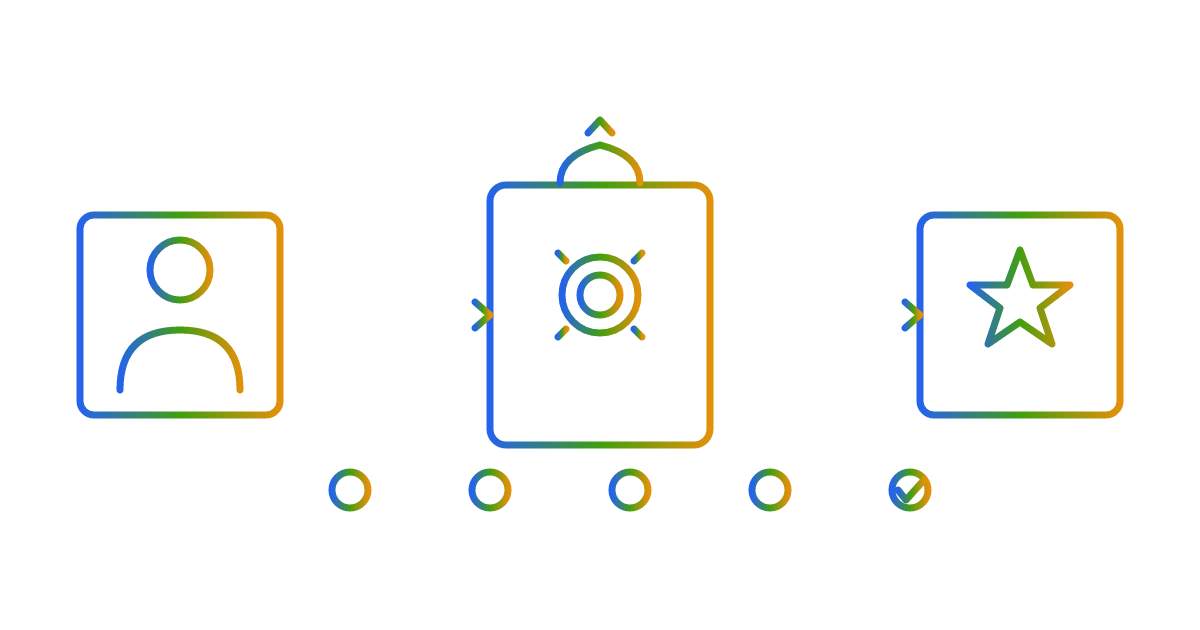
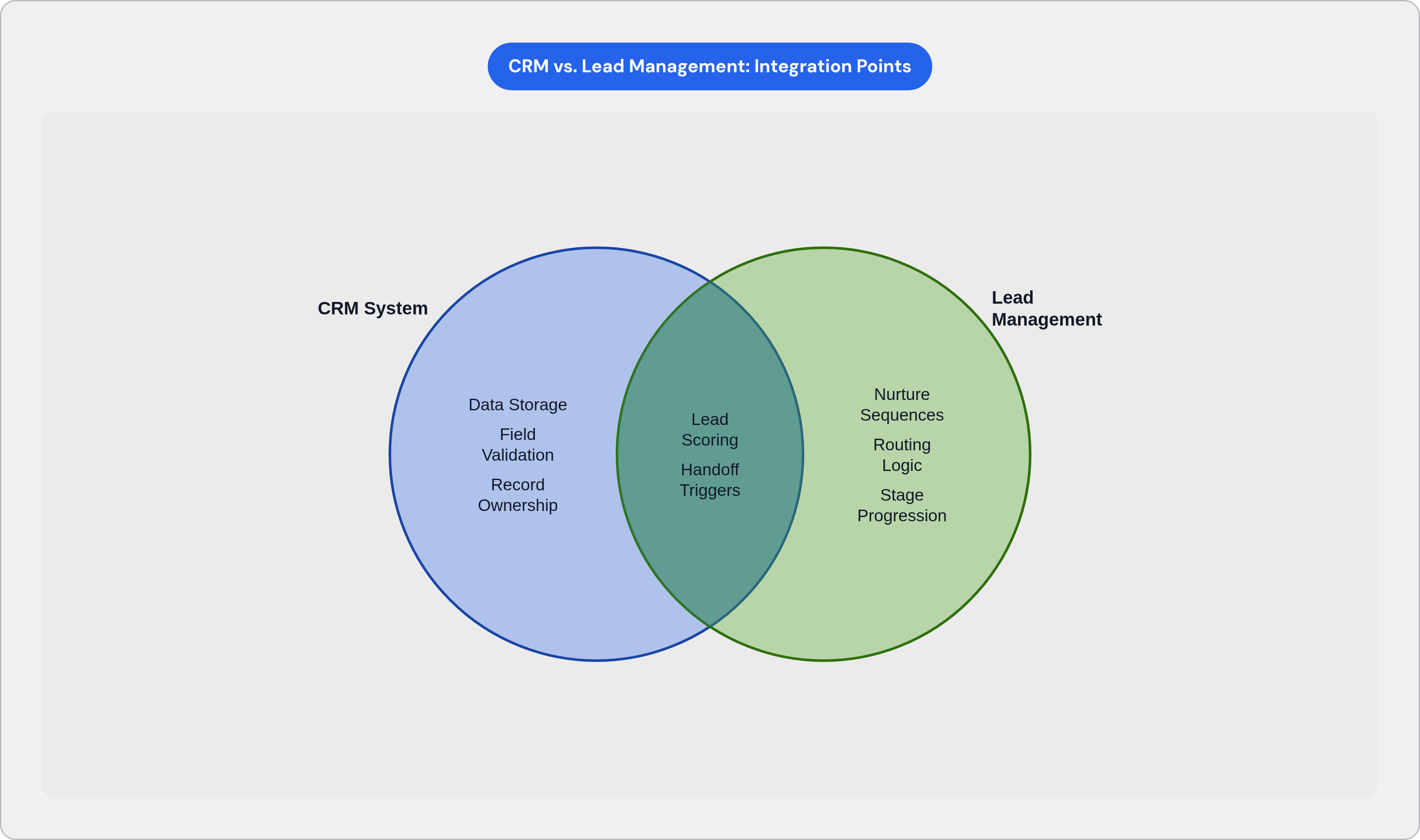
CRM and lead management get treated as two different jobs at most companies. One team owns the database, another owns "the process," and the two talk to each other through exports, Zapier duct tape, and a shared sense of dread. Integration means something narrower and more useful: every lead moves through capture, qualification, routing, nurture, and handoff, and the CRM records each step as it happens instead of hearing about it later.
Those five stages are not just workflow steps. Each one is a data event, and something gets written, triggered, or synced. When that works, marketing, SDRs, and sales are all looking at the same record, updated in real time, with zero manual re-entry and zero parallel spreadsheets living in someone's downloads folder.
When it doesn't work, leads die at the seams, not inside a stage, but between them: the gap after capture and before qualification, the silence between "nurtured" and "handed off." Tools that don't talk to each other create these gaps, and gaps are where pipeline disappears without an alarm going off anywhere. The rest of this piece walks that pipeline stage by stage, showing where the seams are and how to close them.
Lead Capture Is a Data Architecture Decision
A typical B2B stack pulls leads from web forms, chatbots, paid ad integrations, event platforms, enrichment APIs, and inbound email parsing. Six different sources, six different data shapes, and one CRM that has to make sense of all of it.
Every one of those sources has to write to the same object schema in the CRM. If a chatbot calls it "company_name" and your web form calls it "organization," you don't have a data problem yet; you have a future data problem that is compounding.
Research on this is blunt: poor data quality drains businesses at scale, with a significant share of leads carrying inaccurate information the moment they enter the system. CRM data doesn't hold still once it's clean, either; it decays steadily year over year, so a record that was accurate in January can be unreliable by December. Research has found a substantial share of CRM users report actual revenue loss tied to bad data.
The fix isn't a cleanup sprint every quarter. Building deduplication, source tagging, and mandatory field validation into the capture step itself, before a record ever enters the pipeline, is what actually works. Source tagging does double duty: it handles attribution, but it also feeds the scoring model downstream. A lead from a webinar and a lead from a cold paid ad are not the same lead, and the system needs to know that from the start.
Lead Scoring Is Where Pipeline Credibility Lives
Qualification is where you lose volume on purpose, because the whole job is fewer leads, better leads, moving forward.
Traditional scoring assigns static points for job title, company size, and page visits. It's fast to set up, but it ages poorly. Behavior changes, buyer patterns shift, and a scoring model built in Q1 is often inaccurate by Q3.
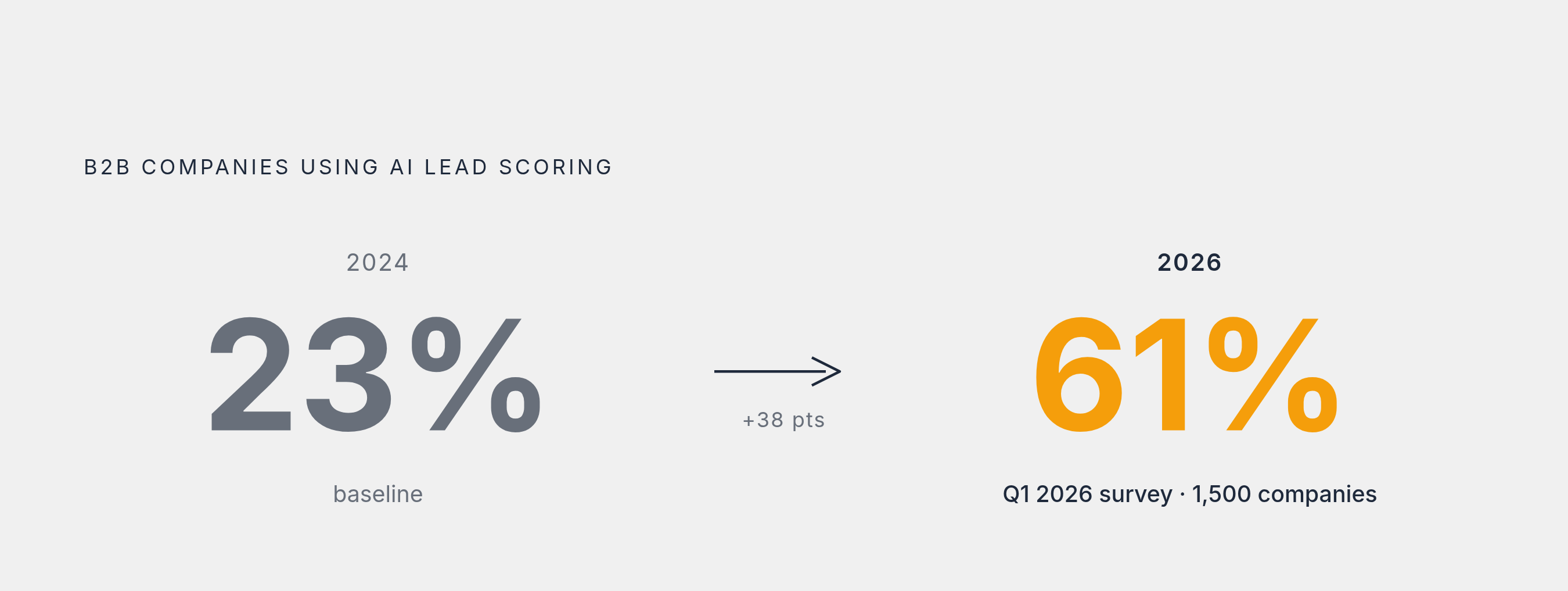
AI-powered scoring reads behavioral, demographic, firmographic, and engagement signals together, and reweights itself as conversion data rolls in. A Q1 2026 survey of 1,500 B2B companies found AI lead scoring use jumped from 23% in 2024 to 61% in 2026.
CRM history, site behavior, email engagement, content downloads, webinar attendance, and social signals are what go into an AI score, all weighed together rather than derived from a spreadsheet of point values someone built two years ago.
MQL-to-SQL conversion sits at a 13% median industry-wide. Top-quartile teams run roughly double that, largely because they reject bad-fit leads at the scoring layer before an SDR wastes a call on them. Scoring only works if it's current, though. A score that's 18 hours old isn't accurately describing the same lead, because behavioral signals move fast, especially in the first hours of someone's buying research. AI-powered scoring is pushing qualification signals earlier in the buying journey, before a prospect ever fills out a form.
Wrong Routing Kills a Qualified Lead
Routing is the handshake between what the system decided and what a human does next. Getting it wrong means a perfectly qualified lead lands on the wrong desk, or no desk at all.
Models vary: round-robin, territory-based, account-based, skill or segment-based. The right model depends on how your sales team is actually structured, not on what the CRM vendor's default setting happens to be.
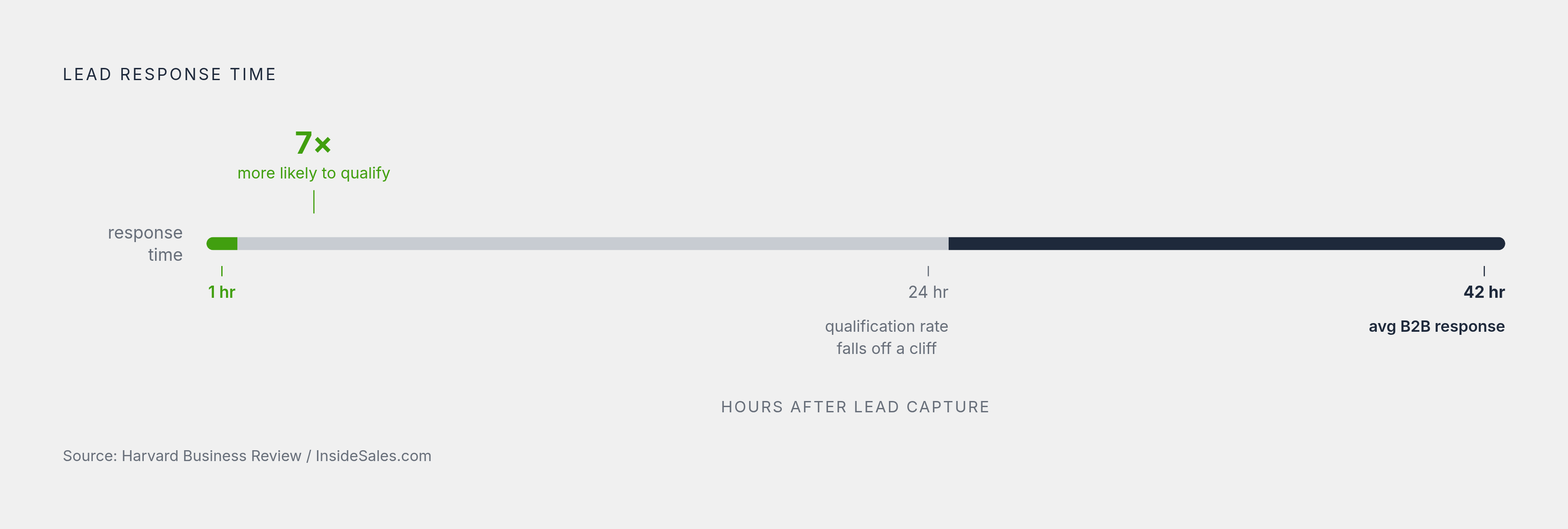
Speed is where routing quality becomes measurable. Research found companies that respond to leads within an hour are seven times more likely to qualify them than companies that wait longer, and teams waiting 24 hours or more saw qualification rates drop sharply. Yet the average B2B lead response time sits at 42 hours. Additional research found that roughly a third to half of all sales go to whichever vendor responds first, which means response speed is often the deciding factor in a deal.
Automation is what closes that gap. 2025 data shows 47% of small businesses under 10 employees have adopted CRM software, because manual handoff is where response delays originate. The moment a lead crosses the qualification threshold, routing should fire automatically, with no manual step in between, because every manual step introduces delay.
Assignment should also trigger a task in the rep's queue, a notification in whatever channel the rep actively monitors, and a timestamp for accountability. Without the timestamp, leads can sit untouched without anyone noticing until the quarter's numbers come in low.
Nurture Sequences Must React, Not Broadcast
Most captured leads are not ready to buy the day they show up. Nurture keeps them engaged, but only if it's built to react to lead behavior rather than run on a fixed schedule regardless of what a lead actually does.
A drip campaign runs on a timer: email one, then three days later email two, regardless of what the lead actually did. A conditional sequence branches based on lead behavior, and that distinction determines whether nurture stays relevant or becomes noise.
Running marketing automation and lead management as separate tools creates leakage at the API boundary, where leads' behavioral data gets lost in translation between systems or arrives too late to act on. Integrating them directly reduces that leakage. The requirement is that behavioral triggers, including email opens, link clicks, page visits, and content downloads, all write back to the CRM record in real time so the sequence can branch, accelerate, or pause based on where the lead actually is.
Consider a lead who opens a pricing page in the middle of a nurture sequence. That signal should re-score and potentially re-route the lead immediately, because someone checking pricing is exhibiting different buying intent than someone reading a blog post.
Segmentation matters as well: a VP of Sales at a 500-person company and an ops manager at a 30-person shop should not receive the same sequence with the same cadence and content. Multi-channel sequences combining email, LinkedIn, phone, and retargeting are broadly recognized as more effective than single-channel outreach, and coordinating that mix requires the CRM to hold state across every channel simultaneously.
The Sales Handoff Needs Structure, Not Conversation
Handoff is where the most context gets lost, and it typically happens in untraceable places: email threads, Slack messages, a rep's personal notes. None of that lives in the CRM record, which means none of it survives the transfer.
A structured handoff means the record, at the moment of transfer, contains the full engagement history, the reasoning behind the score, notes from the SDR or nurture stage, whatever pain points or objections the lead voiced, and the agreed next step. The record should be complete enough that someone unfamiliar with the lead could pick it up and act on it immediately.
The trigger for handoff should be a defined threshold, some combination of score, stage, and qualification criteria, rather than a rep's judgment that a lead "seems ready." That threshold has to be agreed between marketing and sales before anyone configures the system. The integration enforces the agreement; it cannot create one.
Research has found only a small fraction of MQLs ever convert to actual revenue, which means handoff criteria are not a minor detail. A meaningful improvement in MQL-to-SQL conversion can lift overall revenue by a significant margin, making the handoff threshold a lever worth calibrating carefully.
Adoption data supports why this matters organizationally: 65% of companies report better cross-team collaboration after adopting a CRM. But that collaboration at the handoff moment requires both teams to trust the record, not just have marketing populate it while sales works from memory. The feedback loop also matters after handoff: closed-won and closed-lost outcomes need to flow back into the lead scoring model so it sharpens qualification for subsequent leads.
Design Against These Common Integration Failures
Four failure modes appear consistently. Field mapping drift is the quiet one: someone adds a field in the marketing tool, nobody maps it to the CRM, and data stops flowing with no error message to signal the problem. Sync latency is the batch-job problem, where syncs running on a schedule instead of an event trigger mean the CRM's version of reality is always hours behind. Ownership conflicts occur when the same lead exists in two systems under two different owners, producing duplicate outreach and a split activity history that nobody can fully reconstruct. Score staleness means yesterday's data is driving today's routing decision.
Even well-established platform pairings still require explicit sync rules, defined object ownership, and campaign membership logic to function correctly. Two market leaders integrated together is still not plug-and-play.
CRM data decays substantially every year. An integration that isn't actively maintaining data quality guarantees that a growing portion of the pipeline is running on outdated information. Every integration point is a place things can break, and sync health should be monitored as a first-class metric alongside pipeline conversion rates.
A stage showing zero leads might mean the pipeline is genuinely clean, or it might mean the integration broke recently. Those two situations look identical from the outside, and a mature system needs to distinguish between them from inside the CRM rather than relying on someone to notice something is wrong and investigate manually. A monthly stage audit that counts leads per stage, checks last-sync timestamps, and verifies fields are populated catches drift before it corrupts a quarter's worth of decisions.
A Synced Stack Produces Trustworthy Pipeline Reporting
When data, actions, and teams are actually synced, the pipeline becomes measurable at every stage rather than only at the endpoints of leads generated and deals closed.
Stage-level conversion rates, from capture to qualified, MQL to SQL, SQL to opportunity, and opportunity to closed, show exactly where volume disappears. Time-in-stage metrics reveal how long a lead sits before moving forward or stalling. A spike in time-in-stage points to a routing delay, a nurture gap, or friction at handoff, and the location of the spike identifies which problem is occurring.
Companies using CRM dashboards report meaningfully faster decisions, though a dashboard is only as trustworthy as the data feeding it. 2025 data shows CRM with workflow automation lifts productivity by a meaningful margin, and the reporting layer is what makes that lift visible rather than theoretical.
Attribution closes the loop that source tagging opened at capture, connecting which channels produced leads that converted to revenue rather than simply leads that submitted a form. The feedback mechanism is what compounds the value over time: closed-won and closed-lost data flowing back into the scoring model is how the system improves with each cohort of leads. Research has found sales teams using AI inside their CRM grow revenue at a notably higher rate than teams without it, reflecting the difference between reporting that describes what happened and reporting that anticipates what's coming.
The practical test of a mature integration is straightforward: a rep or manager opens one record and sees everything, the lead source, every interaction, every score change, every routing event, and every nurture touch, without leaving the CRM. No second tab, no asking a colleague what happened last week, just one record with a complete and accurate history.