What Happens to a Lead at Each Stage of the Sales Pipeline
Unqualified leads downstream waste sales time and derail pipeline velocity.
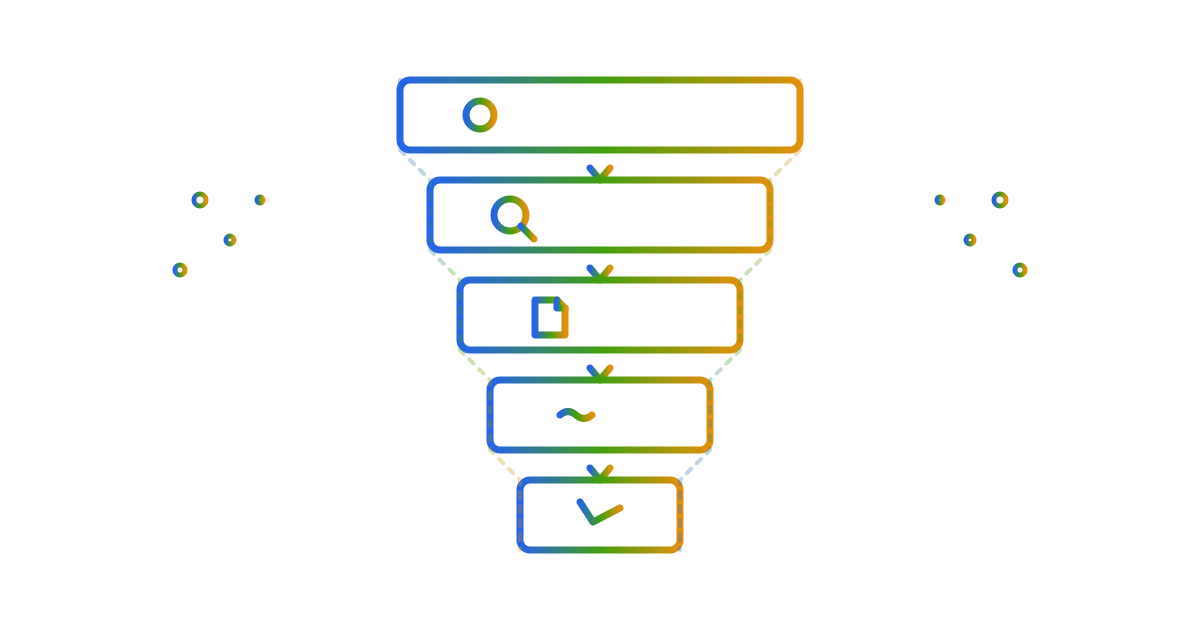
Leads come in two ways: they find you, or you find them.
Inbound channels like content, events, and email capture people already looking for a solution. Outbound prospecting goes after everyone else. Most B2B organizations need both, and neither one alone gets the job done.
The conversion reality at the top of the funnel is genuinely humbling. B2B averages somewhere around 1 to 3% from awareness all the way to lead generation. Small to mid-sized SaaS companies see roughly 1.4% visitor-to-lead conversion. Enterprise companies land closer to 0.7%, mostly because their buying committees are enormous and their cycles drag on forever. What that means in practice: the overwhelming majority of your outreach produces nothing. That's not a failure of effort. That's just the math.
The trap is obvious once you've lived through it. Because conversion is so low at the top, volume feels like the answer. More outreach, more content, more events, more leads. And volume does matter. But stuffing unqualified leads into the pipeline doesn't solve the problem. It just relocates it downstream, where a rep burns their week chasing contacts who were never going to buy in the first place.
I've watched teams celebrate a 40% jump in lead volume and then wonder six weeks later why revenue didn't move. Because those leads weren't real. They were noise dressed up as activity.
Entry criteria at this stage are intentionally minimal. A lead needs to have shown some signal of interest or fit. That's it. The real filtering happens next.
Stage 2: What qualification actually does (and the criteria that determine whether a lead advances)
Qualification is not a one-time gate. It's an ongoing process that keeps refining as you learn more about a prospect. The more you know, the better your decisions about whether to keep investing time in them.
Two terms come up constantly here:
- MQL (Marketing Qualified Lead): fits your target market or buyer persona and has engaged with your content enough that marketing considers them worth pursuing
- SQL (Sales Qualified Lead): has shown actual intent, confirmed the product is relevant, appears to have budget, and is actively talking to a rep
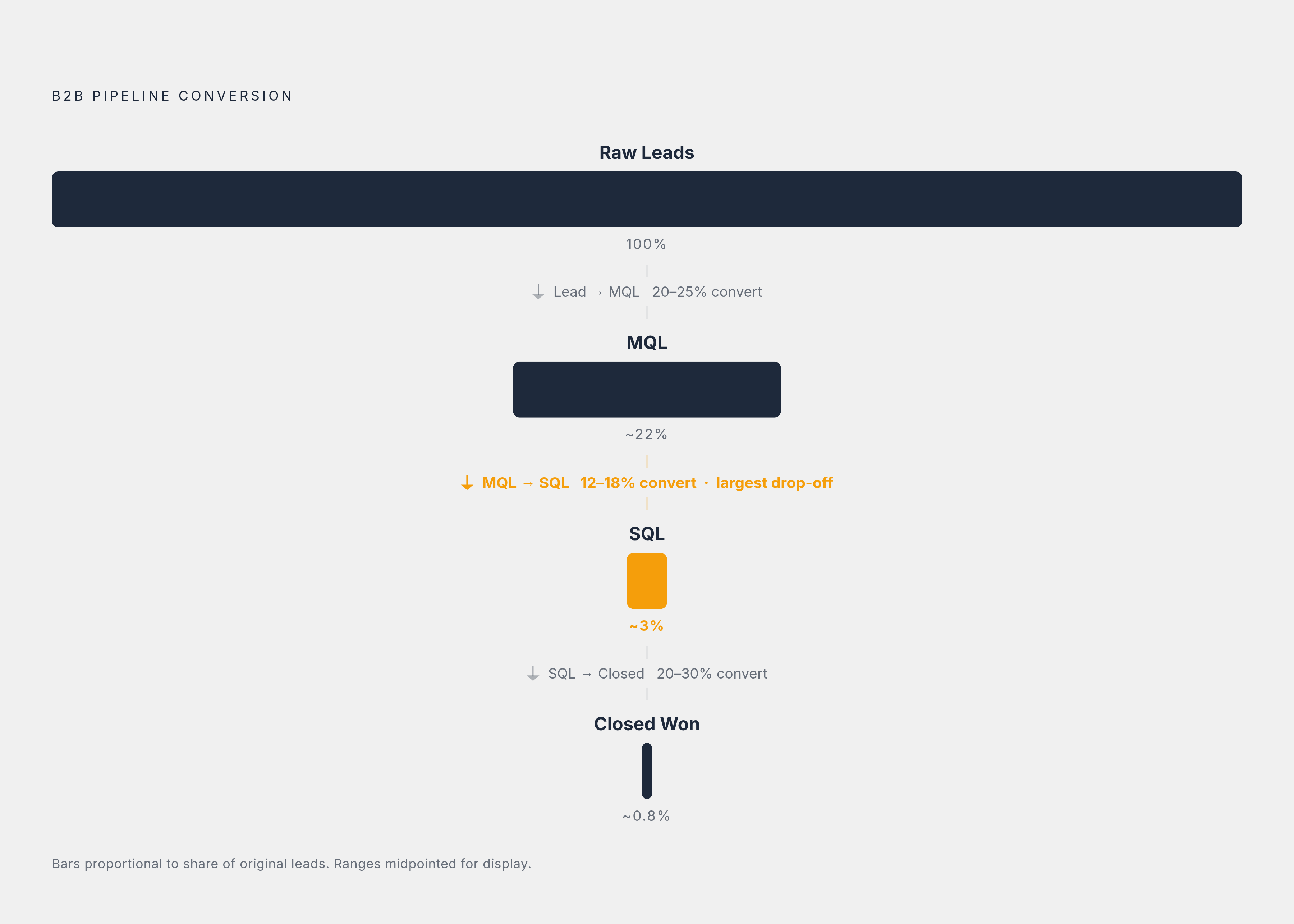
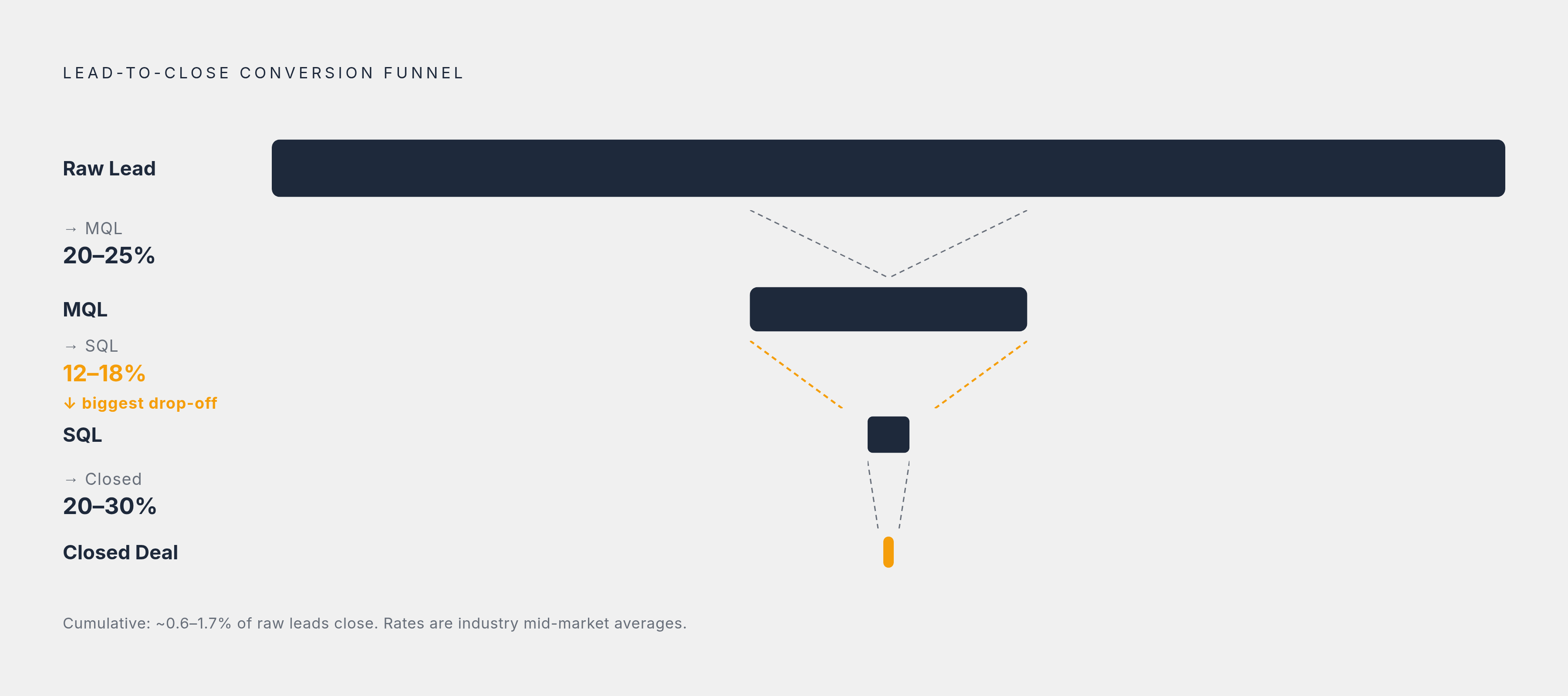
The handoff between those two is where most leads quietly die. Conversion from raw lead to MQL runs around 20 to 25%. MQL to SQL drops further, somewhere between 12 and 18%. That's the biggest single drop-off in the entire pipeline, and the root cause is almost always the same thing: marketing and sales aren't aligned on what "sales-ready" actually means.
Two frameworks do most of the heavy lifting here.
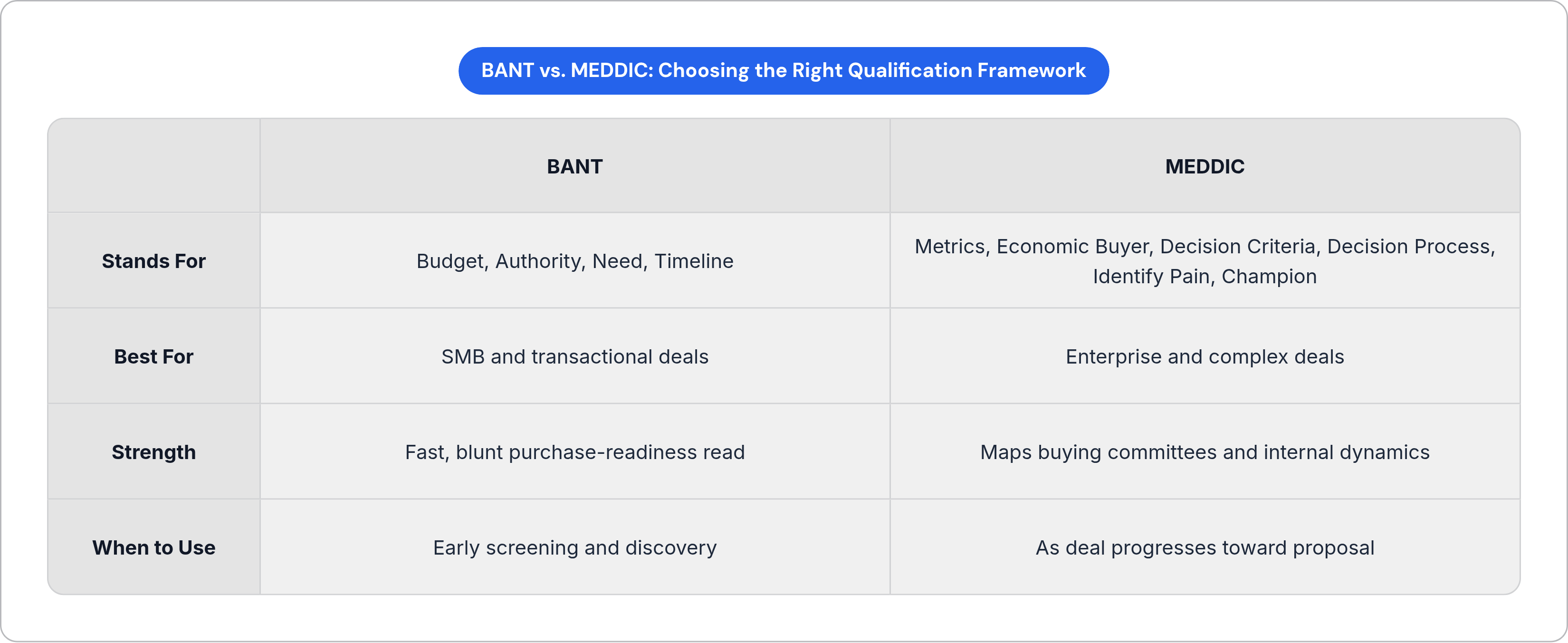
BANT (Budget, Authority, Need, Timeline) is fast and blunt. It works well for SMB and transactional deals where you need a quick read on purchase readiness. Not elegant, but efficient.
MEDDIC (Metrics, Economic Buyer, Decision Criteria, Decision Process, Identify Pain, Champion) is built for complexity. It maps the buying committee, surfaces internal dynamics, and improves forecast accuracy when multiple stakeholders are involved. For enterprise sales, it's the right tool.
The practical approach: use BANT for early screening, shift to MEDDIC as a deal progresses toward proposal. Don't try to run MEDDIC on a five-minute discovery call. You'll scare people off.
One thing worth naming explicitly: over-qualification. Pressing a prospect for their full budget, decision timeline, and internal approval process on a first call isn't discovery. It's an interrogation. Qualification depth should match relationship depth.
Only about 44% of companies were using lead scoring systems as of 2025. The other half are essentially treating every lead the same, which means reps are burning real time on contacts that never had a real chance.
Stage 3: First contact and discovery (what needs to happen before a rep can advance a deal)
First contact has two jobs: confirm there's a real fit, and earn the right to a deeper conversation. That's it.
Speed matters more here than most reps want to admit. The average business takes nearly 47 hours to respond to a new lead. Responding within 5 minutes makes a company 21 times more likely to qualify that lead. That's not a rounding error. That's the difference between catching someone when they're interested and catching them after they've already talked to your competitor, signed up for a free trial somewhere else, and moved on with their life.
Wait an hour, and your odds of qualifying that lead drop by 10x. Delay actively kills pipeline. It's one of the few things in sales that has a clear, measurable cost and almost nobody fixes it.
Discovery is where qualification stops being a checklist and starts being an actual conversation. Good discovery surfaces three things:
- The specific problem the prospect is trying to solve
- Who else is involved in the decision
- What success actually looks like to them
Those three things shape every stage that follows. Without them, you're guessing. You'll build a proposal for a problem they don't actually have and wonder why nobody responded.
Follow-up persistence matters just as much as first-contact speed. Around 80% of sales require five or more follow-ups after the first meeting. Nearly half of reps quit after one attempt. Only 2% of deals close on first contact. Most close somewhere between the fifth and twelfth touch. Persistence isn't pushiness. It's structure. There's a difference, even if it doesn't always feel that way.
Before moving forward: you need a confirmed need, an identified decision-maker, and some signal that the prospect is willing to keep talking.
Stage 4: Nurturing — keeping qualified leads engaged through longer cycles
Not every qualified lead is ready to buy right now. Some need a budget cycle to turn over. Some are waiting on a contract renewal with a current vendor. Some just need more time before the pain is urgent enough to justify the internal fight required to make a purchase happen. That's completely normal.
Nurturing's job is to stay relevant and trustworthy across that gap so that when the prospect is finally ready, they come back to you instead of starting over with someone else.
The failure cost of skipping this is real. A significant portion of marketing leads never convert, not because a competitor wins them, but because nobody followed up consistently enough to still be in the picture when the timing changed.
What nurturing actually looks like in practice:
- Email is still the dominant channel. Most B2B marketers use email newsletters as a primary nurture tool, and it works.
- Automated sequences carry more weight than you'd expect. Automated emails drive a disproportionate share of email-generated sales despite accounting for a small fraction of total email volume.
- Generic nurturing barely outperforms no nurturing. Aligning content to where the buyer actually is in their journey matters. Sending everyone the same drip sequence is lazy and prospects can tell.
Lead scoring inside the nurture phase helps reps distinguish between a prospect who needs three more months of content and one who's approaching SQL status today. Miss that window and you're essentially starting over.
Stage 5: Proposals and demos — where value has to be made concrete or deals stall
By the time you get here, the prospect has confirmed interest, discovery is done, and there's shared understanding of the problem. The proposal's job is to translate everything learned in discovery into a specific, priced solution. When done right, it should feel like the logical next step, not a pitch that came out of nowhere.
The failure mode at this stage is consistent. Deals stall when value hasn't been connected to outcomes the buyer actually cares about. A proposal sent before success criteria are agreed on creates friction instead of momentum. The buyer has to work to understand why it matters to them specifically. That's your job, not theirs.
I've seen reps send technically flawless proposals that went completely silent for two weeks. Almost every time, it traced back to the same thing: they sent it before confirming what "success" actually meant to the person on the other side.
Demos serve a parallel function. They make abstract capabilities real. The most effective demos are built around the specific pain points surfaced in discovery, not a feature-by-feature walkthrough of everything the product can do. A demo that doesn't reflect the buyer's actual problem is just a presentation. A very expensive one.
Stakeholder risk shows up here more than anywhere else. Proposals frequently surface new players (procurement, finance, IT) who weren't part of the original discovery conversations. The smart move is to map those stakeholders before the proposal goes out, not after you get the "we need to loop in legal" email on a Friday afternoon.
Exit criteria: the prospect has reviewed the proposal, asked real questions, and signaled willingness to talk terms. Silence after a proposal is not a pipeline stage. It's a stall.
Stage 6: Negotiation — what's actually being resolved and where the real objections originate
On the surface, negotiation is about pricing, contract terms, timelines, and outstanding concerns. Procurement, legal, and finance often show up here for the first time. It looks like the moment where deals win or lose.
It's not, usually. Negotiation is the most visible point of loss, but it's rarely where the problem started. Pricing objections and competitive pressure almost always trace back to incomplete qualification or a proposal that never properly landed the value case. By the time you're in negotiation, the damage was done two stages ago.
If a deal has been sitting in negotiation for three times the normal cycle length, that's a sign. Something upstream wasn't resolved. Escalation (a senior rep, an executive sponsor, someone with enough organizational weight to move things) is often the only way to break the logjam.
A few things that actually matter here:
- Predefined frameworks for your most common objections keep momentum. Improvising every response is slower, less consistent, and tends to produce worse outcomes.
- Leaving room for the prospect to surface concerns builds trust that carries directly into the post-sale relationship.
- Your internal champion (the person inside the prospect's organization who genuinely wants you to win) is your most valuable asset at this stage. They can navigate internal stakeholders you can't directly reach.
That champion was identified back in qualification and discovery. If you skipped that work, you'll feel it here.
Stage 7: Closing — what converting a deal requires and why win rates are under structural pressure
The exit criteria are concrete. Verbal or written commitment. Signed contract. Approved payment terms. The prospect becomes a customer at this point. Not before.
The signals that a deal is ready to close are usually obvious in hindsight: the prospect is asking about next steps, giving positive feedback, and has stopped raising new objections. Those are buying signals. Pay attention to them.
And closing isn't just getting the signature. It includes double-checking documentation, aligning internal teams on implementation and customer success, and making sure the customer knows exactly what happens next. A failed handoff after a signed contract is still a pipeline failure. The deal is not over until the customer is actually handed off.
Now for the uncomfortable part. Only about 20 to 30% of qualified opportunities close. Qualification and nurturing are necessary. They are not sufficient.
And the close is getting harder. B2B pipeline conversion rates declined meaningfully between 2022 and 2024. Three structural forces are driving it:
- Longer sales cycles push decisions into future budget periods, where they stall indefinitely
- Larger buying committees slow down consensus and make "no decision" the path of least resistance
- Tighter budgets mean more deals die quietly without anyone actually losing to a competitor
Around 84% of sales reps missed quota last year. That's a systemic pressure, not a personal failing. The loss isn't always to another vendor. It's often just to inertia.
How pipeline stage data turns individual deals into a repeatable system
Every stage generates data: time in stage, conversion rate, common reasons deals exit without advancing. That data is the raw material for figuring out where your pipeline actually breaks, as opposed to where you suspect it breaks, which is almost never the same place.
Stage velocity matters as much as conversion rate. A deal aging past the normal time-in-stage isn't just slow. It's an early warning sign that something is stuck, and the longer you wait to address it, the harder it gets.
When win rates drop, pipeline data usually points to where. Here's how to read it:
- High MQL-to-SQL drop-off means qualification criteria aren't aligned between marketing and sales
- Proposals not converting usually means discovery was incomplete, or the value case wasn't tied to outcomes the buyer actually cared about
- Deals stalling in negotiation points to missing stakeholders, or a champion who doesn't have enough internal pull to close out the decision
A regular review cadence (weekly for active deals, monthly for trends) surfaces systemic issues before they compound into a missed quarter. Without that cadence, you're always reacting to results. You're never actually managing toward them.
When entry criteria, seller actions, and exit criteria are defined for every stage, reps make more consistent decisions. Forecasts become more accurate. Coaching gets specific instead of generic.
And when a lead goes cold after a demo, it's not lost. It re-enters at nurturing with a full record of what's already been established. That's a completely different starting point than a cold lead with no history. Knowing the difference (and having a system that captures it) is what separates a pipeline that produces predictable revenue from one that just produces activity reports.