Generating Sales Leads Through Inbound and Outbound Channels
Combining inbound and outbound creates more pipeline than either channel alone.
Most teams treat inbound and outbound as a strategic choice between two competing philosophies, but the confusion runs deeper than that. Many organizations default to one channel without fully understanding what the other one does, how it compounds over time, or why the combination consistently outperforms either approach on its own. That misunderstanding has real consequences: wasted budget, missed pipeline, and lead generation programs that plateau because they were built on only half the available infrastructure.
Understanding both channels starts with their fundamental structure, which is simpler than most strategy documents make it sound.
Inbound is pull-based. Content, SEO, newsletters, webinars, and social publishing bring buyers to you because something you created surfaced when they went looking. You did not interrupt them. They arrived on their own terms, usually because a search result, a referral, or a piece of content answered a question they were already asking.
Outbound is push-based. Cold calls, cold email, paid ads, direct mail, and trade shows send you toward the buyer. Contact happens on your timeline, not theirs, which means you are introducing yourself to someone who has not yet expressed any interest in hearing from you.
That one structural difference, which side initiates contact, ripples into everything that follows:
- Cost per lead
- Speed to pipeline
- Average deal size
- Conversion rate
- Whether the channel builds on itself over time or resets with every new campaign
Neither channel has a monopoly on lead quality. Inbound leads self-select, which sounds promising, but self-selection does not automatically mean high intent. Someone can read your blog every week for two years and never be close to buying. Outbound leads are targeted but cold. The channel shapes how a lead shows up. It does not determine what they are actually worth.
What has shifted in 2025 is that both channels now operate mostly in digital spaces, which makes them more comparable and, more importantly, more combinable than they have ever been.
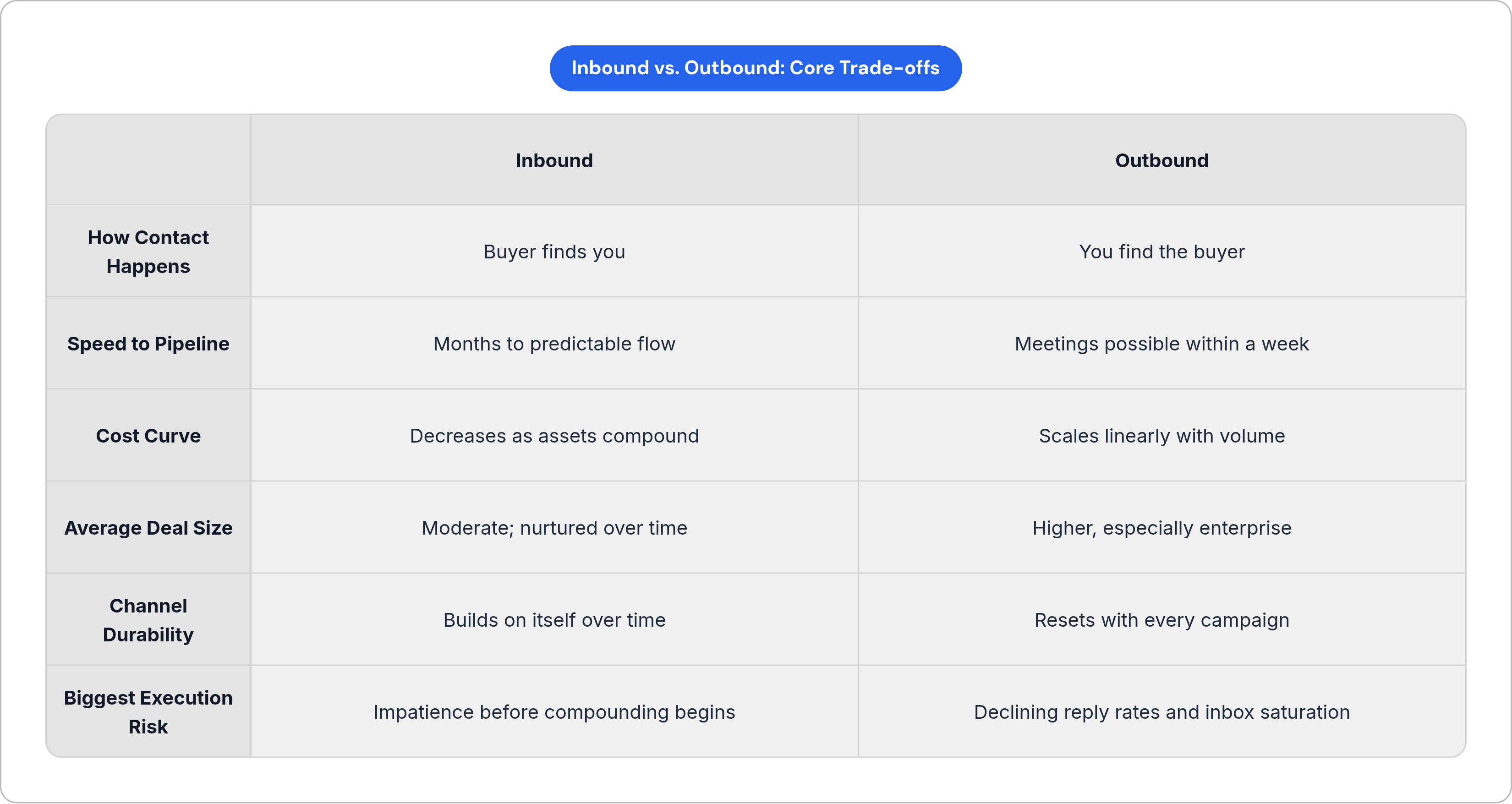
How inbound compounds: the mechanics of pull-based lead generation
The early months of inbound feel like spending money to build something invisible, because that is essentially what is happening. Content and SEO accumulate domain authority slowly. Assets you publish today generate leads months from now with no additional spend. Around the five-month mark of consistent execution, cost per lead starts dropping in a way you can actually measure. After a year or more, customer acquisition cost falls in a way that fundamentally changes the economics of the program.
The mechanism is not complicated. Fixed-cost assets keep working after you stop paying to distribute them. The hard part is maintaining investment before the evidence of that compounding shows up in the numbers.
Why SEO still does the heaviest lifting
SEO leads close at a higher rate than outbound leads because someone searching for a solution to a problem they already know they have is in a completely different headspace than someone opening a cold email they never asked for. One person raised their hand. The other had a hand extended toward them without warning.
Organic search drives more than half of all website traffic. Companies that publish consistently generate substantially more leads per month than those that do not. Publishing frequency matters more than most teams expect, and there is a real performance gap between teams publishing once a week and those publishing four or more times.
The execution gap that buries most inbound programs
A minority of companies have a documented content strategy, even fewer have a functioning lead nurture program, and the vast majority of web pages across the internet get zero organic traffic.
Publishing content without a strategy does not produce inbound leads. It produces a large archive no one reads.
Inbound takes three to six months to build enough SEO authority for predictable lead flow. Most teams underestimate this timeline by about half. They get impatient, pull back on investment, and then point at the results as proof the channel does not work. The investment was working. The patience ran out first.
The cost advantage is real but delayed. The organizations that benefit are the ones who invest before the returns are visible, which is exactly the thing that is hardest to justify in a quarterly review.
What inbound channels work hardest and how to deploy them
Content and lead magnets
Format and friction level matter as much as topic. Interactive content outperforms static content. Video consistently ranks as one of the most effective B2B content formats. Checklists convert at higher rates than eBooks as lead magnets because a checklist is immediately useful while an eBook requires a significant time commitment before delivering value.
Match the asset to where the buyer is in their decision process. Top-of-funnel content builds awareness. Mid-funnel content provides decision support. Bottom-of-funnel content delivers proof.
Email nurture
Email delivers one of the highest returns of any channel in the marketing stack. Companies that execute lead nurturing well generate more sales-ready leads at lower cost because they stay in front of the right people long enough to matter when those people are ready to act.
Segmented campaigns outperform unsegmented ones. Automated sequences outperform manual sends. A significant portion of conversions happen more than 90 days after the first prospecting touch, which means nurture programs that cut off at 30 or 60 days are walking away from deals that were still in play.
LinkedIn and social
LinkedIn is the dominant B2B social platform for lead generation, and most B2B marketers report that it produces quality leads at a meaningful rate. YouTube, Instagram, and TikTok are growing channels for top-of-funnel awareness, particularly when you are trying to reach younger members of buying committees who are not primarily active on LinkedIn.
The deployment logic
Use content and SEO to capture demand. Use email to nurture it. Use LinkedIn to seed relationships at accounts that have not found you organically yet. These channels are not competing with each other. They operate sequentially, with each one reinforcing the others.
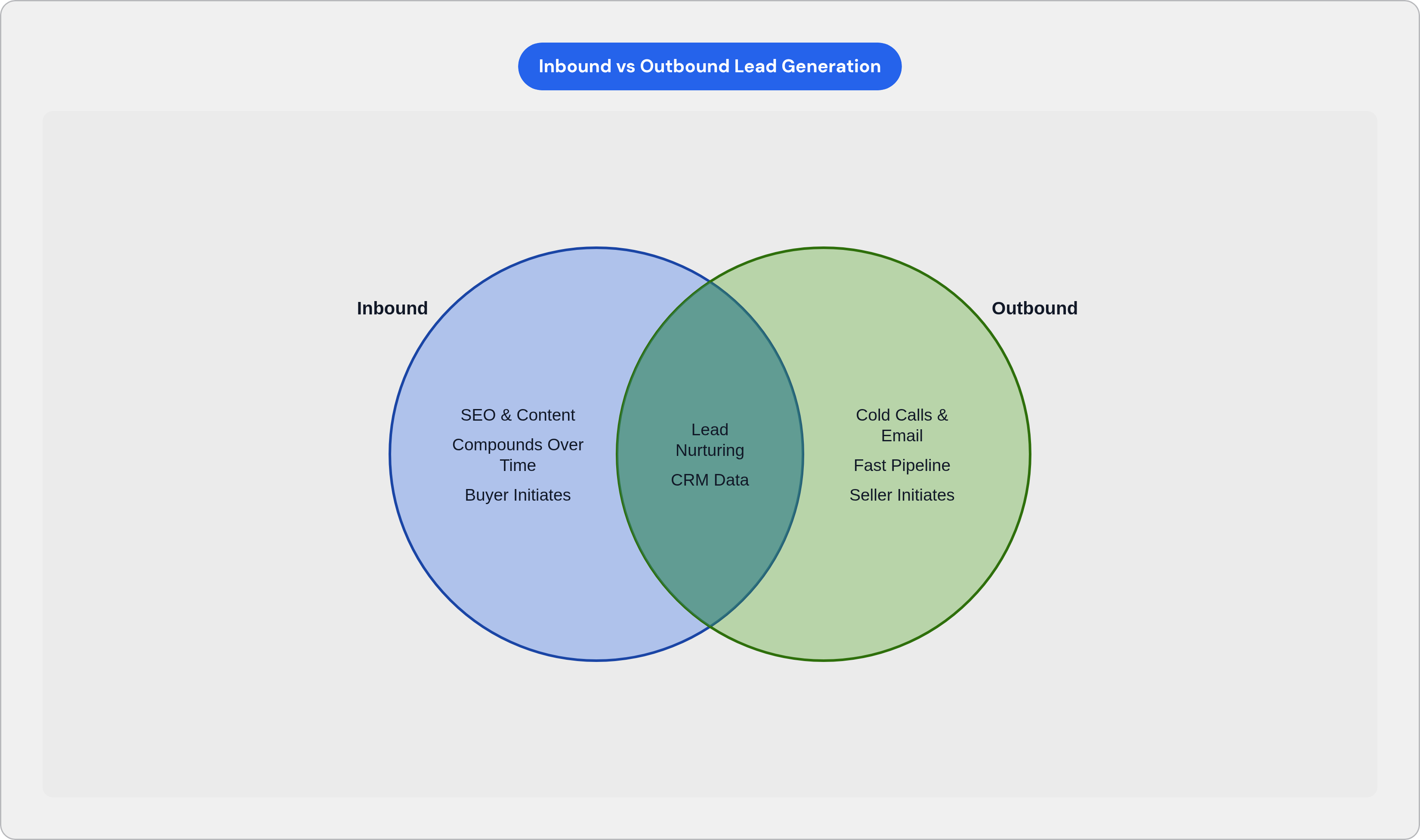
How outbound generates pipeline: speed, targeting, and deal size trade-offs
Outbound is fast in a way inbound cannot match. A campaign can produce meetings in the first week. There is no version of SEO that generates pipeline by Friday. When you need to know whether a market exists before you have built any authority in it, outbound is the only tool that actually answers the question in a useful timeframe.
Outbound also produces larger average deal sizes, particularly in enterprise and mid-market segments. A higher cost per lead can make sense when the deal on the other end justifies it, but the math needs to be run deliberately rather than assumed in either direction.
Cold calling in 2025
Cold calling has a bad reputation that the data does not support. A majority of B2B leads still originate from cold calls, and most B2B buyers say they are open to receiving them. The channel's real problem is execution quality rather than buyer resistance. Bad callers working bad lists gave the whole channel its reputation for ineffectiveness.
The conversion funnel is genuinely challenging, requiring real volume to produce a meeting and more volume still to close. Companies that cut cold calling entirely saw less pipeline growth than those that kept it in the mix, which suggests the channel has a baseline of effectiveness that simply stopping does not improve.
Cold email in 2025
Open rates and reply rates have declined for several consecutive years as inbox saturation continues to worsen. Cold email still costs less per lead than cold calling, which makes it the higher-volume, lower-cost outbound channel, but those economics only work at scale, and scale requires both list quality and sequence quality to be solid before you send anything.
Shorter emails outperform longer ones. Reaching multiple contacts at the same company meaningfully increases response rates compared to single-contact outreach. The volume required to generate one qualified meeting is high enough that teams who have never run their funnel math are usually surprised when they finally do.
Outbound is fast and targetable, costs more per lead, and because engagement rates keep declining, message quality and targeting precision matter more each year.
Where outbound still wins and where it runs out of runway
Where outbound wins
Outbound is the right tool when:
- Your ideal customer profile is narrow and well-defined
- The deal size justifies a higher cost per lead
- You are at an early stage with no organic authority yet
- Speed to pipeline is the primary constraint
- You need to test a new market or segment quickly
That last point is underrated. You can launch a cold email campaign to 500 targeted accounts in a week, which gives you signal about whether a market responds to your offer before you have committed to a long-term content investment. Paid advertising sits in a similar position: faster to traction than organic SEO and more scalable than individual outreach, though cost scales linearly with volume and does not compound the way organic channels do.
Where outbound runs out of runway
The ceilings are real:
- Cold email reply rates have declined for several consecutive years, so sustaining the same output requires increasing volume, which increases cost without any corresponding efficiency gain.
- Cold calling conversion rates are low and do not improve simply because you increase activity.
- Outbound does not build an asset. Each campaign is a fresh spend, and nothing carries forward to the next quarter.
Most companies still direct the majority of their marketing budgets toward outbound, a spending distribution that does not reflect the available ROI evidence. For teams willing to rebalance deliberately, that gap represents a genuine opportunity.
How inbound and outbound create compounding results when run together
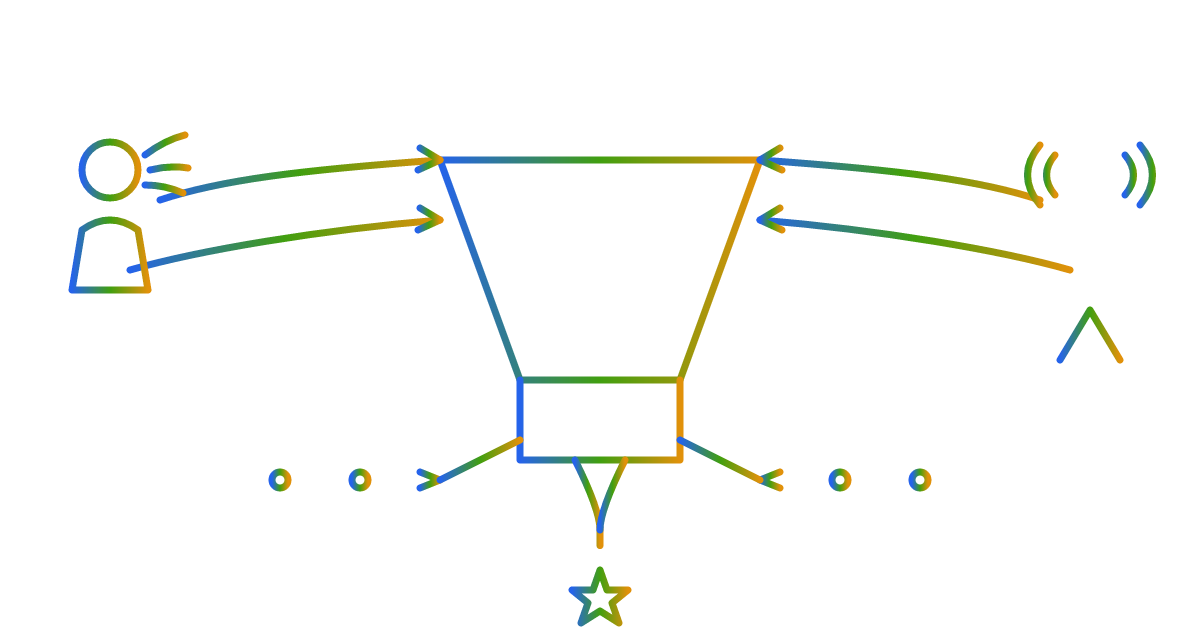
The core mechanic is that inbound warms the market while outbound accelerates it. The programs that generate the most pipeline over time use both channels together rather than treating them as alternatives to each other.
Nurture is not a separate program. It is the connective tissue between outbound's cold outreach and inbound's content engine. Nurtured leads produce larger deals on average not because the leads are inherently different but because they have had more time and more touchpoints before anyone asked them to buy.
How the flywheel works in practice
A few concrete examples of how the channels feed each other:
- Content built for inbound, such as case studies, benchmarks, and guides, becomes outbound collateral. The rep sends the same asset the buyer might have found organically. The content is identical. The delivery mechanism is different.
- Outbound prospecting identifies high-fit accounts that can then be enrolled in inbound nurture sequences or retargeted with paid social. Outbound finds the account, and inbound stays present until the timing is right.
- Intent signals from inbound behavior, including content downloads and repeated visits to high-intent pages, trigger outbound sequences at the right moment. A call is not cold anymore when the prospect just read your pricing page twice in three days.
The buyer journey map
- Top of funnel: Inbound content, social presence, and paid awareness create surface area for discovery.
- Mid-funnel: Outbound targets accounts showing engagement signals while nurture sequences keep warm accounts engaged.
- Bottom of funnel: Sales-assisted outbound closes while inbound proof assets such as testimonials and case studies reduce friction at the moment it matters most.
Teams running coordinated programs do not simply add the results of each channel together. The channels lift each other's conversion rates over time. Inbound feeds warmer signals into outbound. Outbound surfaces accounts that inbound can then stay in front of. The longer the system runs, the more efficient it gets, and the numbers after 12 to 18 months of running both channels together consistently reflect that.
The operational infrastructure a combined lead engine requires
The hidden cost of running both channels together is data chaos. Inbound leads fall through because sales does not know they exist. Outbound sequences fire on accounts that are already mid-negotiation. Teams optimize their own channel metrics while the handoff between channels quietly leaks deals. This is not primarily a strategy problem. It is an operational plumbing problem, and because it is unglamorous, it does not get fixed until something breaks visibly enough to demand attention.
CRM and marketing automation as the connective layer
Lead source, stage, and engagement history need to be visible across both motions. Without that visibility, you are not running a combined program. You are running two separate programs that occasionally intersect by accident. AI-powered lead scoring and predictive analytics can reduce wasted outreach meaningfully, but these tools only work when inbound and outbound signals are feeding the same system.
The integration problem
The tools running each channel, including CRM, email sequencing platforms, intent data providers, ad platforms, and enrichment services, each produce data that needs to flow to the others in real time. When these integrations are hand-built and manually maintained, teams spend cycles on plumbing instead of pipeline, and when they drift, the result is stale data, missed triggers, and outbound sequences firing on the wrong accounts at the wrong time.
Pre-built, managed connector solutions let revenue and growth teams handle integrations between their lead generation stack without engineering involvement on every new data connection. The specific tooling matters less than the underlying principle: every inbound touch should be visible to the outbound team, and every outbound response should feed back into the nurture sequence. That requires live data flowing continuously, not a spreadsheet someone exports on Friday afternoon.
The operational standard is not complicated to describe, but it is genuinely harder to maintain than most teams expect. The gap between knowing what the system should look like and actually keeping it running is where many combined programs quietly fall apart.
Building a lead generation mix that improves over time
The right mix depends on where you are on the inbound maturity curve.
Early stage with no organic authority yet: Lean on outbound for immediate pipeline while building inbound infrastructure in parallel so the compounding clock starts. Do not wait until you have enough content before investing in the system, because that moment does not arrive on its own.
Growing inbound presence: Use outbound to target accounts that are engaging with your content but have not converted. At this point, outbound becomes acceleration rather than cold acquisition, because the accounts you are reaching are no longer strangers. They have read your content. They simply have not raised their hand yet.
Mature inbound engine: Outbound becomes precision-targeted, reserved for high-value enterprise accounts and new market segments where inbound has not yet penetrated. You have earned the right to be selective about where you spend the cold outreach budget.
How to measure it properly
Track cost per lead and cost per acquisition by channel, not just lead volume. The gap between inbound and outbound cost per lead only becomes visible when both are measured with the same standards and the same methodology. Teams that optimize for volume instead of acquisition cost almost always over-invest in outbound and under-invest in the channels that compound.
The realistic timeline
Expect three to six months before inbound produces predictable lead flow. Run outbound during that window to sustain pipeline while the long-term investment matures. These two timelines are not in conflict with each other. They are designed to cover each other.
The teams that figure this out are not necessarily the ones with the biggest budgets. They are the ones who stopped treating inbound and outbound as competing philosophies and started treating them as two parts of one integrated system. Building that system takes longer than it should. Staying patient through the first few months of inbound investment takes longer than most teams expect. None of it is conceptually complicated, but it requires sustained commitment at a point when the evidence of progress is not yet visible, which is what makes it genuinely difficult to execute.