Generating Leads in Sales With Product-Led Motions
Shifting from form fills to product usage reveals who actually wants to buy.
Only 13% of MQLs ever convert to a sales-qualified lead or reach the opportunity stage. That number comes from a sample of over 1,500 companies, and it should make everyone who runs a revenue team deeply uncomfortable. Not because the number is surprising, but because of what it quietly admits: the model most B2B sales teams are running treats marketing activity as a reliable signal of buying intent, and it is not. It never really was.
A form fill is not intent. A webinar registration is not intent. Attending a virtual event, downloading a whitepaper, clicking a retargeting ad — none of these tell you whether someone actually wants to buy your product. They tell you someone was curious, or bored, or doing research for a presentation they have to give next Thursday. The MQL model built entire sales motions on that distinction being less important than it is.
The result shows up everywhere. Sales teams missing quota. Marketing caught in a volume trap, generating more leads that convert less often. The average B2B buyer now swimming in cold outreach every single day, which means the signal-to-noise ratio in email and LinkedIn has basically collapsed — like trying to find a whisper in a stadium full of people all shouting the same thing. And the cost of acquisition keeps climbing, because every channel that gets accessible gets crowded.
What this means for a rep on the floor is stark. If 13% of what lands in your pipeline is statistically likely to close, you are spending most of your time working deals that aren't really deals. The burden of figuring out which 13% is real falls entirely on human judgment applied to indirect signals. That is an exhausting, expensive way to run a sales team.
Here is the important part: this is not an execution problem. Better SDRs won't fix it. More personalized email sequences won't fix it. The flaw is structural. The model itself mistakes declared interest for demonstrated intent, and those are not the same thing. Chasing declared interest while ignoring demonstrated intent is like watering a plastic plant and wondering why it won't grow.
Product-led growth is designed to close exactly that gap. Instead of inferring intent from marketing behavior, it observes intent directly through product behavior. Usage replaces guesswork. What the user actually does inside the product becomes the primary signal for when and how sales engages.
What Product-Led Growth Actually Means for Lead Generation
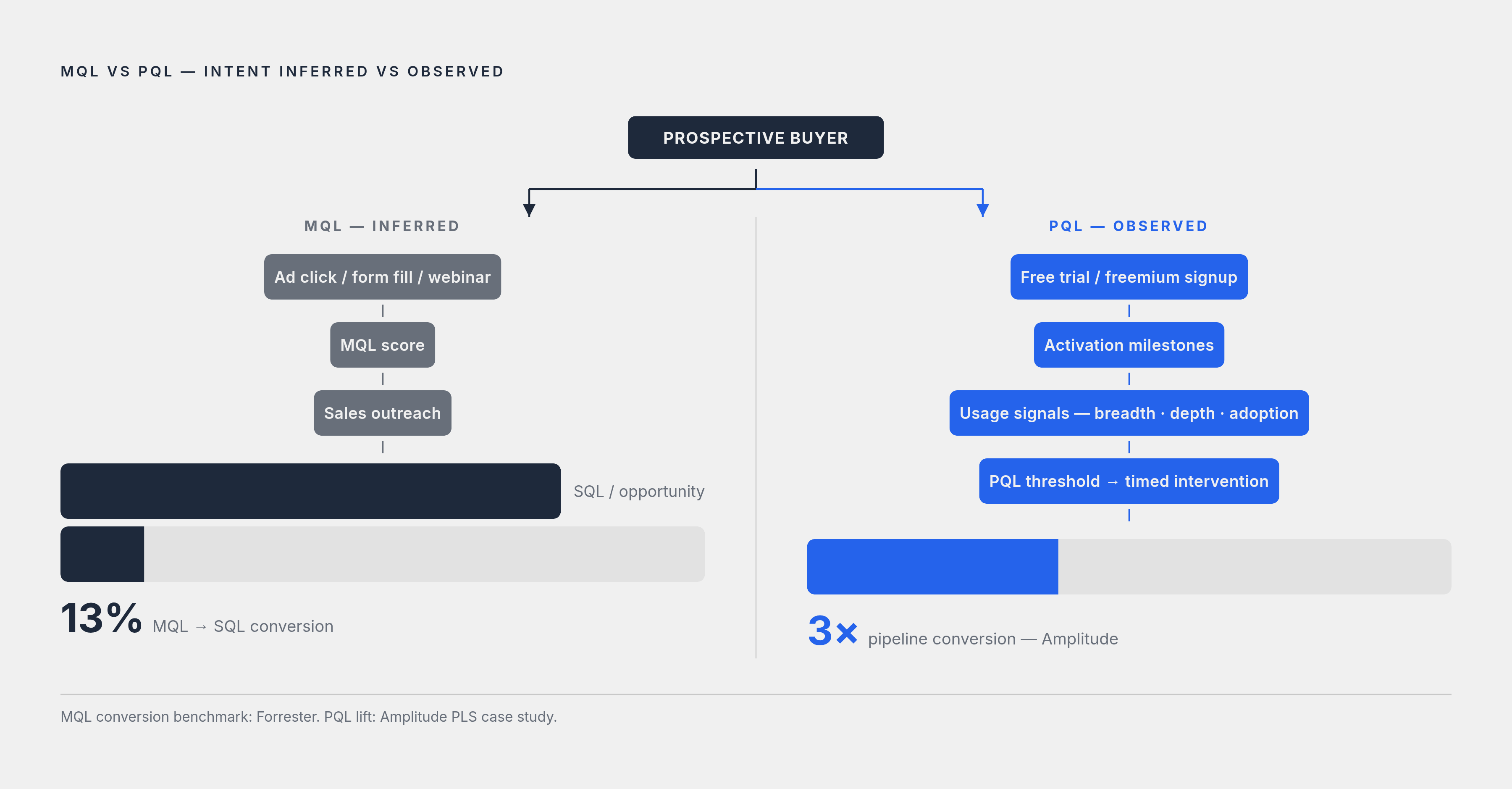
PLG has a simple core premise: the product is the primary acquisition driver. Not ads. Not SDRs. Not gated whitepapers. The product itself.
The conceptual shift this requires is bigger than it sounds. In a traditional sales model, product usage is the end goal. You do all the sales and marketing work, you close the contract, and then the customer finally gets to use the thing. In a PLG model, product usage happens first. It creates the pipeline. The sequence is reversed.
Product-Led Sales (PLS) is the layer that goes on top of this. It is not PLG in place of sales — it is a sales motion built on top of self-serve behavior. End-user activity inside the product becomes the basis for enterprise pipeline. Sales does not disappear. It becomes more precise.
The unit that makes this work is the Product-Qualified Lead, or PQL. A PQL is a user who has experienced meaningful value inside the product. Not someone who clicked an ad. Not someone who attended a webinar. Someone who actually used the product in a way that suggests it is solving a real problem for them.
A well-defined PQL framework typically looks for signals across five dimensions:
- Activation. Did the user complete key onboarding milestones? A user who never activated is not a PQL, no matter what else they do.
- Engagement. Are they coming back? Regular usage at defined frequency thresholds is a sign the product is becoming part of their workflow.
- Feature adoption. Are they using features that live at or beyond the free tier? This suggests they are running into the edges of what the free product can do.
- Expansion signals. Are they inviting teammates? Approaching usage limits? These are organizational signals, not just individual ones.
- Explicit intent. Pricing page visits, demo requests, upgrade clicks. High-confidence signals, but rare. Waiting only for these means missing most of your PQLs.
The difference between a PQL and an MQL is not a scoring tweak. It is a different theory of what "ready to buy" actually looks like. Demonstrated value versus declared interest. Every downstream tactic in a PLG motion — how you design trials, how you score usage, when sales reaches out — depends on that distinction being precise.
How Free Trials and Freemium Models Create the Raw Material for PQLs
Before you can score PQLs, you need behavioral data. That means getting users into the product. The two primary models for doing that are free trials and freemium, and they generate very different data sets.
Free trial gives users full or near-full product access for a limited time window. It converts a higher percentage of the people who sign up, but it attracts fewer signups overall. The urgency is built in. The behavioral signal window is short.
Freemium gives users permanent access to a limited version of the product. It generates more signups and more free users. The conversion funnel is longer, but the signal set you accumulate over time is richer. You can watch behavioral patterns develop over weeks or months, not just a two-week clock.
Free trial is the more common choice across SaaS products by a wide margin. That said, freemium deserves more credit than it usually gets. Per Kyle Poyar's 2026 analysis, freemium can actually produce more paying customers per cohort of website visitors than a standard free trial once you account for total funnel volume. That challenges the assumption that trials always win on conversion efficiency.
The activation window matters enormously regardless of which model you choose. Amplitude's 2024 Product Report found that top-quartile growth companies activate trial users within the first 24 hours at dramatically higher rates than bottom-quartile companies, and the correlation between early activation and 30-day conversion is nearly linear. The first day is not onboarding theater. It is the primary determinant of whether a trial user ever becomes a PQL.
Opt-in versus opt-out trial design also matters. Credit-card-required trials convert at a much higher rate per signup. The tradeoff is a smaller, more self-selected pool. No-credit-card trials generate more volume with lower conversion efficiency. The right call depends on whether volume or conversion efficiency is the bigger constraint on your specific growth model.
One more thing worth noting if you are building in the AI-native category: these products convert at meaningfully higher rates than traditional SaaS equivalents. The value demonstration tends to be faster and more visceral, which compresses the activation window in a good way.
The design decision between trial and freemium is not just a marketing call. It determines what behavioral data is available for PQL scoring downstream. Whatever model you choose, build it with that in mind.
What Usage Signals Actually Look Like and How to Score Them
Not all usage is equal. Someone who pokes around an app for ten minutes and never comes back is not the same as someone who logs in four days a week and has pulled three teammates in. The job of a PQL framework is to tell those two apart at scale, without a human reviewing every account.
I once watched a sales team spend three weeks chasing a lead who had downloaded every piece of content they had ever published — whitepapers, case studies, recorded webinars, the works. The rep was convinced this person was a hot prospect. Turned out they were a graduate student writing a thesis on SaaS pricing models. Meanwhile, an account two rows down in the CRM had quietly added eight teammates and was bumping into the collaboration limit every other day. No one called them. They churned to a competitor. The content downloader was a ghost; the quiet expander was a buyer. The data was there. No one was looking at the right columns.
Slack figured out a specific threshold that predicted conversion better than any form fill or marketing signal they had: accounts that exchanged roughly 2,000 messages were deeply engaged and converted at an extremely high rate. For a team of ten, that took about a week. One behavioral marker, clearly defined, did more qualification work than an entire outbound sequence could.
That is the level of specificity you are trying to build. Not a vague sense that engagement is "high." A threshold that triggers an action.
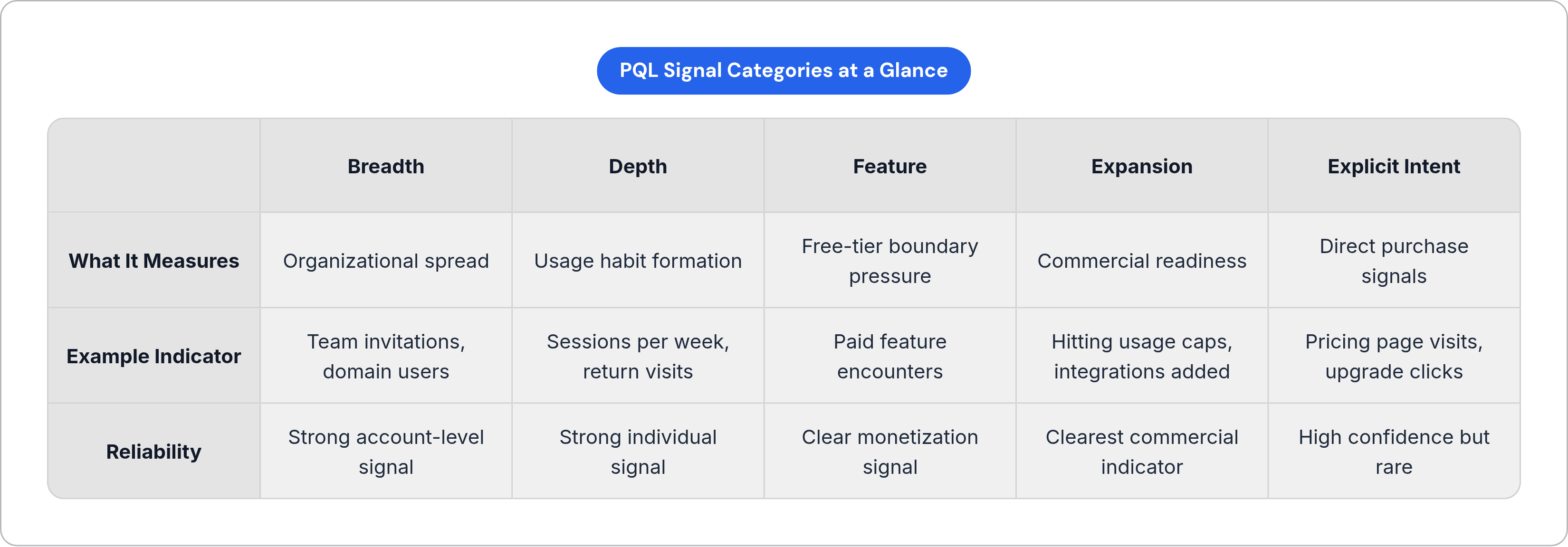
The five signal categories worth instrumenting:
- Breadth signals. Number of users from the same corporate domain. Team invitations sent. These indicate organizational spread, not just individual adoption. One power user is interesting. Ten users from the same company is a buying signal.
- Depth signals. Frequency of use, sessions per week, return visits after the first login. Is this product becoming a habit, or was it a one-time experiment?
- Feature signals. Adoption of features that sit at or beyond the free tier. If a user keeps bumping into paid features, they are telling you something without saying it.
- Expansion signals. Hitting usage caps. Attempting to access paid features. Adding integrations. These are the clearest commercial indicators in the entire signal set.
- Explicit intent signals. Pricing page visits. Demo requests. Upgrade clicks. High confidence when they happen, but rare. Do not build your PQL model around waiting for these.
Figma's collaboration model is worth studying as a structural expansion signal. Every shared design file introduced a new viewer — developers, product managers, stakeholders — without requiring them to have an account. Organizational footprint expanded as a byproduct of normal collaboration. The signal worth tracking was domain penetration. How many people from a given company were touching the product, even as viewers? That metric predicted account-level conversion in a way individual activation data alone could not.
Integration breadth is another underrated signal. The number of integrations a user connects often predicts stickiness and expansion intent better than session frequency alone. A user who has wired your product into five tools in their stack is not leaving easily. That behavioral pattern is worth weighting heavily in any scoring model.
What the scoring model should produce is not a probability score that sits in a dashboard and requires human interpretation every time. The output should be binary: route to sales now, or continue nurture. The model exists to make that call without someone having to review a chart.
When and How Sales Should Enter a Product-Led Motion
Here is a thing that does not get said enough: pure self-serve PLG rarely reaches significant scale without hitting friction. When deals involve security reviews, custom terms, and multi-stakeholder buying committees, a credit-card signup flow is not sufficient. At some point, a human has to get involved.
The practical signal for when to start building a sales-assist motion comes from Elena Verna, who has run growth at several PLG companies: when requests for deals above a mid-four-figure threshold start appearing in your pipeline, that is when you begin investing in a sales layer. Early PLS teams often set quotas by logo count rather than by revenue, because the deals in the mid-four-to-low-five-figure range are where you learn the motion before scaling it.
What changes in a hybrid model:
- Sales does not replace self-serve. It runs as a second engine targeting accounts the product alone won't close.
- The rep's job shifts from cold prospecting to timed intervention. The accounts are already in the product. Sales is deciding when and how to step in.
- Outreach is contextualized by usage data. "I saw your team hit the collaboration limit" is a completely different conversation than a cold pitch to someone who downloaded a PDF.
91% of B2B SaaS companies running a PLG motion plan to increase investment in it. The hybrid model is not an edge case. It is the consensus direction.
Zoom is the canonical example of how this plays out at scale. Canonical PLG company. Enormous enterprise sales organization. The majority of its revenue comes from enterprise accounts. The self-serve motion fills the top of the funnel. Sales converts the high-value segment. Both engines run simultaneously and neither undermines the other.
Buyer behavior data supports this hybrid structure. A majority of SaaS buyers say they prefer a mix of self-serve and sales-assisted experience when evaluating a product. Neither pure PLG nor pure sales-led matches what buyers actually want.
Amplitude documented a concrete outcome when it introduced a PLS layer: leads-to-pipeline conversion tripled. The sales motion did not cannibalize self-serve. It converted accounts that would otherwise have churned at the free tier.
The failure modes are worth naming explicitly:
- Too early. Sales reaching out before a user has hit activation milestones reads as intrusive. It undermines the self-serve experience and signals that you are watching too closely.
- Too late. The user has already decided to leave or has upgraded without help. The intervention window passed.
- Context-free outreach. Pitching a generic demo to someone who has been using your product for six weeks erodes trust. They already know what the product does. The conversation needs to be about what they specifically are trying to accomplish.
How PLG Companies Scale Acquisition Without Proportional Headcount Growth
In a traditional sales-led model, pipeline grows roughly in line with sales headcount. You want more pipeline, you hire more reps. In a PLG model, the product generates pipeline, which means growth can outpace hiring in ways that are structurally impossible in a pure sales-led model.
Cursor reached multiple ARR milestones faster than any prior SaaS company without hiring an enterprise sales rep until well past significant scale. The product generated demand that a traditional SDR team would have taken years to build. That is an extreme case, but it illustrates the ceiling that becomes available when acquisition is built into the product.
The mechanisms that make this work are viral and collaboration loops:
- Calendly. Every scheduling link sent is an implicit product demo to the recipient. They do not need to be prospected. The product introduces itself.
- Loom. Every video shared exposes a non-user to the product's core value proposition in real time.
- Figma. Every shared design file adds a viewer who may become a user, then a paying seat.
- Dropbox. Referral incentives tied to storage made users the acquisition channel. A large share of daily signups in early growth came through this mechanism.
Canva built to hundreds of millions of monthly active users and tens of millions of paying customers on user education and template virality. Not outbound sales.
HubSpot's model is instructive for a different reason. Give away the sticky product — in their case, a free CRM — and monetize the workflows built around it. Once customer data lives in your platform, the switching cost is enormous. Expansion into adjacent products becomes the natural path, not a hard sell.
Datadog illustrates what usage-based pricing does to the growth math. Revenue nearly doubled over two years while customer count grew more modestly. The growth came from existing customers expanding usage, not from new logos. When pricing is tied to value delivered, revenue scales with actual adoption.
For teams building integration-heavy products: each integration a user connects embeds the product more deeply into their workflow. Every integration is a stickiness multiplier and an expansion signal. It is not just a feature. It is retention infrastructure.
Expansion Revenue as the Long-Term Payoff of PQL-Driven Pipeline
Most thinking about lead generation stops at the initial conversion. PLG's real economic advantage does not. It compounds over time through net revenue retention.
Best-in-class PLG companies achieve net revenue retention well above breakeven, per Gainsight's 2023 Customer Success Industry report. What that means in plain terms: the existing customer base grows revenue year over year without requiring new logo acquisition to sustain growth. The customers you already have are expanding faster than any churn can offset.
Figma's exceptionally high net dollar retention rate in 2025 is a concrete illustration of what this looks like in practice. The company grew revenue from existing customers by more than a third annually. That is a direct result of the collaboration-driven expansion model. Every viewer of a shared file is a potential new paying seat. The acquisition model and the expansion model are the same model.
Elite PLG companies generate a substantially larger share of new ARR from expansion than traditional sales-led companies, per Kyle Poyar at OpenView. The PQL framework that surfaces acquisition intent is the same framework that surfaces expansion intent later. Feature adoption, team growth, integration breadth — these signals recur at higher thresholds as accounts mature.
The practical implication for how teams structure customer success: expansion revenue requires that CS teams have access to the same usage signal infrastructure that sales used for initial conversion. Siloed data means missed expansion opportunities. If the signal that triggers a sales handoff is invisible to the CS team after the deal closes, you are leaving money on the table in a very predictable way.
This is also where integration signals compound in a measurable way. Tools like Letterbrace, which enable free-tier users to easily add integrations within a product, make integration adoption itself a trackable indicator of serious engagement — and serious engagement is what expansion conversations are built on.
The closing argument is not complicated. Product-led motions do not generate leads by adding more prospects at the top of the funnel. They generate better leads by letting the product filter for demonstrated intent. And then they compound that advantage through customers who expand because the product keeps delivering value worth paying more for. The 13% MQL conversion rate is not a number to optimize around. It is a number to build a different model instead of.