How to Increase Sales Without Growing Headcount
Automation, existing customers, and coaching unlock hidden selling time without adding headcount.

Sales teams don't have a headcount problem. They have a time problem, and hiring doesn't fix that. It just gives you a second person with the same broken calendar. The knee-jerk reaction to a flat quarter is to post two AE jobs and pray the pipeline fills itself. Salesforce's 2024 State of Sales Report found reps spend 30% of their time actually selling. HubSpot ran the numbers and landed at roughly 2 hours a day of real selling, once you strip out everything else a rep does between logging in and logging off. Every rep on your team is carrying a part-time job's worth of selling capacity that just evaporates into CRM fields and Slack threads.
Hiring into that mess doesn't fix it, and it's not cheap either. Recruiting and onboarding a new rep runs $7,000 to $15,000 before they close anything, and then you wait 6 to 12 months for them to ramp. Only 25% of B2B reps hit quota in 2024. Half are projected to miss in 2025. Pour more people into a system that's already leaking and you just get a bigger puddle. So skip it. Four things already sitting inside your current team cost a lot less than a signing bonus, and they're just waiting to get pulled.
Admin Work and Automation
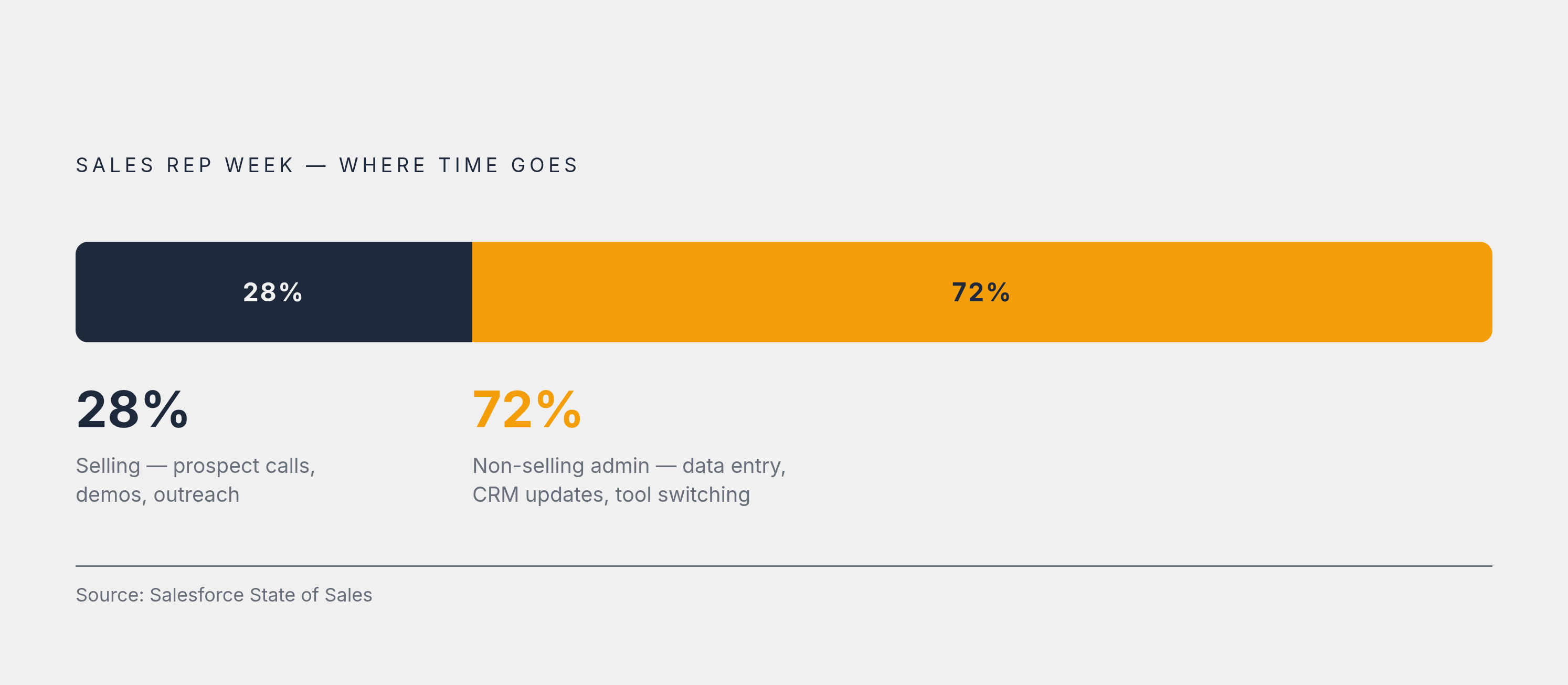
Reps sell about 28% of the week. The other 72% goes to data entry, tool switching, and updating fields nobody will ever read again. It's the sales version of hiring a chef and watching him spend the shift on dish duty.
Automation goes straight at that gap. Sellerant found automation tools reclaim 4 to 6 hours a week per rep, hours that go straight back into selling instead of into a CRM field. Bain's 2025 research found early AI deployments in sales lifted win rates by 30%, which is the number in this whole piece worth actually stopping on.
Adoption isn't waiting around for stragglers. AI use among sales reps jumped from 24% in 2023 to 43% in 2024, per HubSpot's State of AI in Sales report, nearly doubling in a year. Gartner found sellers who partner well with AI are 3.7 times more likely to hit quota than the ones who treat it like a novelty.
Where does the automation actually belong? A handful of categories carry the weight:
CRM automation. 94% of businesses report measurable productivity gains after rollout, mostly from killing manual logging.
Lead scoring. AI-driven scoring improves qualification accuracy by 40%, so reps chase fewer ghosts.
Conversation intelligence. 88% of sales teams use it now, so nobody's stuck trying to remember what a prospect said three calls ago.
Conversational AI and chatbots. They handle inbound qualification, so a rep only picks up the phone once someone's already warm.
61% of overperforming teams use automation, versus 46% of underperformers. That gap isn't closing, it's widening.
Here's the counterpoint, because there's always one waiting in the wings. The average rep juggles at least 6 tools already, and when those tools don't talk to each other, admin busywork just gets traded for tab-switching busywork. Reps buried under too many tools are 45% less likely to hit quota. MIT found in 2025 that 95% of organizations saw zero measurable bottom-line impact from AI spending, mostly because they bought the tool with the best demo instead of the one that actually fit how the team worked. Consolidate before you buy anything new. Judge a tool by whether it removes a step from someone's day, weighing that against how good it looked in the pitch (and yes, the irony of getting sold a bad sales tool by a great sales pitch is not lost on anyone who's lived through it).
Existing Customers as Pipeline
Acquiring a new customer costs roughly 5 times more than keeping one you already have. Selling to an existing customer closes 60 to 70% of the time, a number cold prospects can only dream about. Put those together and the recovered rep time from the last section has an obvious home: the CRM you already own.
Upselling and cross-selling are the mechanism. McKinsey found cross-selling lifts sales by roughly a fifth and profits by roughly a third. In SaaS, upsells convert at a notably higher rate than cold outreach, a number worth stapling to your forecast and checking against quarterly.
There's a catch. the vast majority of customers ignore a cross-sell offer that doesn't fit their actual situation, which means this is a targeting problem more than a volume one. Pitching more people rarely moves the needle on its own. Personalized recommendations beat generic ones by a wide margin, and AI-driven scoring paired with CRM history is what makes that relevance possible at scale instead of relying on a rep's gut. The discipline is knowing the accounts you have well enough to name what they need before they ask.
One more lever gets skipped constantly: pricing review. Plenty of teams run legacy pricing on existing customers forever instead of testing whether those customers would pay more for value that's already there but never got named out loud. Tiered packaging or value-based pricing often uncovers margin nobody priced in the first time, and it takes zero new logos to find it.
Coaching and Enablement
Enablement moves win rate. G2 found organizations with formal enablement programs hit a meaningfully higher win rate on forecasted deals than teams without one. The ROI on sales training averages 353%, meaning every dollar spent comes back as several times that amount in revenue. None of that needs a new hire. It just needs the reps you have closing more of what they already touch.
Here's the part nobody likes admitting: training doesn't stick on its own. Without reinforcement, about 70% of training content is forgotten within 24 hours, and most of what's left is gone within a week. That all-day workshop with the catered lunch and the trainer flown in from three states over? Mostly wasted, unless something ongoing follows it. What actually works is coaching folded into real deals, week after week, on a real cadence. Nearly 30% of sales professionals who get weekly coaching rank among the top achievers in their field. Consistency compounds where spectacle fades.
Content has its own quiet problem. 65% of company-produced content goes completely unused by sales teams, sitting in a folder somewhere nobody opens. Meanwhile 50% of all prospect engagement comes from just 10% of enablement content, and 84% of sales executives name content search and utilization as their top productivity fix. Find the 10% that actually works and put it where reps already live (inside the CRM, inside the deal), rather than producing more material destined for the shared drive graveyard.
There's a bonus that compounds later, too. Strong enablement cuts onboarding time, so whenever you do finally make that hire, they ramp faster. Enablement sharpens the team you already have, and it makes the eventual hire worth what you paid for them.
Untapped Pipeline in Your CRM
74% of U.S. businesses already use a CRM. Having one and actually using it well are two different things, sort of like owning a treadmill and letting it hold your laundry. After meaningful CRM implementation, businesses report a 29% average increase in sales revenue and a 34% boost in productivity. That gain comes from using what's already sitting there, no new software required.
A CRM run well surfaces things that would otherwise stay buried: deals gone quiet because a follow-up never happened, a proposal sitting unanswered for three weeks while everyone assumed someone else had it covered, purchase history that makes upsell timing obvious instead of a guessing game, and rep activity that shows which habits actually correlate with closed revenue instead of just looking busy on a dashboard.
CRM data is also the floor everything else in this piece stands on. That 40% lift in lead scoring accuracy only holds if the underlying data is clean. Feed a scoring model garbage and it automates the guesswork faster, just with more confidence behind it. CRM hygiene isn't a housekeeping chore for the admin team; it's the precondition every other lever here depends on.
The habits that make it pay off aren't complicated: regular pipeline reviews built on actual CRM data, stages with real exit criteria instead of "it's basically qualified," and reps held to keeping records complete. None of it is glamorous. All of it separates a CRM that runs the business from one that's just an expensive filing cabinet.
Sequencing These Levers
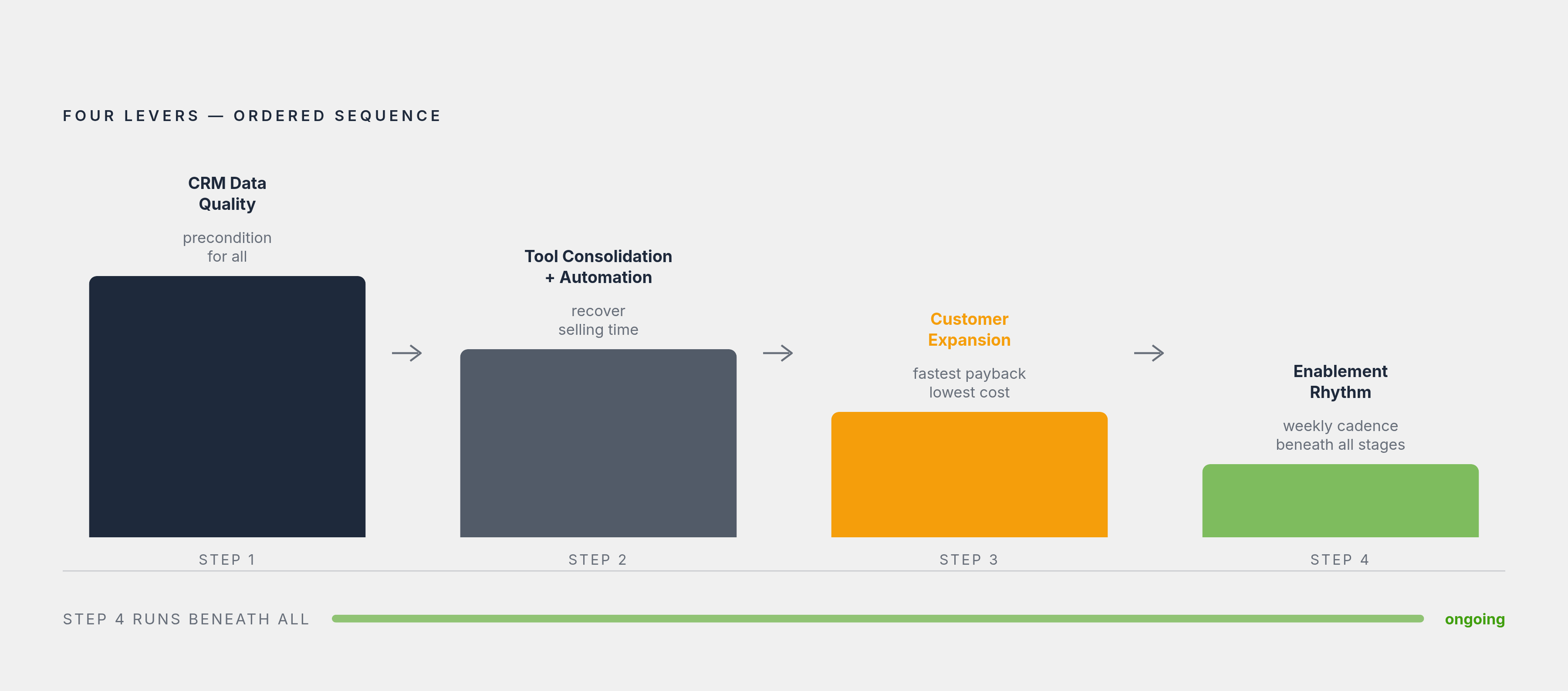
Rolling out automation, expansion, enablement, and CRM discipline all at once is the most common way teams waste this list. It splits attention four ways and rebuilds the tool sprawl problem from section one.
Start with CRM data quality. It's the precondition for lead scoring, AI tooling, and any real visibility into expansion opportunities, so nothing else works without it. Consolidate the tools already in the stack before buying anything new, recover the time first, then decide where it goes. Once that's done, point the recovered time at customer expansion, since it's got the fastest payback and the lowest cost of anything on this list. Enablement runs underneath the whole thing, not as a phase you finish but as a weekly rhythm tied to real deals.
Four numbers tell you whether it's working: selling time as a share of total rep time (28 to 30% is the floor to clear), win rate on forecasted deals (the number enablement moves directly), expansion revenue as a share of total revenue (this tells you if existing accounts are being worked or just quietly maintained), and revenue per rep, which ties the other three together without a single new req.
Hiring makes sense once your existing reps are consistently hitting quota, selling time is recovered, and expansion revenue inside current accounts is already tapped out. At that point a new hire adds capacity to something that already works. Hire before that and you're just handing another person a broken process and hoping enthusiasm makes up the difference. These four levers don't replace growing the team forever; they just make sure the next hire is worth what you're paying them.