Sales Tools in Marketing and Revenue Operations Alignment
Shared data structures, not trust falls, actually close the gap between marketing and sales.
Marketing and sales alignment is often framed as a culture problem, but the mechanics tell a different story. Companies keep sending their teams to trust-building offsites when the real fix is making sure lead status in the CRM matches pipeline stage in the sales engagement platform. Here's the thing nobody wants to admit: shared values help, but alignment ultimately tracks shared data. This post digs into the actual tools and structures that determine whether marketing and sales operate as one revenue engine or two separate teams arguing over whose numbers are right. We'll move through the cost of misalignment, the rise of RevOps as an organizational response, the paradox of tool sprawl, and then the specific platforms, CRMs, sales engagement tools, enablement platforms, and conversation intelligence, that either close the gap or quietly widen it depending on how they're wired together.
What misalignment actually costs companies
Misalignment between sales and marketing costs businesses an estimated $1 trillion a year, and that's not a typo, nor is it a rounding error dressed up to scare a boardroom. It's the going rate for two teams working off different spreadsheets and calling it a strategy.
Only about 8% of companies report strong alignment, which means that trillion-dollar tax gets spread across almost everybody, not just a handful of unlucky laggards. If you're reading this thinking "not us," the math says otherwise.
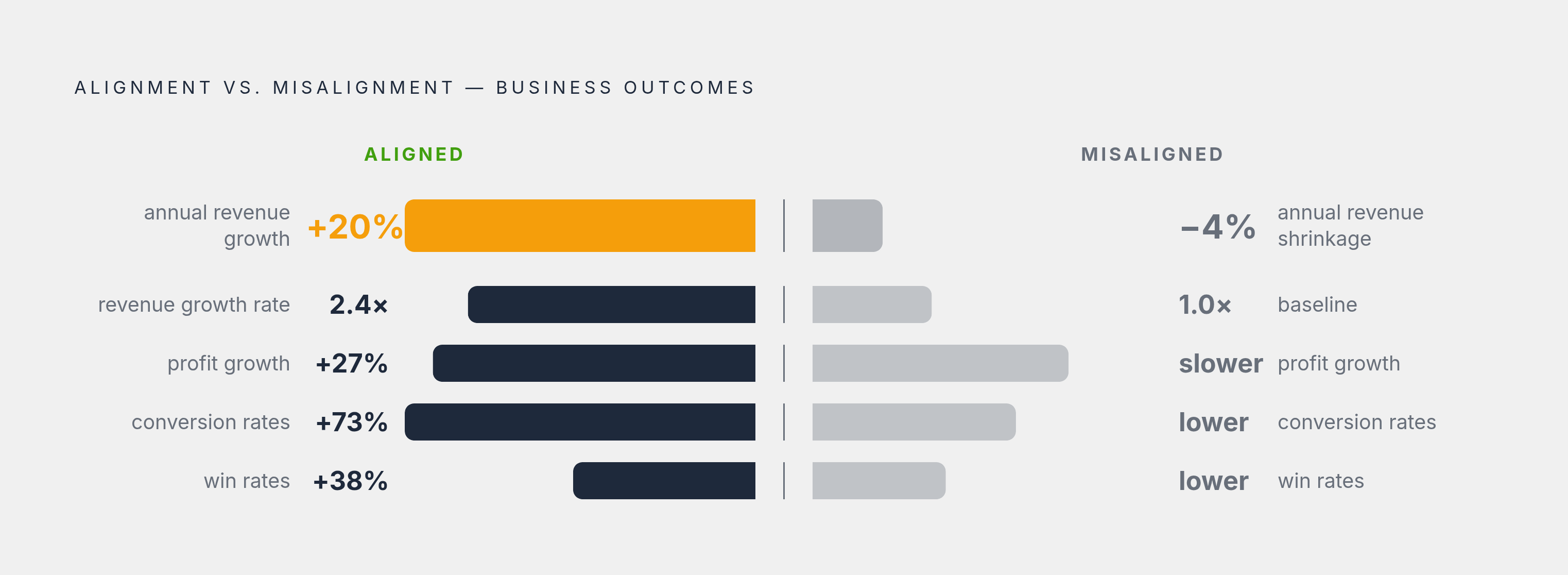
Flip it around and the case gets even more interesting. Forrester found aligned organizations post 2.4 times higher revenue growth and double the profitability growth of their misaligned peers. HubSpot's numbers tell a similar story: 24% faster three-year revenue growth, 27% faster profit growth, a 38% bump in win rates. When marketing content actually maps to where the buyer is in their journey, sales cycles shrink by 30% and conversion rates jump 73%.
Here's the part that should worry you more than the trillion-dollar headline: aligned companies grow 20% a year, while misaligned ones see revenue shrink 4%. Alignment adds real, compounding value over time, while misalignment actively rots the business from the inside, like termites with quarterly targets.
None of these numbers tell you how to fix it, though, since they only tell you the size of the bill. For the mechanism, you have to look at how companies started restructuring around the problem.
How RevOps closed the alignment gap
RevOps went from a scrappy side function to a full-blown department because organizations got tired of throwing meetings at a data problem. In 2023, 48% of B2B companies with 50 or more employees had a dedicated RevOps function. By 2025, that number hit 65%. The VP of Revenue Operations title grew 300% in eighteen months, which is the kind of growth curve normally reserved for meme stocks and viral dance trends.
Adoption isn't even, though. Enterprise companies sit at 84% adoption, midmarket at 52%, small business at 21%. That gap explains a lot of the alignment complaints you hear from smaller companies: they're feeling the pain without having built the structural answer to it yet.
What does RevOps actually do? It puts sales, marketing, and customer success under one roof with shared metrics and one person (or team) accountable for the handoffs where things usually fall apart, like lead qualification and revenue attribution. It converts alignment from a value on a poster into a workflow someone actually owns.
Forrester found that companies aligning people, process, and technology across revenue teams saw 36% more revenue growth and up to 28% more profitability. The market noticed. Global RevOps spend was valued at $4.39 billion in 2024 and is projected to hit $16.98 billion by 2033, growing at a 16.6% annual clip. North America holds a third of that market, concentrated exactly where B2B sales cycles are long enough and complicated enough that coordination failures actually show up on a P&L.
But here's the catch, and it's an important one: RevOps is a structure, and structures still depend on what fills them. Stand up a RevOps team and hand them the same disconnected tools everyone else was using, and you've just built a nicer org chart around the same broken plumbing.
Why more tools break alignment faster
Bain surveyed more than a thousand senior commercial executives across 18 industries in 2025 and found something that should make every VP of Sales wince. A large majority claim to run structured, repeatable sales and marketing plays. But most don't actually integrate those plays into their technology stack. Do the subtraction and you get roughly 20% of companies actually getting full value out of what they've bought.
Sales reps aren't short on tools; they're drowning in them. Most reps juggle a stack of platforms every day, and a majority report feeling overwhelmed rather than underequipped. Productiv's 2025 research found companies running large SaaS portfolios with a big chunk of licenses sitting unused or barely touched, like gym memberships nobody cancels out of guilt.
Something shifted around 2023: average SaaS portfolios started shrinking as companies got serious about pruning the dead weight. Stack rationalization become an actual line item on the strategic plan, and a large majority of sales orgs now say they're consolidating tools in 2024 and 2025.
Why does sprawl kill alignment specifically? Every disconnected tool builds its own little universe of data, so lead status over here doesn't match pipeline stage over there. Marketing trusts one source of truth, sales trusts another, and RevOps spends its days playing translator instead of actually improving anything. Worse, handoff failures go invisible: no dashboard shows you exactly where a prospect fell out of the funnel or whose definition of "qualified" got applied at the moment it mattered.
The count of tools matters less than whether the tools you already have talk to each other.
CRM as the real alignment layer
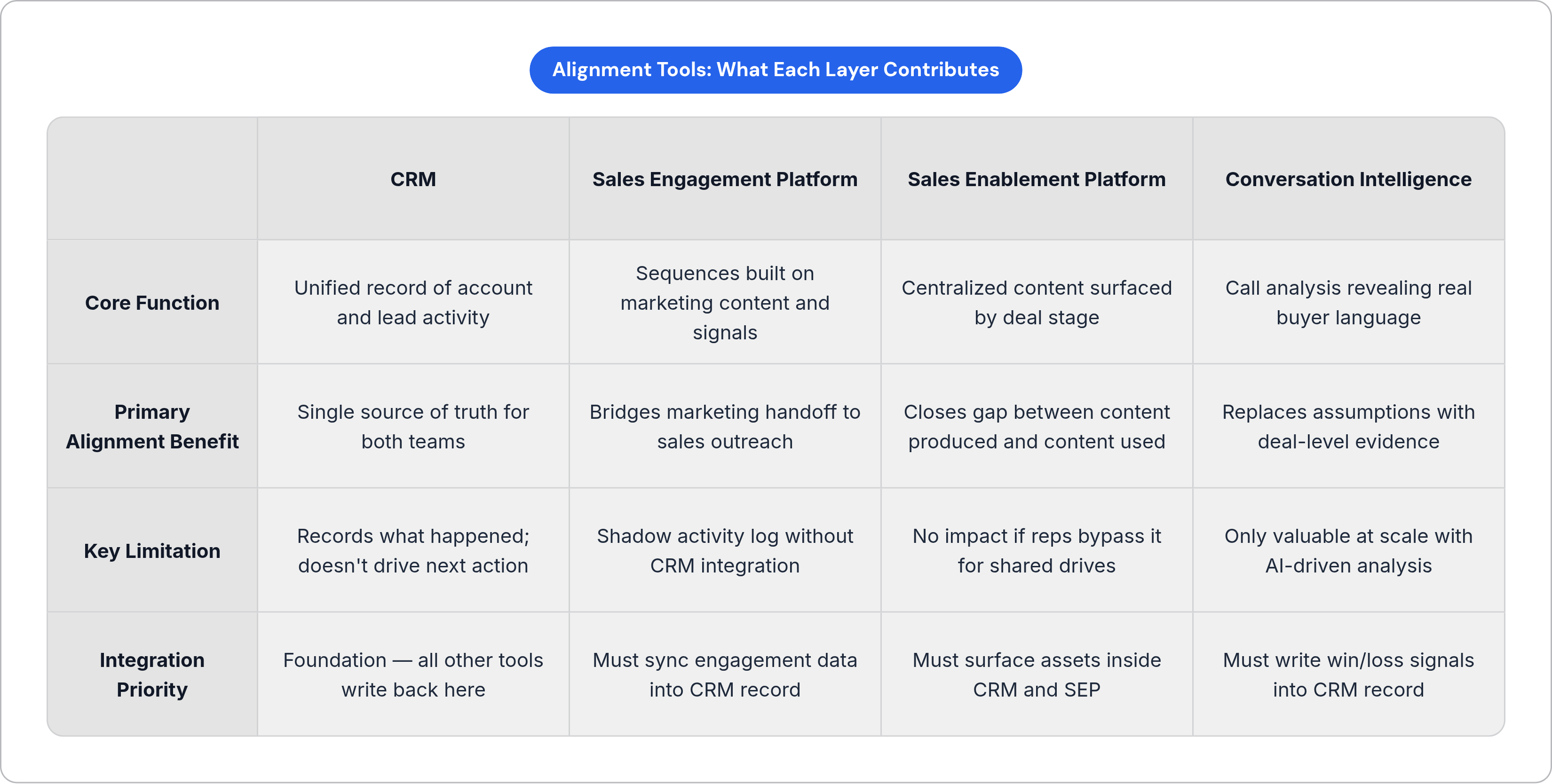
The CRM is where most alignment conversations start, and for good reason: 78% of salespeople say their CRM genuinely helps sales and marketing work together, according to HubSpot's 2025 data. That's a strong vote of confidence for a tool that used to just be a fancy Rolodex.
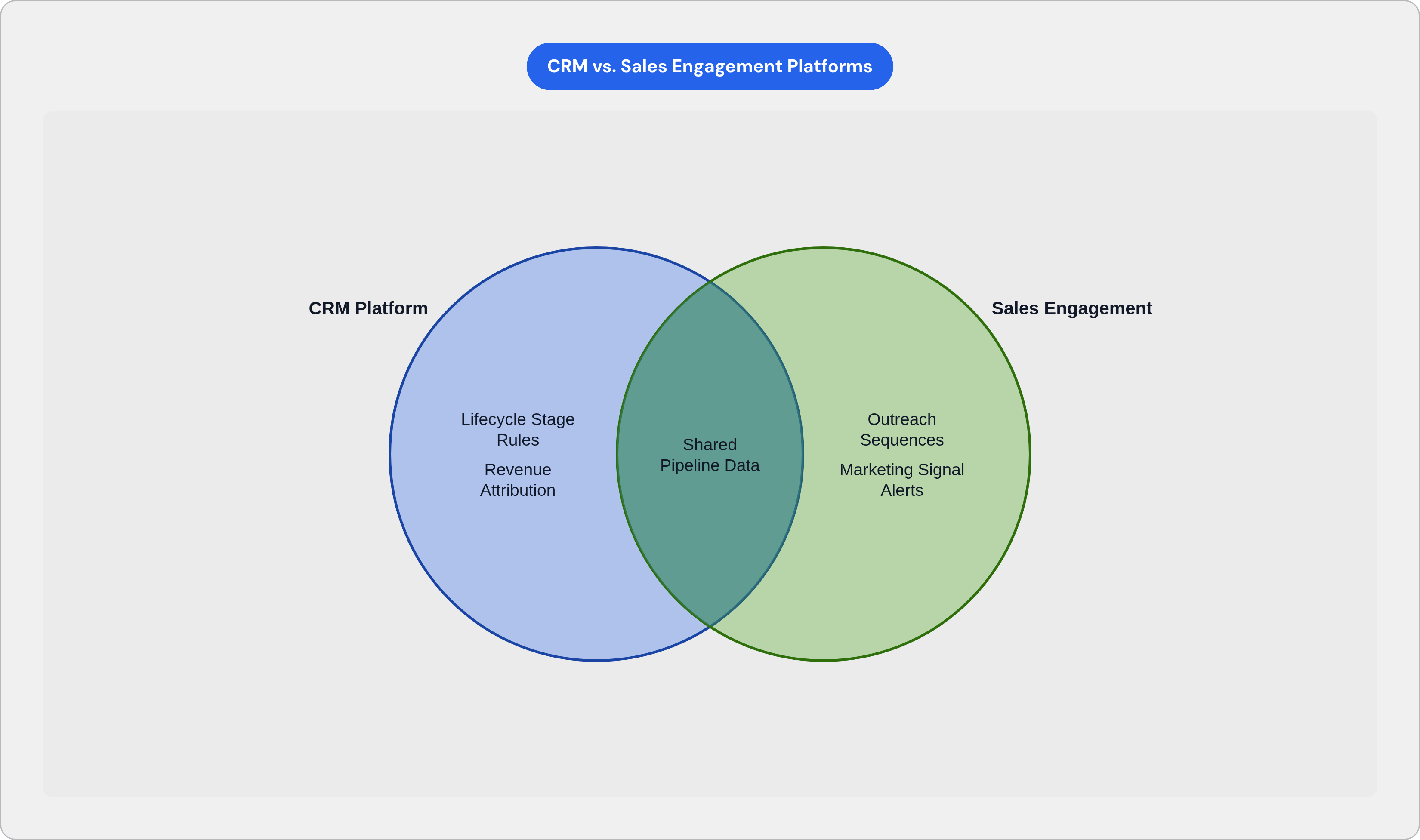
A CRM that's actually doing its job unifies three things. First, one contact and account record that both teams read from and write to, so you stop having marketing's lead count disagree with sales' lead count in the same weekly meeting. Second, lifecycle stage rules enforced in the data itself, not just written down in a playbook nobody reads twice, so a lead can't magically become an SQL because a rep is having a good day. Third, revenue attribution that traces a closed deal backward through every marketing touch, finally answering the question that starts most sales-marketing arguments: what actually generated this deal?
Cloud-based CRMs now make up roughly 80% of all CRM deployments, which matters because it means real-time access across scattered teams isn't some premium add-on anymore; it's just how the tool works.
Where the CRM runs out of road: it's great at recording what happened, but it doesn't tell anyone what to do next. Campaigns, sequences, and content delivery still live outside the CRM at most companies, which means data gets re-entered, and every re-entry point is a chance for two systems to disagree with each other. Without other tools layered on top, a CRM functions mainly as a shared filing cabinet, a nice one, sure, but a filing cabinet doesn't run a workflow.
Salesforce and HubSpot have both pushed past pure CRM into broader revenue platform territory, picking up functions that used to require a separate vendor and a separate login.
Sales engagement bridges marketing intent to execution
Here's a scenario that plays out at nearly every B2B company: marketing qualifies a lead, hands it to sales, and then goes completely dark on what happens next. The rep improvises an outreach sequence, ignores whatever nurture context the lead already got, and marketing has no idea what its own lead actually experienced. That gap is exactly what sales engagement platforms exist to close.
Done right, an SEP builds outreach sequences on marketing's actual content and messaging, so the prospect isn't getting whiplash between the campaign they signed up for and the cold email that shows up three days later. Engagement data, opens, replies, call outcomes, flows back into the shared CRM record, so marketing can actually see how its leads behave once they're in a rep's hands. Alerts tied to marketing signals mean a prospect who suddenly re-reads a case study gets surfaced to the rep immediately, not at next Tuesday's pipeline review.
Outreach, Salesloft, Apollo.io, HubSpot Sales Hub, and LinkedIn Sales Navigator all play in this space, each with varying degrees of CRM integration. That integration depth, more than the feature list, is what separates a tool that helps alignment from one that just adds another tab to keep open.
The sales engagement software market reached several billion dollars in 2024, and AI-driven engagement tools are among the fastest-growing pieces of it; a large majority of organizations expect to adopt AI-enabled SEPs by 2026. Fair warning though: an SEP running without CRM integration creates a shadow activity record. Reps log their best calls and quietly skip the rest, so marketing's attribution model inherits every one of those gaps without ever knowing it.
Enablement fixes where content alignment breaks
Marketing produces a mountain of content every quarter, and most of it never gets touched by sales. Reps often can't find the right asset, don't know when to use it, or don't trust it reflects what the product actually does this month. That's a content problem wearing an alignment costume.
Enablement platforms fix the structural issue underneath it. A centralized content repository that actually understands context, rather than a shared drive with 400 loosely-named PDFs, surfaces the right asset for the right stage of the right deal. Usage analytics flow back to marketing, showing which pieces get used, which get ignored, and which ones correlate with deals that actually close. Playbooks encode the agreed-upon story: what the product does, how it stacks up against competitors, and how to handle the objections that come up every single week.
The alignment payoff shows up directly in the numbers. A majority of companies with a defined sales enablement function report good alignment between sales and marketing, versus a much smaller share without one. Companies with mature enablement programs post a notably high win rate on forecasted deals, which is the kind of number that gets a CFO to stop asking why marketing needs another tool.
The category has grown up fast. Gartner released its first Magic Quadrant for Revenue Enablement Platforms in late 2025, and forecasts that more than 70% of B2B companies will use a dedicated sales enablement platform by the end of 2025, up from just 34% in 2021. Highspot, Seismic, Showpad, and Allego are the names you'll hear most. When picking between them, the deciding factor should be CRM integration and the quality of the usage analytics, not how many content formats the vendor's demo can juggle.
Conversation intelligence closes the feedback loop
Marketing builds campaigns based on assumptions about what buyers care about, while sales actually has those conversations. The gap between what marketing thinks buyers say and what buyers actually say on the call is where messaging quietly drifts off course, usually without anyone noticing until pipeline numbers look weird a quarter later.
Conversation intelligence platforms record, transcribe, and analyze sales calls, and you can search them for competitor mentions, objection patterns, pricing pushback, feature requests. Marketing gets to hear actual buyer language instead of a rep's summary, which, let's be honest, is often filtered through whatever the rep thinks leadership wants to hear. Win and loss patterns surface at the deal level, showing which messaging landed and which competitive claim caused a prospect to go quiet for two weeks.
Pipeline analytics add the numbers side of the same story: conversion rates at each funnel stage, time spent in each stage, revenue attribution split across channels. It turns the handoff from a diagram on a slide into something you can actually point at and measure.
Gong is the name most people reach for here, alongside Chorus (now part of ZoomInfo) and Clari for pipeline analytics. The real shift these tools enable is that marketing gains deal-level evidence for what messaging works, replacing arguments made from intuition, and sales gains recorded examples of what actually wins, replacing improvisation. AI-driven analysis of call data is one of the fastest-growing pieces of this whole market, since finding patterns across thousands of calls by hand was never realistic for a human team anyway.
Integration architecture makes the stack work
Bain's finding is worth repeating here because it's the whole point: 70% of companies don't integrate their sales plays into their tech stack. Tool selection was rarely the bottleneck; the real issue is that none of them were told to talk to each other.
A properly integrated stack has a clear shape. The CRM sits as the single system of record, with every other tool reading from it and writing back to it. The SEP pulls lead context from the CRM and pushes engagement activity right back in, so a rep's actions are visible to marketing without anyone filing a report request. The enablement platform surfaces content recommendations inside the CRM and the SEP directly, so reps aren't logging into a fourth portal just to find a case study. Conversation intelligence and pipeline analytics write deal-level signals, win and loss reasons, call themes, stage velocity, back into that same record, sitting right next to the campaign attribution marketing already trusts.
Integration alone doesn't solve everything, though. Even a perfectly wired stack still needs both teams to agree on what "qualified" means and what counts as a stage change, because software can sync data all day long; it can't sync definitions for you. That last piece is still a conversation, not a config setting, but it's a much shorter conversation to have when the data in front of both teams is finally the same data.