Lead Qualification Methods for B2B Sales Teams (Part 1)
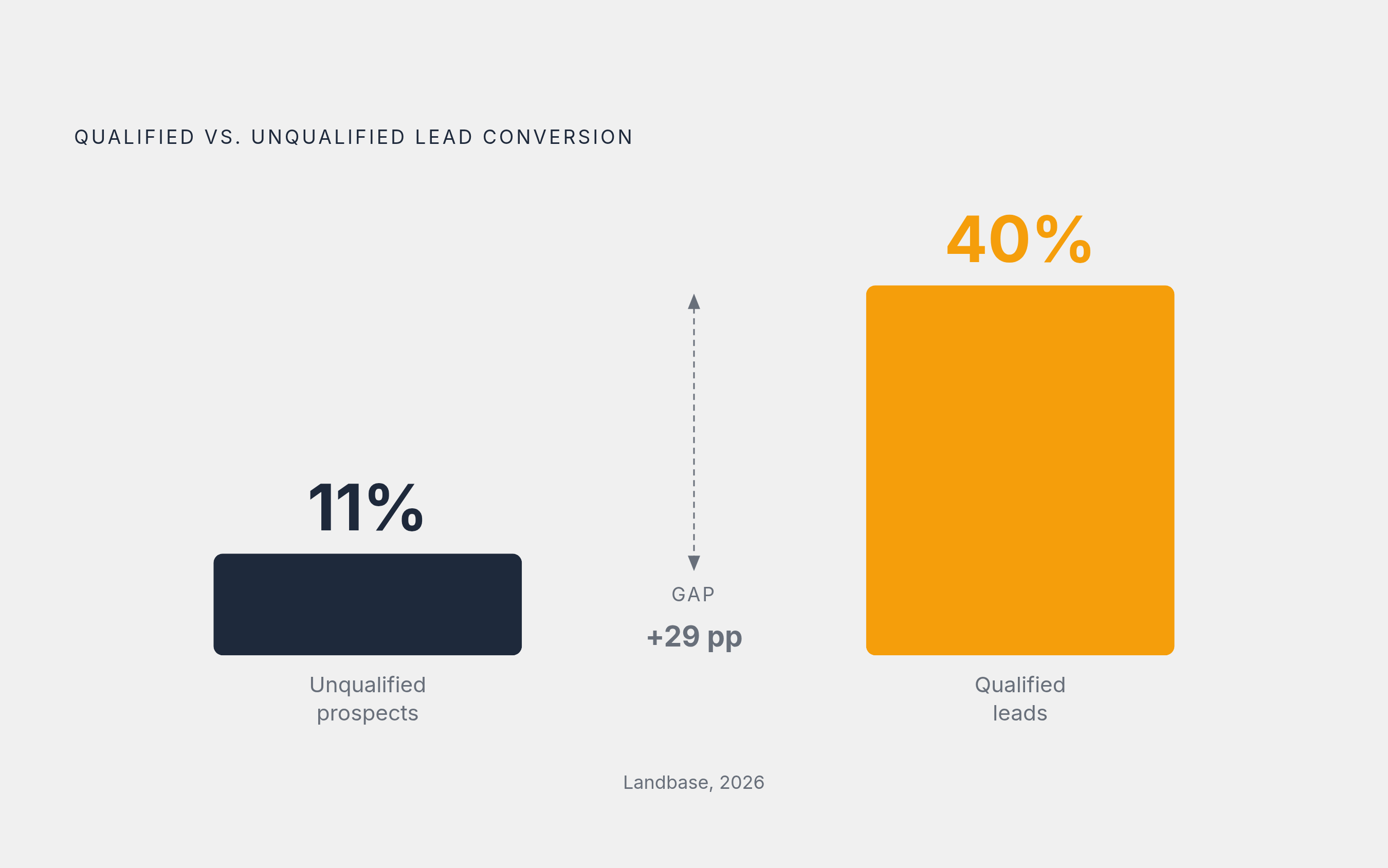
Qualified leads convert at 40%, unqualified ones at 11%—here's how to tell the difference.
Most sales teams don't lose because they can't find leads. They lose because they spend real time, real energy, and real rep capacity on leads that were never going to buy. That's the central failure mode in B2B sales, and it's quiet enough to go unnoticed until the quarter is already gone. The fix isn't more leads; it's better qualification. Think of an unqualified pipeline like a fishing net full of holes — you can haul it up all day, but you're not keeping much. Research from Landbase in 2026 puts the gap plainly: properly qualified leads convert at around 40%, while unqualified prospects convert at roughly 11%. That delta isn't marginal; it's the difference between a productive pipeline and a very busy one that fails to close.
The cost of working the wrong leads compounds fast. Reps run out of capacity to go deep on deals that actually matter. Unfit deals linger and stretch cycles. Forecasts get noisy because deals that should have been cut are still sitting in the pipeline taking up column space. Qualification isn't a gate that keeps people out; it's a repeatable judgment call that separates signal from noise before the effort snowballs.
The Four Types of Qualified Leads (and Why They Are Not All the Same)
Before you pick a qualification framework, you need to know what kind of lead you're actually dealing with. There are four types, and each one earns a different response.
MQL (Marketing Qualified Lead). An MQL is engagement-based. Marketing surfaced it. Maybe they downloaded an ebook, attended a webinar, or hit a certain page-view threshold. No direct sales contact has happened yet. The MQL label means marketing thinks this person is worth a conversation. It does not mean they're ready to buy.
SQL (Sales Qualified Lead). An SQL has shown actual buying signals. Demo requests, pricing page visits, detailed product inquiries. A rep has typically touched this lead and confirmed there's something real here. The shift from MQL to SQL is where a lot of teams bleed leads, because the MQL label alone is not a qualification. Only a small fraction of MQLs in B2B SaaS actually progress to sales-qualified opportunities — that gap is worth sitting with.
PQL (Product Qualified Lead). This one's underused and underrated, especially in SaaS. A PQL has already experienced value inside the product. Feature activations, usage thresholds crossed, workflows completed. This is qualification evidence that bypasses the whole self-reported-need problem. When someone has used the product and hit a meaningful moment, that's a stronger signal than most content engagement.
Buying Group or Account-Level Lead. Forrester's revenue-waterfall model shifted how mature teams think about this. Qualification now tracks the committee, not just one contact's form fills. An account-level lead is a signal that an entire buying group at a company is showing intent, even if only one person has surfaced in your CRM. Treating a single contact's engagement as a pipeline signal while ignoring the rest of the account is how teams get surprised late in deals.
The distinctions matter operationally. Each type warrants a different qualification motion. Once you know what you're dealing with, you can pick the right method to evaluate it.
BANT: What It Does Well and Where It Breaks Down in Modern Buying
BANT has been around long enough to have grandchildren. IBM developed it. Budget, Authority, Need, Timeline. It's still widely deployed, and for certain scenarios, it still earns its place.
BANT genuinely works when:
Sales cycles are short and budget owners are clear
You're running high-volume environments where reps need a fast filter
Deals are transactional, roughly in the low thousands of dollars, with one or two decision-makers involved
The problems show up when you take BANT into more complex territory. Leading with budget means you'll disqualify leads where need is real but budget hasn't been formally allocated yet. In enterprise deals, budget often gets created during the sales process. You can't ask for money that doesn't exist yet and then walk away because they lack it. The framework punishes legitimate opportunities for being at the wrong stage of their internal buying journey.
The Authority question is not binary. Modern buying involves committees. And Timeline is the one reps often manufacture when they need to fill pipeline. A prospect says "Q3" because it sounds reasonable, not because Q3 is real. It's a compliance answer, not a true signal. BANT is less a qualification framework and more a qualification costume — it looks the part, but underneath, it's not always dressed for the occasion.
BANT's best role today is top-of-funnel screening. Fast pass/fail. Not deep opportunity qualification.
Two variants worth knowing:
ANUM flips the sequence: Authority first, then Need, Urgency, Money. Useful when getting to a decision-maker is the actual bottleneck.
FAINT adds Interest into the mix: Funds, Authority, Interest, Need, Timing. Useful for cold outreach where prospects have no product awareness yet and you need to gauge whether curiosity exists before anything else.
CHAMP and SPIN: Qualification Methods That Lead With the Buyer's Problem
Here's the philosophical shift these frameworks make: instead of interrogating the buyer, they help the buyer think.
CHAMP stands for Challenges, Authority, Money, Prioritization. Notice what leads. Not budget. Challenge. Surfacing the prospect's pain before asking about resources is just good sales instincts codified into a framework. For consultative motions, it earns the right to talk about money instead of demanding it upfront. Prioritization is also a better question than Timeline. "Where does this initiative sit relative to everything else your team is working on?" tells you more than "when are you hoping to buy?"
For consultative SDR motions, CHAMP on cold-call qualification outperforms BANT by a meaningful margin. When you lead with empathy for the prospect's problem, you get more honest answers.
SPIN Selling is less of a checklist and more of a questioning methodology. Situation, Problem, Implication, Need-Payoff. Reps move through four question types to help the prospect articulate the size and consequence of their own problem.
The engine is the Implication question. Implication questions expand latent dissatisfaction into felt urgency, without the rep having to assert it. Instead of saying "this is a big problem," the rep asks questions that lead the prospect to say it themselves. That's a very different dynamic. Need-Payoff questions then let the prospect describe the value of a solution in their own language, which sets up proposal conversations better than any deck you'll ever build.
SPIN works best in mid-funnel discovery where the rep has time to go deep.
SPICED is a faster variant for SMB or shorter-cycle contexts: Situation, Pain, Impact, Critical Event, Decision. It streamlines discovery for deals where you don't have the runway for full SPIN depth. Still surfaces the right information. Just more efficiently.
MEDDIC and MEDDPICC: How Enterprise Deals Actually Get Qualified
MEDDIC was developed at PTC in the 1990s for high-stakes enterprise sales. It's the framework the market has largely converged on for complex deals, and with good reason. When you apply it consistently, enterprise close rates improve significantly. That's not a claim about the acronym; that's the outcome of actually doing the work each element demands.
The six original elements:
Metrics. What's the quantifiable impact the solution delivers? Without this, a Champion can't make the case internally. "It will help" is not a business case.
Economic Buyer. Who actually controls the budget and can say yes without getting approval from someone else? Not the champion. Not the project lead. The person who can sign.
Decision Criteria. The specific factors the buying group uses to evaluate options. If you know these, you can shape how your solution is scored. If you don't, you're guessing.
Decision Process. How the purchase actually moves through approvals, legal, and procurement. This is often where deals die. Not the evaluation. The process after.
Identify Pain. The business problem with enough urgency to justify change. "It would be nice to fix" doesn't move budgets. Real pain does.
Champion. An internal advocate who will sell for you when you're not in the room. This is the most underweighted element in the entire framework. Without a champion, you have a contact. You don't have a deal.
MEDDPICC extends the original with two additions:
Paper Process. Procurement, legal, and security review steps. In many enterprise deals, this is the actual timeline driver, not the evaluation.
Competition. Other solutions being evaluated, including the "do nothing" option. That last one gets ignored too often.
The structural difference between MEDDIC and most other frameworks is that MEDDIC treats qualification as continuous throughout the deal lifecycle. You don't qualify once at entry and call it done. Each stage of the deal can confirm or invalidate earlier answers. That's what makes it the right tool for complex sales.
One honest note: MEDDIC is not the right tool for every deal. Inside sales reps running high volumes of smaller transactions can't run full MEDDIC on every conversation. Framework depth has to match deal complexity.
GPCTBA/C&I: When Goals Have to Come Before Budget
HubSpot developed this one, and the acronym is as long as the sales cycle it was built for. Goals, Plans, Challenges, Timeline, Budget, Authority, plus Consequences and Implications.
The premise is that for complex solution sales, the rep's job is to align with the prospect's long-term business direction, not just fit the product to a stated need. Goals come before budget. Understanding what the prospect is actually trying to accomplish, and what their current plan is to get there, creates context that makes everything else more honest.
The Consequences and Implications layer is what separates this framework from the others. It explicitly asks: what happens if the prospect does nothing? What happens if they choose wrong? Those questions surface stakes that BANT and CHAMP leave implicit. They're also the questions that create real urgency instead of manufactured urgency.
Best fits for GPCTBA/C&I:
Professional services and custom implementations where scope depends on understanding the customer's goals deeply
Deals where the prospect hasn't fully articulated what success looks like yet
The tradeoff is time. This framework is not a cold-call tool. It requires a relationship surface to run well. It's most effective when a deal has already passed initial screening and genuinely warrants a thorough discovery investment.