Qualified Sales Leads Criteria and Scoring Frameworks
How to build a qualification framework that stops deals from dying weeks before close.
Most sales losses don't happen at the close. They happen weeks earlier, when a rep picks up a lead that was never actually qualified. The fix is a shared definition of what "qualified" means, a framework for getting there, and a scoring system both marketing and sales can use without relitigating it every quarter.
There are four lead types you'll hear about in any modern sales org. They're not just labels. Each one represents a different level of confidence, and knowing which type you're holding tells you what to do next.
MQL (Marketing Qualified Lead). Marketing has scored this lead based on behavioral or demographic signals and declared it ready for sales attention. Classic example: someone downloads a whitepaper and their company profile matches your target market. The catch is that a huge share of MQLs never result in revenue, because the criteria used to define them are often too loose. MQL quality is entirely a function of how precisely you drew the lines in the first place.
SAL (Sales Accepted Lead). This sits between MQL and SQL. Sales has formally reviewed the lead and agreed it's worth pursuing before any actual qualification conversation happens. Smaller teams often skip this stage. That's a mistake. A low SAL rate is diagnostic. It tells you that marketing's definition of a qualified lead and sales's definition are misaligned. That gap is worth surfacing, even when it's uncomfortable.
SQL (Sales Qualified Lead). A rep has made contact, confirmed genuine need, and verified real decision-making authority. The jump from MQL to SQL is about readiness, not just fit. Teams that use behavioral qualification models convert MQLs to SQLs at much higher rates than average.
PQL (Product Qualified Lead). This one operates differently from the others. Intent is expressed through product behavior, not marketing content. Someone using your product in a way that signals they're ready to pay, or to expand, is a PQL. This is primarily relevant for product-led growth companies running a freemium or trial motion. PQL-to-paid conversion outperforms MQL-to-close because the signal is behavioral. The lead is showing you they're ready through their actions, not just their job title.
The practical point: the lead type you're holding is a decision map. It tells you which qualification action comes next. Treat the taxonomy as operational, not theoretical.
Why the Ideal Customer Profile Is the Prerequisite to Any Qualification Criteria
No qualification framework works if your team can't clearly describe who they're qualifying toward. That description is your Ideal Customer Profile. It comes before everything else. Building a qualification framework without a documented ICP is like installing a lock before you've decided what's worth protecting.
A well-built ICP captures a few specific categories:
- Firmographic attributes. Industry, company size, revenue range, geography, growth stage, funding status. These describe the fundamental shape of the company.
- Technographic signals. What tools is the prospect already running? Their CRM, their marketing automation platform, their cloud provider. This signals both readiness and stack compatibility.
- Behavioral indicators. Hiring patterns, recent funding, expansion signals. Proxy measures for growth and urgency.
- Pain-based criteria. The specific problems your product actually solves. The broad category it competes in matters less. The actual problems matter most.
Companies with clearly documented ICPs see higher win rates and shorter sales cycles. And yet a surprisingly large share of companies lack a formally documented ICP entirely. Qualification breaks down at this step before any framework is even applied. This is a foundation problem, and no amount of framework refinement will compensate for it.
A common approach is to bucket leads into three tiers: strong fit (pursue immediately), partial fit (qualify further), and poor fit (deprioritize or nurture at low touch). The ICP criteria define where each lead lands. Technographic fit deserves its own callout here, especially in B2B SaaS. A prospect already running a modern sales-engagement stack is a meaningfully stronger signal than one with no detectable tooling. Your ICP should capture this explicitly, not leave it to rep judgment.
One more thing: the ICP is not a one-time document you file somewhere and forget. Revisit it whenever your product changes, your target market shifts, or buyer behavior starts to look different from what you expected. Markets move. Your ICP should move with them.
The Main Qualification Frameworks and What Each One Is Actually Designed For
Six frameworks see wide use. Each one encodes a different set of priorities. None of them are universally correct. A framework is a tool, not a religion.
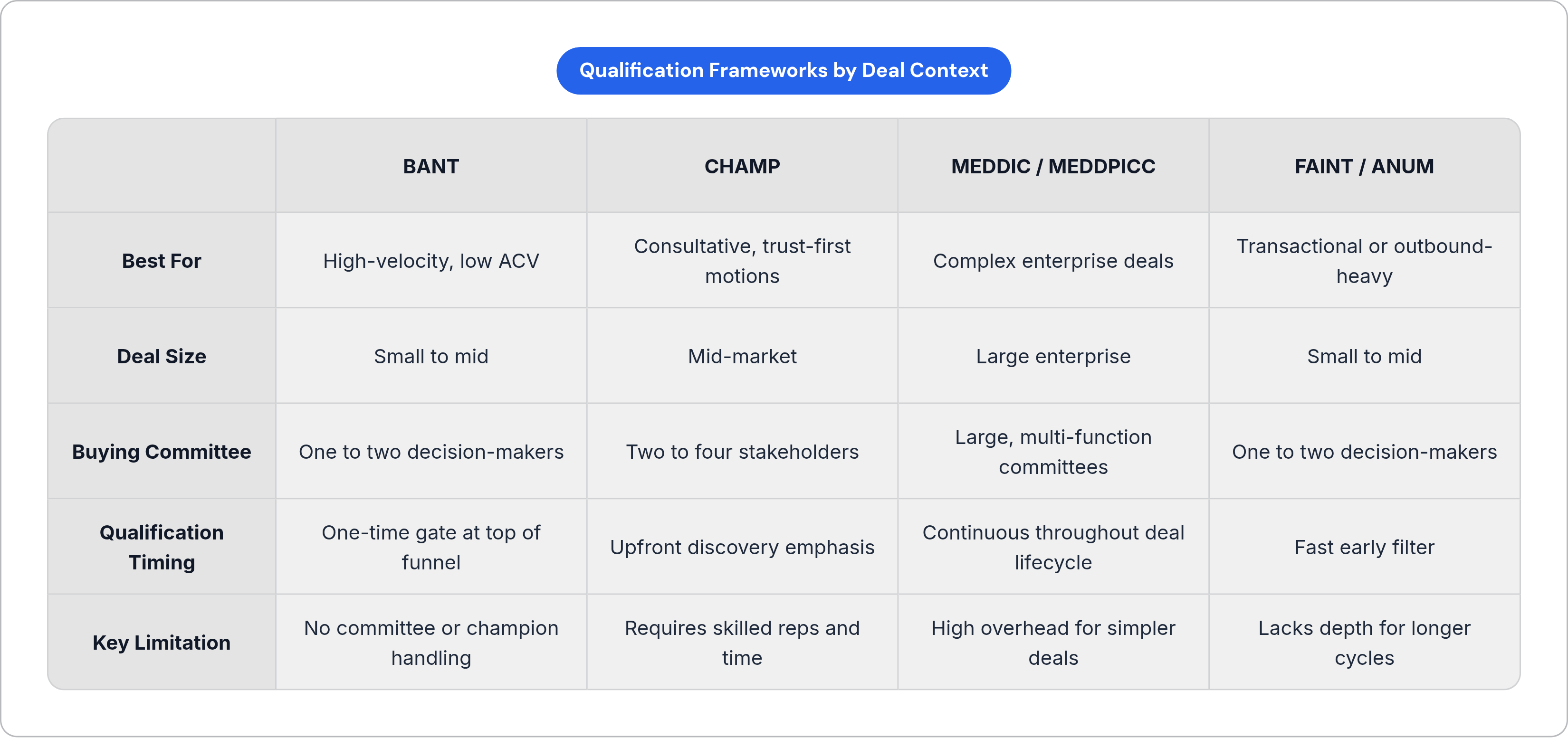
BANT (Budget, Authority, Need, Timeline). IBM developed this in the mid-twentieth century. It's one of the oldest structured qualification frameworks still in active use, which is either a testament to its durability or a commentary on how slowly sales evolves. Four questions: Does the prospect have budget? Is the contact a decision-maker? Is there a genuine need? Is there a defined timeline? Fast, simple, works well as a pass/fail filter at the SDR layer for high-velocity, smaller-deal-size environments. The core limitation is that BANT assumes one or two decision-makers. Modern B2B buying committees regularly involve far more than that, and BANT has no mechanism for handling that complexity. It also treats qualification as a one-time gate rather than an ongoing process, which creates problems the further you get into a deal.
MEDDIC / MEDDICC / MEDDPICC (Metrics, Economic Buyer, Decision Criteria, Decision Process, Identify Pain, Champion. Plus Competition and Paper Process in the extended versions). Built explicitly for complex enterprise deals. Long cycles, large buying committees, significant deal sizes. A key distinction from BANT is that MEDDIC treats qualification as continuous throughout the deal lifecycle, rather than a checkpoint at the top of the funnel. The Champion dimension is where most of MEDDIC's lift in enterprise deals actually comes from. You're identifying an internal advocate who will sell on your behalf when you're not in the room. BANT has nothing like this. MEDDPICC adds Competition (qualifying your rival's position in the deal early) and Paper Process (legal and procurement steps). In enterprise deals, those are often where things quietly fall apart in the final stretch.
CHAMP (Challenges, Authority, Money, Prioritization). Leads with the prospect's Challenge rather than their budget. More consultative and relationship-driven than BANT. Requires skilled reps and more discovery time upfront. Best for selling motions where building trust early matters more than speed.
GPCTBA/C&I (Goals, Plans, Challenges, Timeline, Budget, Authority, Consequences and Implications). Aligns the rep with the prospect's longer-term objectives, not just the immediate purchase decision. Best fit for B2B companies selling complex solutions where the buyer's strategic context determines whether the product will actually deliver value over time.
FAINT (Funds, Authority, Interest, Need, Timing) and ANUM (Authority, Need, Urgency, Money). Both are lighter-weight frameworks suited to transactional or outbound-heavy environments where speed matters more than depth. FAINT replaces Budget with Funds, which acknowledges that budget is not formally allocated yet but the capacity to pay exists. ANUM front-loads Authority on the premise that qualifying the decision-maker first prevents wasted conversations.
How to Choose the Right Framework Given Your Deal Size, Cycle Length, and Team Structure
The framework matters far less than the discipline of using it consistently. A well-applied simple framework will outperform a sophisticated one applied sporadically. Every time. Teams adopt MEDDPICC with great fanfare and then quietly revert to gut instinct because the overhead was too high for their actual deal motion. It happens more often than anyone admits. Pick something you'll actually use.
The primary variables that should drive your selection:
- Average deal size and contract value. Larger deals justify MEDDIC's depth. If your ACV is low, that overhead will cost you more than it saves.
- Sales cycle length. Longer cycles require ongoing qualification. A one-time gate at the top of the funnel doesn't hold.
- Number of stakeholders. Buying committees that span multiple functions break BANT. If your typical deal involves more than two or three decision-makers, you need a framework that accounts for that reality.
- Team structure. Whether you have an SDR/AE split or a single-rep model changes where and how the framework gets applied in practice.
A practical starting point by motion:
- High-velocity, lower ACV, one to two decision-makers: BANT or ANUM at the SDR layer as a fast filter.
- Mid-market, moderate ACV, four to eight month cycles: CHAMP at the SDR stage, MEDDIC at the AE discovery stage.
- Enterprise, large ACV, long cycles, complex buying committees: MEDDPICC throughout. The Champion and Competition dimensions should get active attention from the first discovery call, not just when a deal starts to stall.
The hybrid pattern most higher-ACV B2B SaaS organizations eventually land on: BANT for initial qualification and speed-to-response, then MEDDIC for deeper deal strategy on the opportunities that survive. It's not elegant. It works.
Two additions worth mentioning. First, SPIN Selling as a discovery complement. Pairing SPIN's questioning methodology with MEDDIC's structural qualification improves win rates because they operate at different layers and serve complementary purposes. Second, AI-assisted qualification is increasingly practical. Some teams now use tools that capture qualification signals from recorded conversations and auto-populate framework fields in the CRM. This reduces rep burden and improves data quality for scoring. Worth evaluating if your team is consistently logging incomplete data and you can't seem to fix it through coaching alone.
Review your frameworks formally at least twice a year, and definitely revisit them whenever your product positioning, target market, or buyer behavior shifts in ways your current criteria weren't built to capture.
How Lead Scoring Works and the Two Dimensions Every Scoring Model Needs to Cover
Lead scoring and lead grading address different questions. Scoring measures behavioral engagement. What is this lead doing? Grading evaluates firmographic fit. Who is this lead? A complete model needs both running at the same time. Teams that only score behavior end up chasing engaged contacts at companies that will never buy. Teams that only grade fit end up ignoring warm signals from the right accounts. You need both or you're only seeing half the picture.
The two primary scoring methods:
Rules-based scoring. You manually assign point values to specific actions and attributes. A pricing page visit earns points. A company size outside your ICP loses points. It's transparent, easy to audit, and requires manual maintenance to stay accurate. For smaller teams or earlier-stage programs, this is where to start.
Predictive lead scoring. Machine learning finds conversion patterns in your historical data and scores new leads against those patterns. More accurate as data volume grows. Less interpretable than rules-based. Most modern platforms blend both. Rules-based for explicit criteria you know matter. Predictive for behavioral pattern recognition at scale.
The signal categories you need to be scoring:
- Demographic and firmographic. Job title, seniority, industry, company size, geography, revenue. Fit against the ICP.
- Behavioral. Content downloads, email engagement, webinar attendance, pricing or demo page visits, product trial activity. Intent signals.
- Technographic. Tools detected in the prospect's stack that indicate readiness or compatibility.
- Negative signals. Competitor employment, student or personal email domains, company size well outside your ICP range. Explicitly subtract points. Leaving them unscored is a choice, and it's the wrong one.
Teams with effective lead scoring qualify leads at much higher rates than those without. The gap is large enough that scoring is a lever, not a refinement. Skipping it means you're leaving the routing decision to whoever picks up the phone first, which is not a strategy.
The Fit-and-Intent Matrix as the Practical Framework for Routing Scored Leads
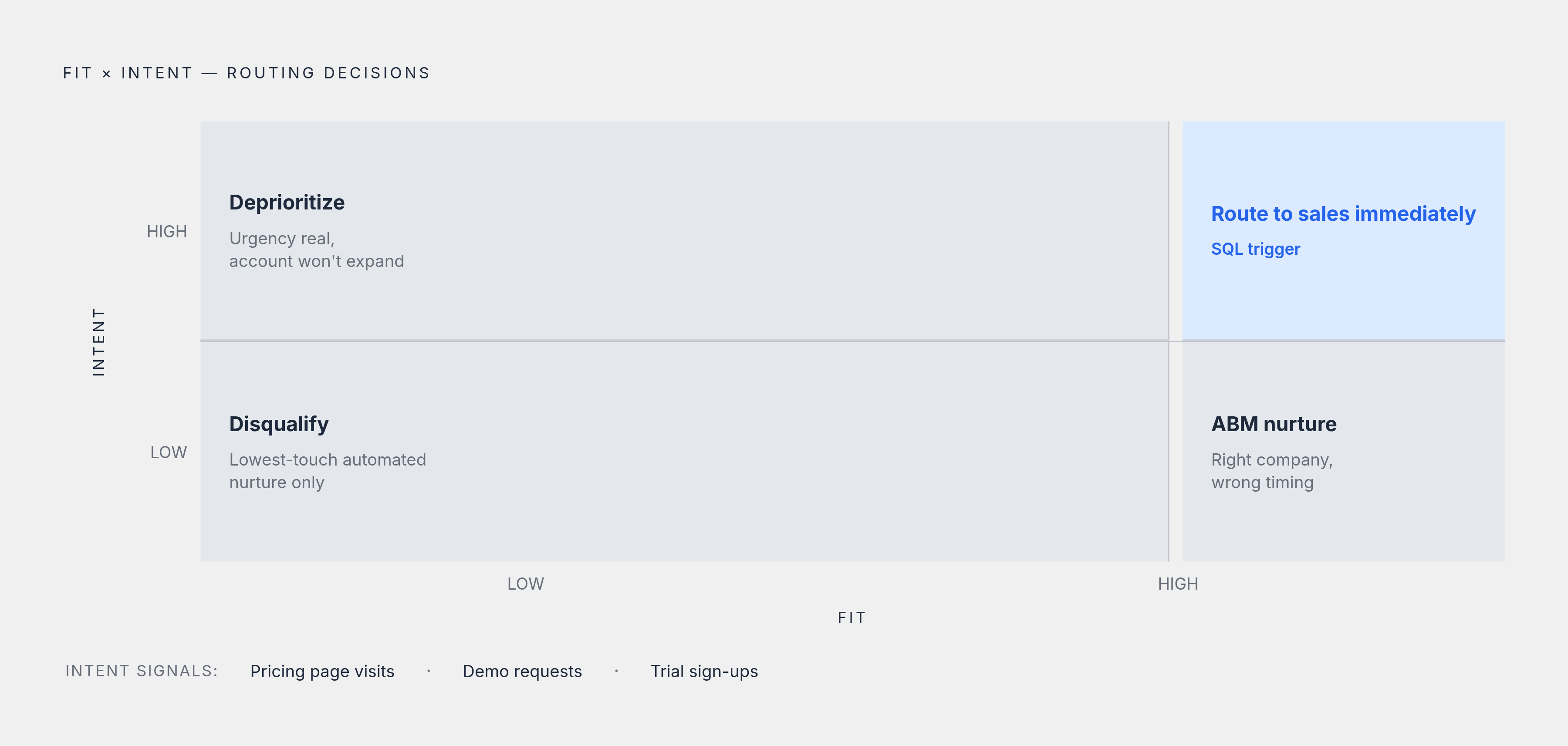
Two-dimensional scoring separates fit (how well the lead matches your ICP) from intent (how actively they're signaling buying behavior). Score each dimension independently. Then route based on where the lead lands.
High fit, high intent: Route to sales immediately. This is your SQL trigger.
High fit, low intent: Enroll in account-based marketing nurture. The company is right. The timing isn't there yet. Stay warm and don't waste SDR cycles on it now.
Low fit, high intent: Deprioritize from active sales. Respond to inbound inquiry if it comes in, but avoid investing SDR time. The urgency is real. The account won't retain or expand.
Low fit, low intent: Disqualify or route to lowest-touch automated nurture only. Move on.
Intent signals that belong in the high-intent quadrant: pricing page visits, demo requests, trial sign-ups, repeated high-value content engagement, direct inbound inquiry.
The matrix does something that's easy to underestimate. It makes routing decisions auditable and consistent. Reps aren't making judgment calls on partial information. It also surfaces the fit-only leads marketing celebrates but sales can't convert. That mismatch gets visible and actionable instead of becoming a recurring argument at the quarterly business review. That alone is worth the setup time.
One calibration note: score thresholds for routing should be set against actual conversion data, not picked arbitrarily at launch. Revisit them whenever MQL-to-SQL rates start to drift. If you set thresholds once and never touch them again, the model will quietly degrade while everyone assumes it's still working.
Why the Buying Committee Complicates Lead Scoring and What to Do About It
This is where most lead scoring models quietly fall apart. Gartner's research puts the average enterprise buying committee at roughly eleven stakeholders. Forrester's more recent data puts it even higher. Each additional decision-maker meaningfully reduces the likelihood of purchase unless someone is actively managing the consensus-building process inside the account.
The problem for scoring is structural. Traditional lead scoring tracks individuals. It assigns a score to a contact record. But enterprise buying decisions aren't made by individuals. They're made by committees. A single highly engaged contact with a great score can make an account look sales-ready when the rest of the buying committee has never heard of you. You end up chasing one enthusiastic champion while the actual economic buyer is still completely out of the loop.
Account-level scoring addresses this by aggregating engagement and fit signals across everyone in the account. The questions shift:
- How many stakeholders from this account have engaged with content?
- Are decision-makers and economic buyers in the mix, or only individual contributors?
- Is there a potential champion in the engaged contacts? Someone with influence and motivation to advocate internally?
Account-level scoring maps cleanly to MEDDIC's Champion dimension. If you're running MEDDIC on enterprise deals, your scoring model should be surfacing champion candidates, rather than just high-scoring individual contacts. If those two things aren't talking to each other, you've got a gap.
Technographic signals are also worth layering into account-level scoring. A buying committee at a company that has already invested in integrating third-party APIs and connectors into their existing workflows is telling you something about their operational maturity and appetite for adding new solutions. That signal belongs in your scoring criteria.
The other practical move for buying committee complexity: map contacts to roles early and track engagement by role, not just by name. A pricing page visit from a CFO is not the same signal as a pricing page visit from a junior analyst. Your scoring model should treat them differently. This requires clean CRM data and role tagging discipline. Neither is glamorous work. Both pay off directly in routing accuracy and forecast quality. And if your CRM data is a mess, no scoring model in the world is going to save you. Fix the data first. The rest follows.