Sales Lead Generation Software Comparison for B2B
Diagnose your pipeline gap first, then pick the tool designed to fix it.
Most teams shopping for B2B lead generation software treat it like a feature comparison. They open up a G2 grid, sort by rating, and start reading bullet points. That's the wrong move. The real question isn't which tool has the longest feature list. It's which category of tool fixes the specific stage where your pipeline is actually breaking down.
That distinction sounds obvious. It almost never gets applied in practice.
The market has fragmented into at least five overlapping categories, and vendors work hard to blur those lines. The result is teams paying for a full platform when they needed one precise tool, or buying a point solution that can't talk to anything else in their stack. This piece gives you a category-first framework for making the decision. Find the break in your pipeline first. Then go shopping.
Five Categories B2B Lead Gen Tools Fall Into
These aren't steps in a funnel. They're parallel lanes. Each one solves a different problem.
Category 1: Prospecting databases. This is the raw material for outbound. Verified contacts, company firmographics, direct dials, emails. The names you know here are ZoomInfo, Apollo, Cognism, and Lusha. If you don't have the names and numbers of people who match your ideal customer profile (ICP), nothing else matters yet.
Category 2: Intent data platforms. These track third-party behavioral signals across the web to identify accounts that are actively researching a solution right now, before they ever fill out a form. Think 6sense and ZoomInfo's intent layer. The question they answer isn't "who fits our ICP." It's "which ICP-fit accounts are in-market today."
Category 3: Outreach automation. Sequenced, multi-channel engagement: email, phone, LinkedIn touches. Often layered on top of a database. Apollo includes this natively. Many teams add a dedicated tool on top of whatever database they're using.
Category 4: Data enrichment. This one fills gaps in what you already have. Missing job titles, outdated phone numbers, incomplete technographics inside your CRM. HubSpot acquired Clearbit specifically to do this natively. Standalone enrichment tools do it as their primary function.
Category 5: CRM-native lead management. The system of record. It tracks, routes, scores, and reports on leads once you've captured them. HubSpot and Salesforce live here. They are not prospecting tools in the outbound sense, but they consistently show up in lead gen comparisons anyway.
Here's the thing about modern platforms: most of them blend two or three of these categories. Apollo is primarily a database that also does outreach. ZoomInfo is primarily a database that also does intent. A tool can appear to do everything while it actually does one thing exceptionally well and the rest adequately, like a Swiss Army knife that happens to have a perfect blade and five other tools you rarely use. Knowing that distinction is how you avoid paying for capabilities you'll never actually use.
Where Pipelines Break and What Fixes Them
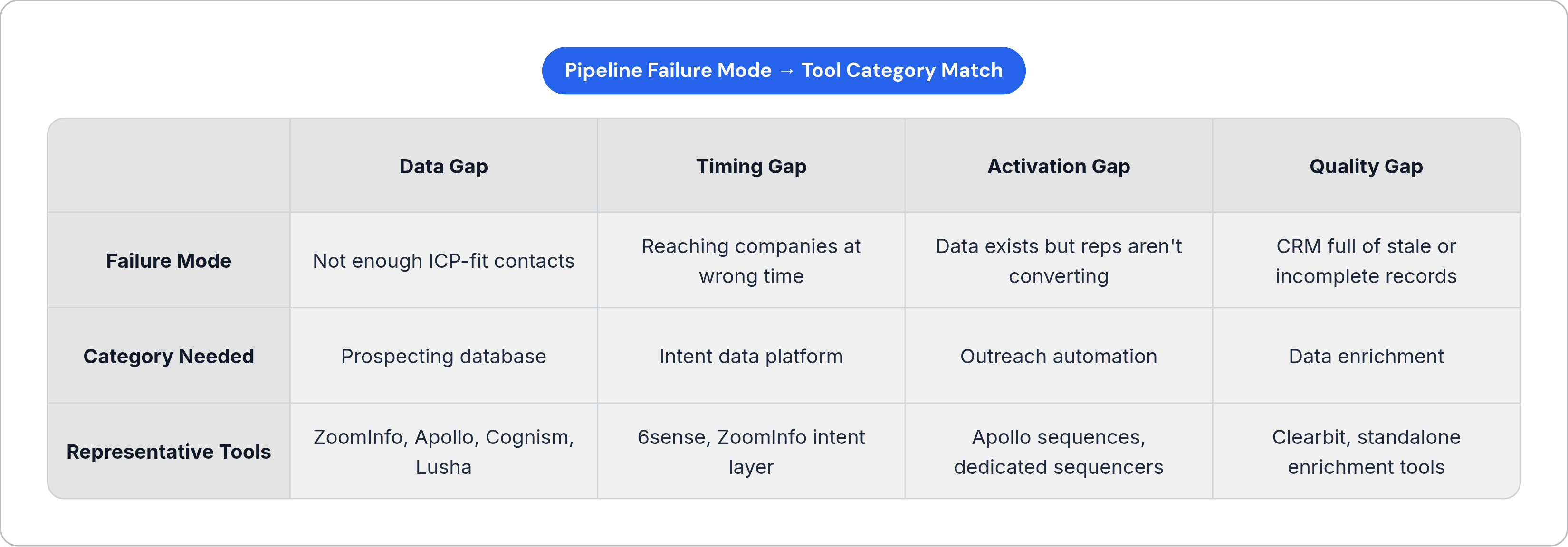
There are four common failure modes. Most teams are dealing with a combination, but one is almost always primary. Misidentifying it is how you end up buying the wrong tool entirely.
"We don't have enough contacts that match our ICP." That's a data problem. You need a prospecting database.
"We're reaching the right companies but at the wrong time." That's a timing problem. You need intent data.
"We have the data but reps aren't converting it into conversations." That's an activation problem. You need outreach automation.
"Our CRM is full of stale, incomplete records." That's a data quality problem. You need enrichment.
Before you evaluate any platform, answer these diagnostic questions:
Is the top-of-funnel volume the problem, or is it conversion from pipeline to booked meeting?
Is the team doing outbound, inbound, or both?
Is your target market primarily North American, EMEA, or global?
Is the primary motion account-based or high-volume transactional?
Those four answers narrow the field significantly before you read a single pricing page.
ZoomInfo, Apollo, Cognism, Lusha: Database Showdown
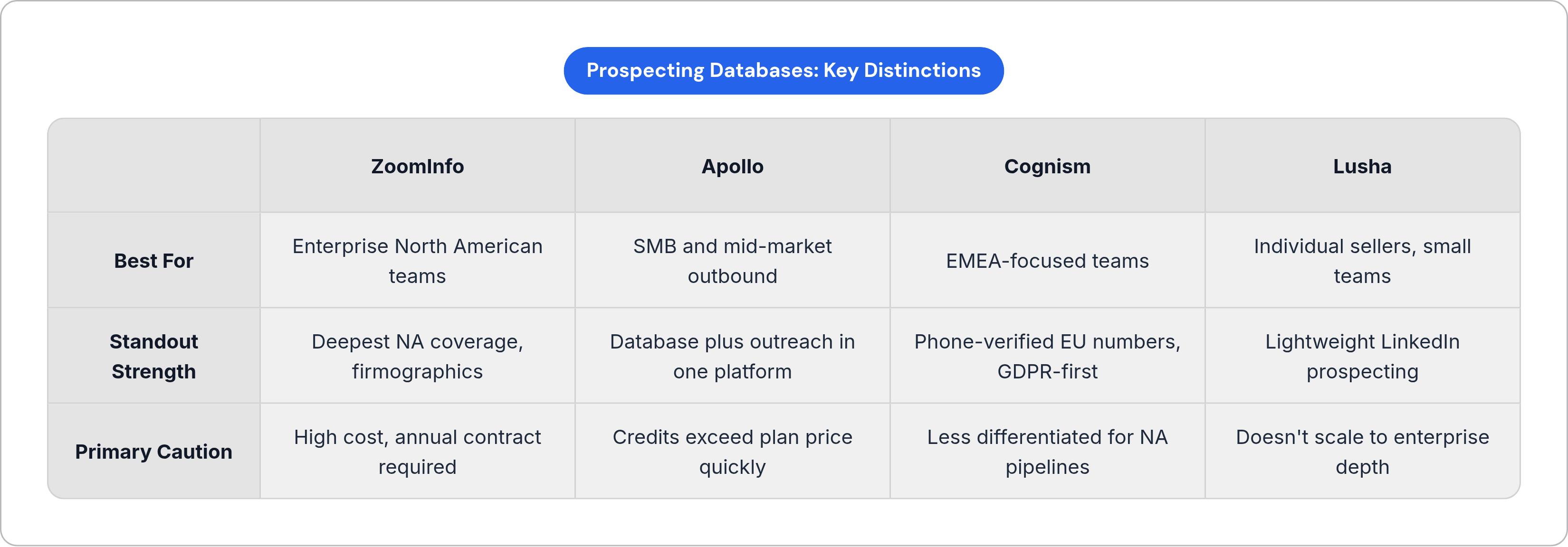
All four live in the same category. They do not serve the same buyer.
ZoomInfo is built for enterprise revenue teams. North American contact coverage is the deepest in the category. Firmographic data is extensive. The platform can consolidate tools that smaller teams might run separately. The price reflects all of that. Annual contracts, meaningful per-user cost, and an onboarding fee on top. It makes sense when deal size justifies the investment and you have RevOps capacity to configure and maintain it.
Apollo is the strongest fit for SMB and mid-market outbound teams. Database plus outreach automation, in one platform, at transparent per-seat pricing with a free tier available. That combination is genuinely useful for early-stage teams that can't justify buying a database and a sequencing tool separately. One thing to model carefully: Apollo runs on a credit system. Active prospecting teams regularly exceed base plan credits. The listed plan price and the actual bill can look very different by month three.
Cognism is the clearest choice for EMEA-focused teams. Phone-verified mobile numbers, a compliance-first data collection model designed around GDPR and CCPA, and match rates on European prospects that North American-built databases simply don't match. For teams primarily targeting European markets, the difference in call connect rates is real. For purely North American pipelines, that differentiation matters less.
Lusha is the lightest-weight entry point in the category. It works well for individual sellers and very small teams prospecting from LinkedIn. It doesn't scale to ZoomInfo or Apollo's depth, but for targeted, low-volume outbound, it's often more than enough.
One thing none of these do especially well: tell you when to reach out. A contact database tells you who to call. Intent data tells you when. That's a separate tool category entirely.
Intent Data: When It's Actually Worth Buying
Intent data is compelling in concept. It's also the easiest category to overspend on before your pipeline is ready for it.
6sense is the fullest expression of the intent-plus-ABM motion. Predictive account scoring, advertising orchestration, account prioritization, all in one platform. It was built for large enterprises with aligned sales and marketing teams, significant deal sizes, and dedicated RevOps capacity to implement and run it. Implementation is not trivial. Pricing is steep. For teams that lack those conditions, the ROI math rarely works out.
ZoomInfo's intent layer runs on a large proprietary signal network tracking buyer research across a wide range of topics and websites. The value proposition is consolidation: you get intent signals alongside your contact data instead of managing two separate vendors. Most useful when you're already in the ZoomInfo ecosystem and want to add prioritization signals without adding a second platform.
Cognism integrates Bombora for intent data rather than building its own. A reasonable middle path for EMEA-focused teams that want signal-based prioritization without a standalone platform commitment.
The honest caveat with all of these: intent data is most valuable for teams that already have a working outbound motion and a clear ICP. It's not a fix for a broken pipeline. It's an accelerant for a functional one — the difference between pouring fuel on a fire and pouring fuel on a pile of wet wood. And it has a short shelf life. Accounts that are in-market this week may not be in three weeks. If your team doesn't have the outreach infrastructure to act on those signals quickly, you're paying for information you can't use in time.
Sales Navigator: Useful Layer, Not a Database
Sales Navigator is a relationship intelligence and network access tool. It is not a contact database. That distinction matters a lot for how you should use it.
Its real advantages are specific and meaningful:
The LinkedIn professional graph updates in near real time when people change jobs. Databases built on static records can lag by weeks or months. For role changes, Sales Navigator is consistently fresher.
InMail engagement rates are substantially higher than cold email. If you have a reason to reach out, a warm InMail often outperforms a cold sequence.
Account IQ (broadly available as of late 2025) uses generative AI to surface decision-makers, summarize accounts, and identify warm intro paths. That's genuinely useful for relationship-driven selling.
What Sales Navigator does not provide: verified emails, direct-dial numbers, third-party behavioral intent signals, or bulk export at scale. Those are the things prospecting databases are built to deliver.
In practice, Sales Navigator works best as a layer on top of a database, not instead of one. It helps reps identify the right person and find a warm path in. Apollo or ZoomInfo closes the contact-data gap that Sales Navigator leaves open. For teams doing primarily inbound or relationship-driven selling, it may be sufficient on its own. For high-volume outbound, it's a complement.
It's also the most accessible price point of any tool named in this piece. For smaller teams thinking about how to sequence a stack, that's worth noting.
HubSpot and Salesforce: CRM, Not Lead Gen
CRMs manage leads once you have them. They do not generate leads in the prospecting sense. This distinction gets lost constantly in comparison articles, so let's be direct about it.
HubSpot fits SMB and mid-market teams that want sales and marketing aligned on a single platform with relatively fast implementation. Its Breeze AI layer handles lead scoring, enrichment, and email optimization at no added cost for paid tiers. The Clearbit acquisition made native enrichment a real feature rather than a workaround. Watch the pricing carefully though. It scales with seat count at higher tiers, and add-ons accumulate. Model total cost at your expected team size, not the per-seat headline.
Salesforce is the dominant CRM for enterprise sales organizations and has been for a long time. It's built for complexity: multi-product, multi-territory, deep integrations, extensive configurability. Agentforce adds autonomous AI handling at scale, but it adds meaningful per-user cost to an already premium price. Salesforce is the right choice when you need its configurability and integration ecosystem. It's not the right choice when simplicity and fast setup are the priority.
Both platforms require additional tools or configuration to cover the top-of-funnel prospecting layer. They are not substitutes for a contact database or an intent platform.
The integration question is important here. Prospecting databases, intent platforms, and outreach tools all need to sync with your CRM, ideally bidirectionally. A stack built on HubSpot or Salesforce should evaluate integration quality as a buying criterion, not an afterthought. Letterbrace addresses exactly this problem: it provides the infrastructure that lets these point solutions sync with a team's CRM without requiring custom API work, so the data flows cleanly across the stack regardless of which tools are in the mix.
Your Stack Costs More Than the Pricing Page
This is where teams get surprised. Repeatedly.
The common hidden cost patterns worth modeling before you commit:
Credit systems. Apollo, Lusha, and several other tools run on credits. Active prospecting teams regularly exceed base plan limits. Overages can push the real monthly cost well above the listed plan price.
Onboarding and implementation fees. Enterprise platforms often charge separately for setup. For large intent platforms, implementation costs can represent a significant portion of a small team's annual software budget on their own.
Annual contract requirements. Most enterprise platforms require a full-year commitment. No monthly optionality. Teams that don't fully adopt the tool still pay for twelve months.
Seat scaling. A price that looks manageable for five reps becomes a significant line item for fifty. HubSpot and Salesforce both scale this way.
Add-on features. Dedicated IPs, advanced AI features, and higher API limits frequently live behind add-on pricing rather than in the base tier.
A useful rule of thumb: a tool advertised at a low monthly price can land at multiples of that number in year one once you account for per-user fees, usage overages, annual contract terms, and implementation.
Before buying anything, model three numbers: total annual spend at expected team size, credit consumption at your actual prospecting volume, and integration costs if the tool requires custom work to connect to the rest of your stack.
Pick the Right Tool for Your Team Type
The decision sequence is simple. Identify the pipeline failure mode. Select the right category. Evaluate platforms within that category by team size, geography, and budget. Then model total cost at real usage.
Here's how that plays out by team profile:
Early-stage or SMB outbound team, North American market, limited budget. Apollo covers contact data and outreach in one platform at transparent per-seat pricing. Sales Navigator adds relationship intelligence if selling is relationship-driven. HubSpot Starter handles the CRM layer at low cost.
Mid-market team scaling outbound, needs better data quality and intent signals. ZoomInfo consolidates database and intent in one platform. Alternatively, Apollo for data with a lighter intent integration layered on. HubSpot or Salesforce at the CRM layer depending on organizational complexity.
EMEA-focused team with compliance requirements. Cognism is the clear data layer choice. Sales Navigator adds relationship intelligence. The existing CRM stays in place.
Enterprise with an ABM motion, large deal sizes, aligned sales and marketing. 6sense or ZoomInfo's intent layer for account prioritization. ZoomInfo for contact data at scale. Salesforce as the CRM backbone.
The whole framework collapses to one question: what breaks first in your pipeline, and which category of tool was built to fix exactly that?
Answer that question first. Everything else follows.