What Customer Relations Means for B2B Retention
Personal attention and proactive outreach drive B2B retention more than pricing.
Retention in B2B isn't decided by your product roadmap or your pricing sheet. It's decided by whether the people on the other side of the contract feel understood, kept in the loop, and worth the vendor's continued attention. This piece breaks down what "customer relations" actually means once you get past the buzzword, and how each piece of it either builds retention or quietly drains it.
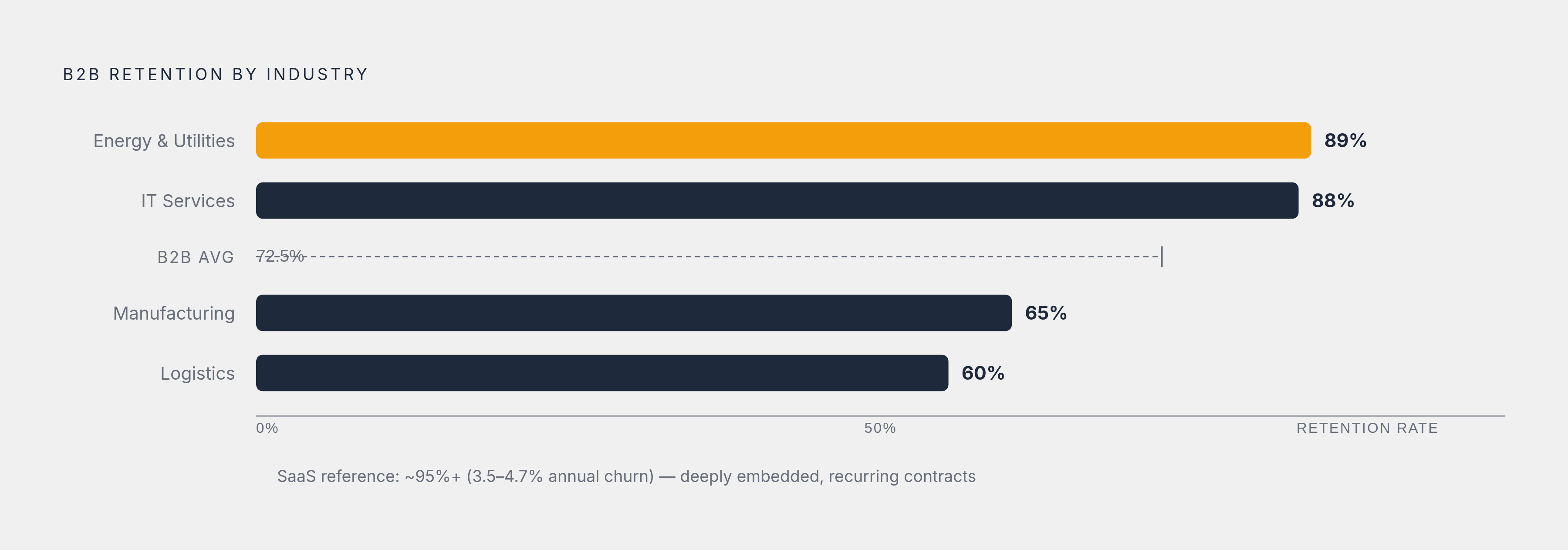
Start with the spread. B2B retention rates aren't one number, they're a range so wide it looks almost like different sports. CustomerGauge's State of B2B Account Experience puts the overall average around 72.5%. But Energy and Utilities sit at 89% retention. IT Services holds 88%. Manufacturing drops to 65% retention (35% churn), and Logistics falls further still, to 60% retention (40% churn). SaaS, meanwhile, plays a tighter game: annual churn in the low single digits, roughly 3.5% to 4.7% per Recurly and other network data, is considered the benchmark, with the best performers doing even better.
That spread isn't random noise. It maps almost perfectly onto how embedded the vendor is in the customer's operation. High retention shows up where contracts run long, switching is a pain, and someone at the vendor actually owns the relationship. High churn shows up where the offering is a commodity and the "relationship" is really just a shared invoice. Which sets up the real question of this piece: what determines which end of that spectrum a company lands on?
What "customer relations" actually means in a B2B context — and how it differs from customer service
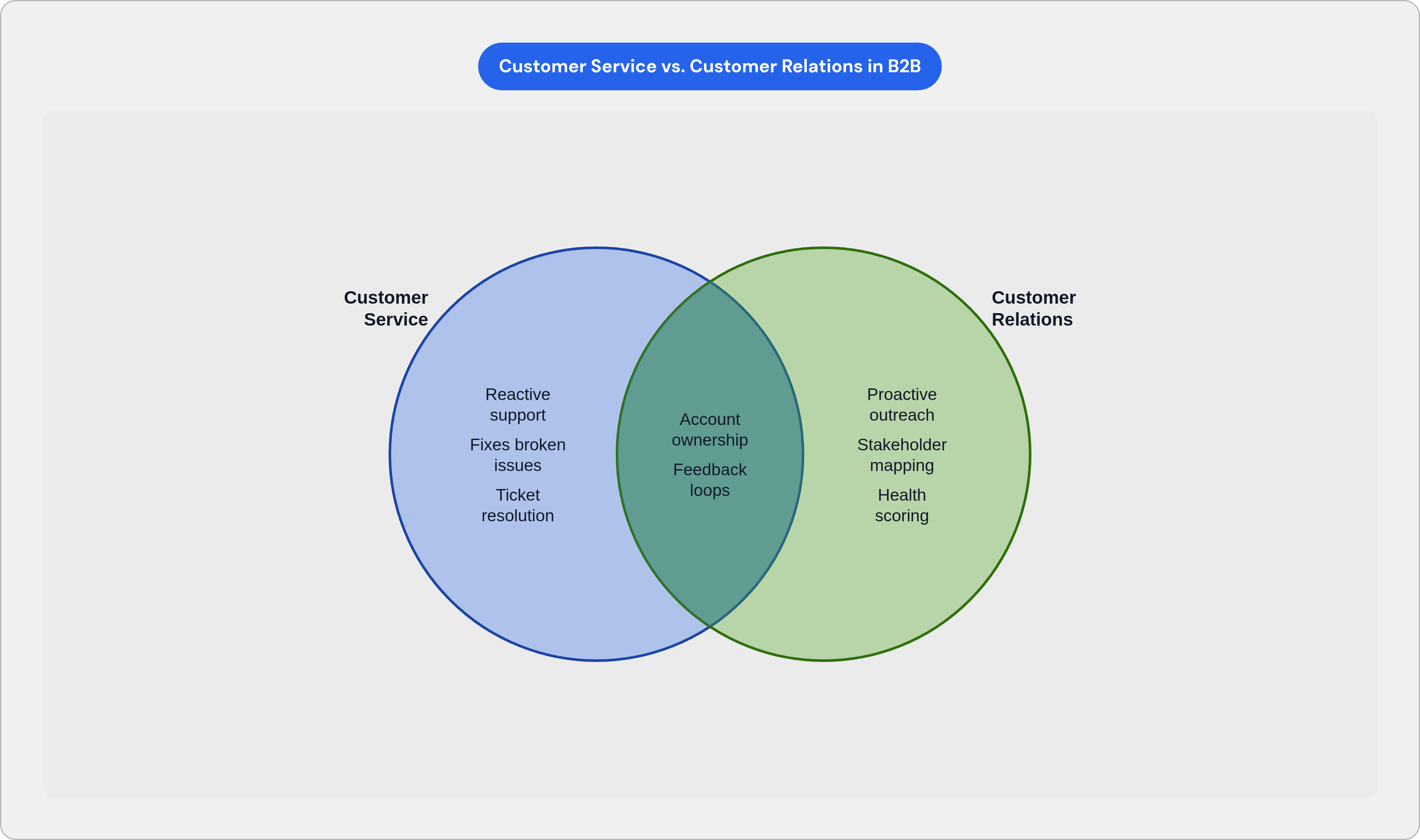
Customer service fixes what's broken. Customer relations is the ongoing, proactive management of the whole account relationship, whether anything is broken or not. Confusing the two is a little like thinking a marriage is going well because nobody's filed for divorce yet.
In B2B, "the customer" is rarely a person. It's a committee: an economic buyer who signs the check, a day-to-day user who lives in the product, and an internal champion who has to defend the purchase in a hallway conversation six months later. Customer relations has to cover all three, because a renewal decision often gets made by someone who's never once talked to your sales team.
The real components, and this isn't a checklist so much as a working system:
- Regular, structured communication (QBRs, check-ins, health reviews)
- Feedback collection that leads to visible, named action, not a survey that vanishes into a spreadsheet
- A dedicated owner of the relationship, whether that's a CSM, an account manager, or some equivalent role
- Proactive risk-spotting, meaning you notice trouble before the customer has to email you about it
- Advocacy, meaning the vendor occasionally surfaces value the customer didn't think to ask for
What it isn't: an NPS survey nobody follows up on, a drip campaign dressed up as a relationship, or a support ticket getting closed fast. Customer relations is a discipline of continuity. It's what happens in the white space between transactions, not during them. And B2B makes this genuinely harder than B2C, because the cycles are longer, the stakeholders are more numerous, the revenue at risk per account is bigger, and the renewal decision often gets made months before the contract actually ends. By the time you notice something's wrong, the decision may already be behind you.
The financial case for treating retention as a primary growth lever
Here's the math nobody argues with once they see it. Acquiring a new B2B customer costs dramatically more than keeping an existing one, and the gap widens the more complex your sales cycle and onboarding process get. Research from Bain and Company (via Frederick Reichheld) puts the multiplier between 5x and 25x. Not a rounding error. A different order of magnitude.
Push retention up by just 5 percentage points, and profits can climb substantially, according to Bain and Company and HBR data cited by Gainsight. That range is wide because retention-driven revenue flows to margin differently depending on the business model, but even the low end of that range beats most acquisition strategies on a cost basis.
Then there's the compounding piece. Customers who stick around spend more as the relationship matures. By the third year, according to Martech Zone, returning customers are spending meaningfully more than they did in their first six months. This is where expansion revenue comes in, and it's the part most acquisition-obsessed leadership teams underrate. Median net revenue retention (NRR) across B2B SaaS sits around 106%, meaning the existing customer base, on its own, grows the top line. Top performers clear 120% NRR. At the median B2B SaaS company, roughly 40% of new ARR comes from accounts that already signed a contract, not new logos walking through the door.
None of that is a coincidence, and it isn't really a "feature" of retention either. It's the direct output of relationship practices that surface expansion opportunities before a competitor does. Add in the fact that selling to an existing customer succeeds at a dramatically higher rate than selling to a brand-new prospect, per Marketing Metrics data cited by Forbes, and the picture is less "retention is nice to have" and more "retention is the whole game, acquisition just gets you a seat at the table."
Where and when churn actually concentrates in B2B accounts
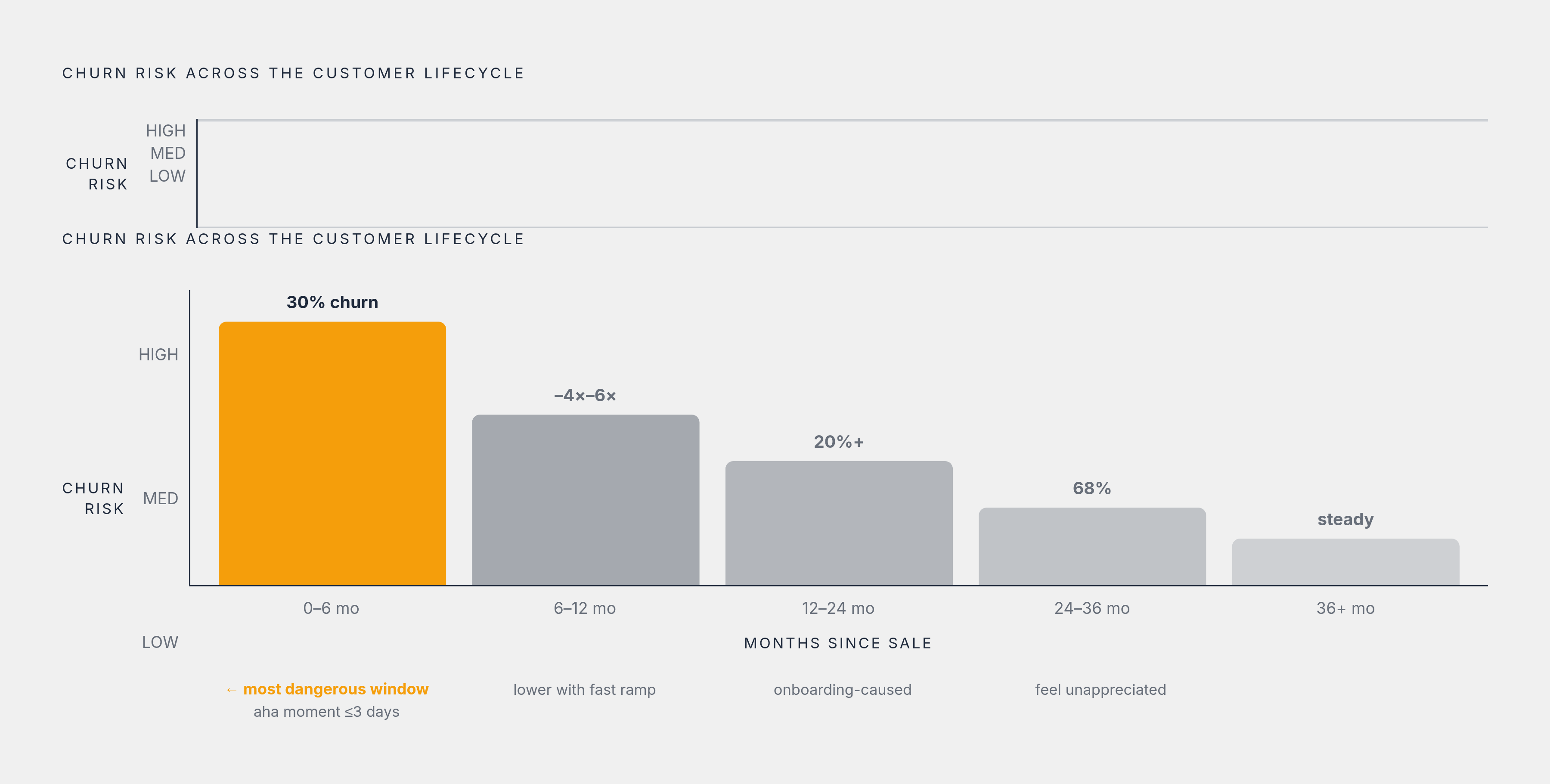
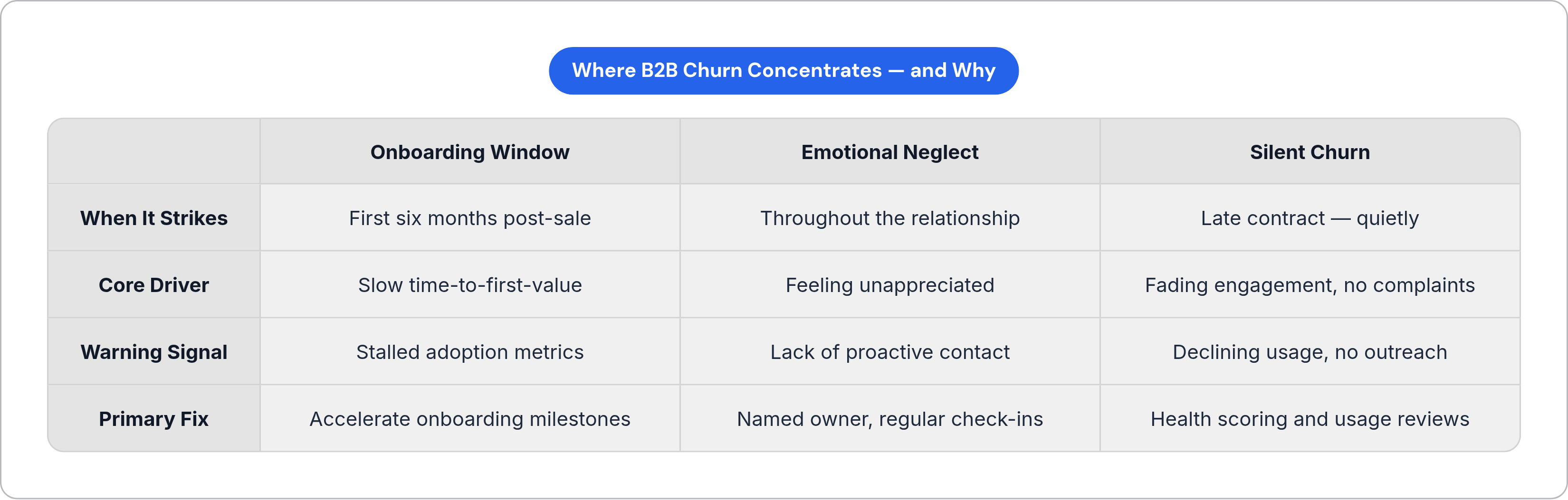
Churn doesn't spread evenly across the life of a contract. It clusters at specific, predictable moments, and if you know where to look, you can usually see it coming.
The first six months after a sale closes are the danger zone. Per data cited by usamaskhan.com (2026), B2B churn peaks at roughly 30% in that window, before the customer has even had a chance to fully adopt the product. Time to first value is the tell here: customers who hit a meaningful "aha" moment within three days of onboarding churn at rates 4x to 6x lower than customers stuck in a slower ramp. Recurly data (via serpsculpt.com, 2025) attributes more than 20% of voluntary churn to poor onboarding alone, making it probably the single most fixable failure point in the entire customer lifecycle.
Then there's the emotional layer, which teams tend to underweight because it doesn't show up in a product usage dashboard. NewVoiceMedia found that 68% of customer churn happens because customers feel unappreciated, not because the product broke or a competitor undercut the price. Feeling ignored, it turns out, is a more reliable churn predictor than feeling disappointed.
And then there's the quiet kind. Silent churn is the account that renews fine, on paper, right up until it doesn't. Usage drops. Engagement fades. Nobody complains, because nobody's angry, they've just mentally moved on. These accounts don't send warning flares. Health scoring, regular check-ins, and usage reviews are the only real early-warning system, because by the time silent churn becomes loud, the renewal conversation is already lost.
The structural neglect that makes most B2B retention efforts ineffective
Here's an uncomfortable number: only 49% of B2B companies actually measure their retention rate, according to CustomerGauge. Half the industry is flying without an instrument panel, guessing at who's at risk and what losing them would actually cost.
It gets worse before it gets better. Fewer than half of B2B companies say retention is a primary focus, compared to a large majority that focus primarily on acquisition, even though the financial case (see above) tilts hard the other way. Attention follows acquisition anyway, out of habit more than logic. Meanwhit, 70% of companies don't link their customer experience program to financial data, which is exactly why those programs get ignored the moment sales or CS leadership needs to make a real budget call. If your CX dashboard can't answer "so what does this mean for revenue," nobody in the room is going to fight for it.
The feedback loop is its own quiet failure. A Gartner study found that most companies ask customers for feedback, but only a small fraction actually act on it, and fewer still bother telling the customer what changed as a result. That last step matters more than it sounds. CustomerGauge's research shows that closing the loop with every customer lifts retention by about 8.5%, a substantial return for what's really just a communication habit, not a product investment. Yet 62% of B2B companies have no target for closing that loop at all. That's 8.5% sitting on the table, unclaimed, because nobody assigned it to anyone.
Forrester's framing puts a number on the gap between knowing this and doing it: companies that hit the bar of "customer obsession" report 49% faster profit growth and markedly better retention than their peers. Only 3% of companies clear that bar. The tools aren't secret. They're measurable, documented, and not even especially expensive. They just require sustained relationship investment, and acquisition-first cultures are structurally bad at funding things that don't show up in this quarter's pipeline number.
How specific customer relations practices translate into measurable retention outcomes
Proactive service beats reactive support, and the gap is bigger than most people assume. B2B companies that provide proactive service, meaning they flag problems before the customer has to, can cut churn substantially and lift satisfaction by 33%. Proactive here means something specific: catching usage anomalies, noticing stalled adoption, and having the value conversation before renewal, not after the invoice lands.
Dedicated customer success ownership matters too. Firms with named CSMs see meaningfully higher NRR than firms without one, according to Benchmarkit. And tiered resourcing, high-touch for strategic accounts, lighter-touch for smaller ones, improves overall retention efficiency by 12% to 20% across mixed B2B SaaS portfolios, per marketingltb.com. A named, accountable human on the account isn't a nice-to-have add-on. It's a retention mechanism in its own right, the same way a seatbelt isn't decoration.
Structured account reviews carry their own weight. Regular QBRs keep relationship context intact, surface renewal risk early, and open the door to expansion conversations that wouldn't happen otherwise. Firms running them consistently report 33% higher expansion revenue, according to serpsculpt.com (2025).
And when churn signals get caught early, 60 to 120 days ahead of renewal, paired with real CS intervention, churn drops by 25% to 45%. But that intervention only works if the relationship infrastructure already exists; you can't build the parachute on the way down. Every one of these practices, at bottom, does the same thing: it makes the customer feel seen. Which loops right back to that 68% figure on feeling unappreciated. Different tactic, same underlying fix.
Where personalization genuinely helps retention — and where it backfires
Buyers say they want personalization. Forrester's State of B2B Personalization (December 2024) found a large majority of marketing decision-makers agree buyers expect a tailored experience. Only a small fraction of buyers say they're actually getting one. That's the setup. Here's the twist.
Gartner's 2025 survey of a large sample of B2B buyers found something that should worry anyone chasing personalization as a retention fix on autopilot: buyers who experienced personalization were roughly twice as likely to feel overwhelmed, and nearly three times as likely to feel time pressure during the buying process. More than half said personalization did more harm than good on their most recent buying journey, and those buyers were significantly less likely to come back and buy again. Personalization, done wrong, doesn't feel like being known. It feels like being watched.
Gartner draws a useful line between two kinds. Passive personalization takes known data and uses it to push more targeted content at you, essentially a smarter version of being followed around by an ad. Active, two-way personalization, what Gartner calls "course-changing personalization," adapts to what the customer is actually trying to accomplish in the moment. The second kind more than doubles the likelihood of completing a critical purchase decision and builds real trust, not the fake kind that evaporates the first time something goes wrong.
The practical rule for customer relations: personalization that serves the customer's goal drives retention. Personalization that serves your sales quota accelerates churn. Good looks like a CSM who remembers what a customer said their strategic priority was three QBRs ago, and connects a new feature to that goal unprompted. Bad looks like a triggered email because someone logged in twice this week. One feels like being helped. The other feels like being tracked.
What the shift to digital-first B2B buying means for relationship-driven retention
The buyer on the other side of the table has changed. Most B2B buyers now are Millennials and Gen Z, people who grew up digitally native, comfortable with self-service, and low on patience for friction. They want fast digital answers and transparent information, and they'd often rather solve something themselves than wait on a call. That reshapes what "proactive communication" even means in practice.
Here's the part that surprises people who assume digital-first means relationship-light: self-service isn't the opposite of relationship investment, it's a form of it. Customer communities, knowledge bases, and structured education programs are relationship infrastructure for buyers who don't want to schedule a meeting to get an answer. Forrester data, cited via Zapnito, shows companies with formalized customer education programs see measurable retention gains. Teaching someone to succeed without you on the phone, oddly enough, is one of the more relational things you can do.
AI complicates this without replacing it. Gainsight's Customer Success Index found most organizations expect AI to have a moderate to significant impact on CS strategy going forward. But Salesforce's State of the AI Connected Customer (2024) found consumer trust in companies has dropped to an eight-year low, even as AI adoption climbs. Put those two facts side by side and the lesson is plain: AI can scale how many touchpoints you cover, but it can't stand in for the human accountability that trust in a high-value B2B relationship actually requires. The channel keeps changing. The underlying need, to feel seen rather than processed, doesn't. Buyers who love self-service still walk when they feel like a ticket number.
Building a customer relations program that actually defends retention
None of this works if it depends on one gifted account manager who happens to remember everyone's birthday. Retention has to be systematic, or it's just luck wearing a nice suit.
That means defined touchpoint cadences by account tier, health scoring with actual thresholds for when someone escalates, closed-loop feedback processes with a named owner and a deadline attached, and expansion conversations built into the relationship calendar instead of getting bolted on as a separate sales motion later. None of these are exotic. They're just consistently applied, which is rarer than it should be.
And it starts with honesty about measurement. Recall that 49% of B2B companies aren't even tracking retention. For a lot of organizations, step one isn't a new CS platform or a fancier health score model. It's simply knowing the number, and knowing what's sitting behind it.