What Good Customer Service Looks Like in SaaS
The real benchmarks show most SaaS support falls short of good.
SaaS support isn't complicated, but it's specific: fast first response, onboarding that actually teaches, proactive outreach before the customer even knows they're annoyed, one consistent experience no matter the channel, and a renewal motion that starts months out instead of the week before the contract's due. Most companies fail more of this list than they'd admit at a board meeting. Let's go section by section and see where the bodies are buried.
What the benchmarks actually say about where most SaaS companies stand
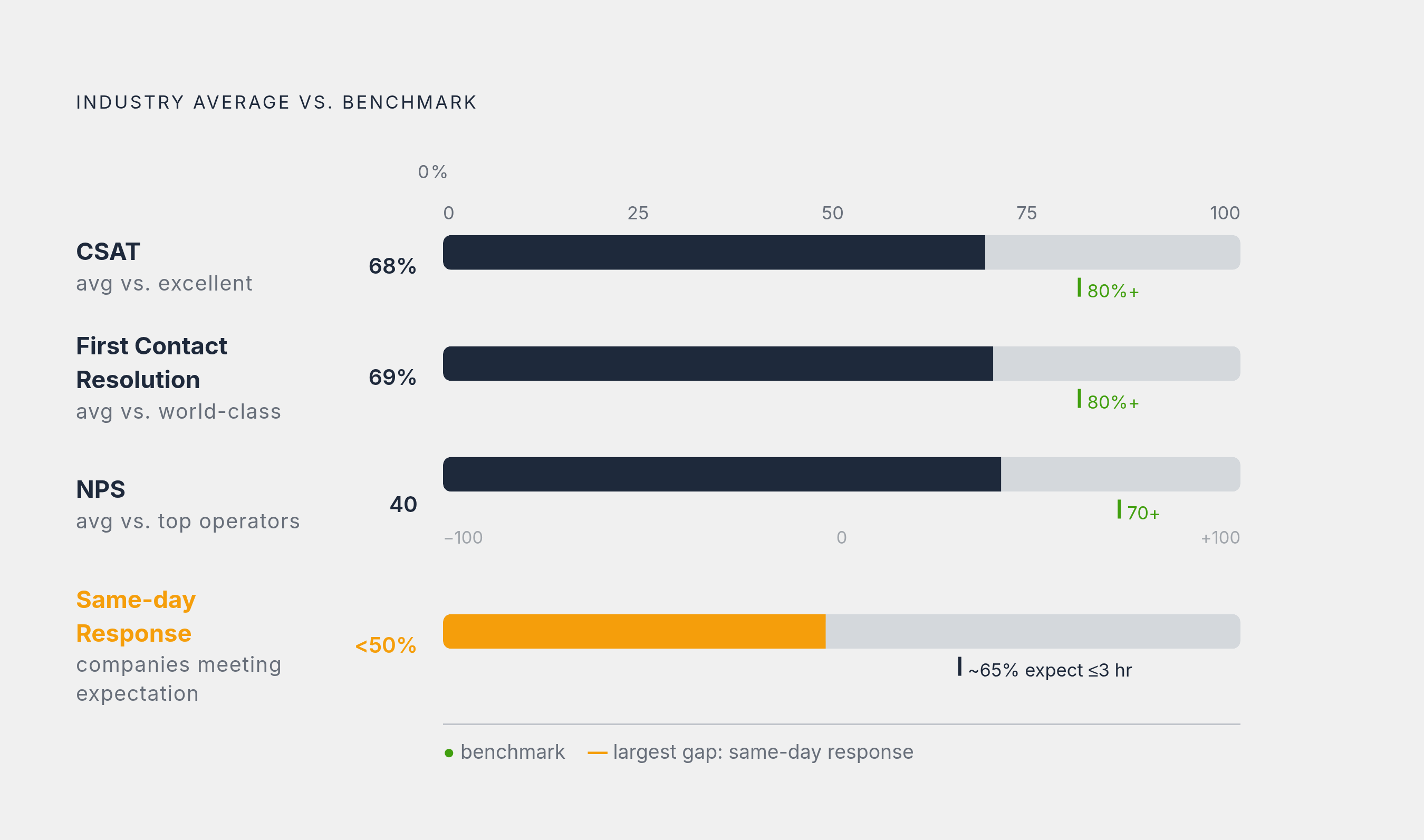
SaaS companies average a CSAT score of 68%, which parks them in the 65-70% range everyone quietly agrees is mediocre, well under the 75-85% window that counts as good, and nowhere close to the 80%+ QuestionPro flagged as excellent in 2025.
NPS is a little kinder to the ego, since tech companies average 45, way ahead of the general benchmark of 32, and SaaS specifically runs 30 to 60 depending on who you ask, with the best operators clearing 70. Then first contact resolution shows up and ruins the mood: SQM Group looked at over 500 North American call centers in 2024 and found the cross-industry average sitting at 69%, versus a world-class bar of 80%.
Response time is where things really fall apart. Two-thirds of consumers expect resolution within three hours, but Thena's 2025 research found fewer than half of enterprise software companies manage same-day response, let alone anything close to three hours.
And here's the stat that should actually bother you: only a small fraction of unhappy customers ever complains, while everyone else just leaves, quietly, without a ticket, without a word, without ever touching your CSAT dashboard. A dashboard that says things look fine is working from a partial picture, since most of the dissatisfaction never gets logged. Kind of like asking your dog if he ate the sandwich and taking his silence as a no.
Fast first response as the threshold behavior every other marker depends on
Nobody feels valued sitting in a queue. It doesn't matter how good the eventual answer is, the waiting itself is the experience, and people remember the wait longer than the resolution.
Ninety percent of consumers say customer service factors into whether they do business with you at all, and a majority define "immediate" as ten minutes or less. Most support teams aren't built for that unless somebody sat down years ago and designed the whole operation around it on purpose, which most didn't.
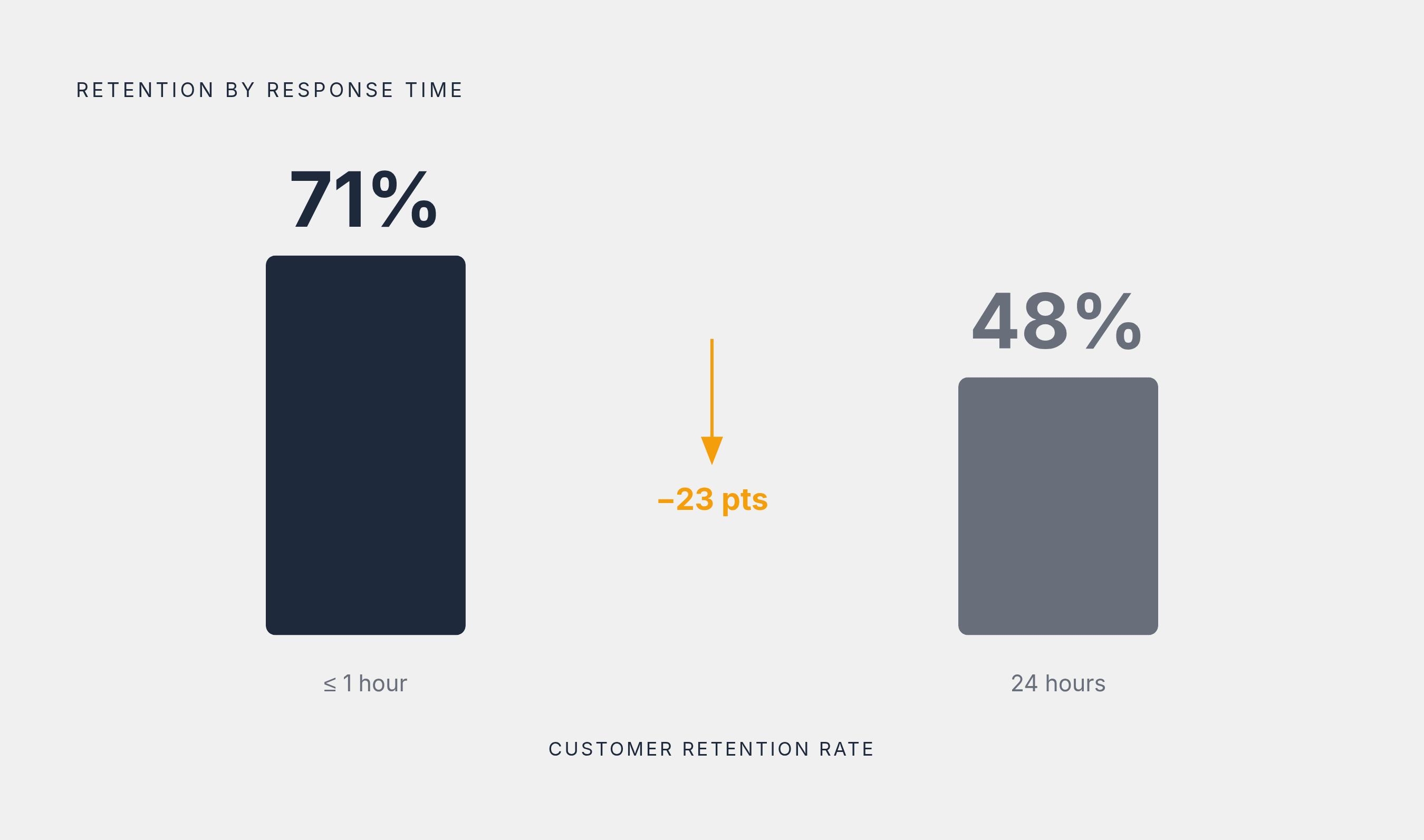
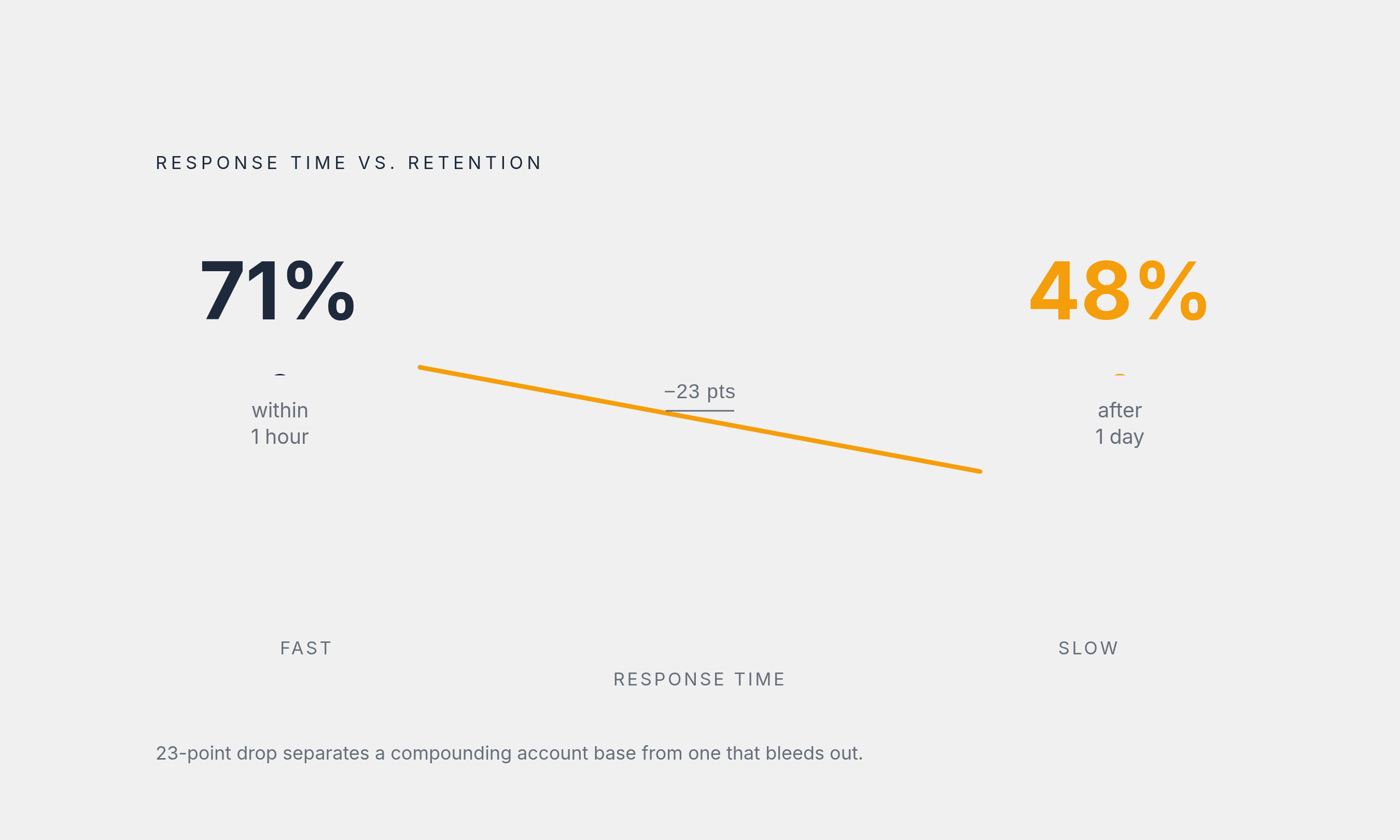
The retention math backs this up hard. Customers who get a response inside an hour retain at 71%, but wait a full day and that number drops to 48%. That gap represents the difference between an account base that compounds and one that's bleeding out through a door nobody's watching.
Getting fast requires some unglamorous plumbing. Written SLAs, rather than relying on whoever's been there longest to just know. Triage logic that separates "my data disappeared" from "how do I change my email" before a human wastes time on either. Coverage that accounts for time zones, weekends, and that one Tuesday your biggest customer's entire company logs in simultaneously and breaks something. And if AI is acknowledging tickets, it needs to say so, rather than politely restating something as though it were resolved.
First response time and first contact resolution get treated as the same metric constantly, and they're not. One's a clock, the other's an outcome, and confusing the two trains your team to optimize the wrong number entirely. A cheerful "we got your ticket!" that goes nowhere for three days doesn't help a single person, and Customer service leaders broadly report that expectations climbed again this year, so whatever felt fast in 2023 is table stakes now.
Onboarding as the first place retention is won or lost
Somewhere between 40 and 60% of trial users open your product once and never come back, depending on whose research you trust, and that's steep enough that onboarding deserves more than a passing mention tucked somewhere in the customer journey map. It's the actual first test of whether you keep the account at all.
A 2025 Rocketlane study, cited by Userpilot, found customers with smooth onboarding churn noticeably less than the ones left to poke around on their own. Onboarding might be the single highest-leverage thing a CS team touches, and it's often the most neglected, mostly because it happens before anyone's paying close attention. Userpilot also found a large majority of customers report more loyalty toward companies whose onboarding actually teaches the product, rather than dropping them into an empty dashboard and wishing them luck like a parent teaching a kid to ride a bike by just letting go.
Good onboarding personalizes setup around what the customer actually said they wanted, rather than a generic product tour built for an imaginary average user. HubSpot's own onboarding gets cited constantly here, and deservedly so, since it's tuned to the stated goal, not a script. In-app guidance catches confusion the moment it happens, before it becomes a ticket three days later, and somebody specific owns a defined time-to-first-value milestone. The sales-to-CS handoff carries context forward so the customer isn't re-explaining their entire situation to a total stranger who just said "welcome aboard!"
The payoff lands on both sides. Good onboarding cuts ticket volume because customers actually understand the product, freeing the team for harder problems, and a widely cited TSIA study found customers who go through real training onboarding renew at meaningfully higher rates. Onboarding's real value shows up later, in the net revenue retention line.
Proactive outreach and health monitoring before customers ask for help
The customers quietly checking out never file a ticket about it. They don't complain about disengagement, they just stop logging in, and by the time the renewal conversation rolls around, the decision's already made. Waiting for them to reach out is waiting for a phone call that isn't coming.
Proactive customer success watches the signals before the silence: adoption rates, login frequency, how deep customers actually go into the feature set, engagement trends over months. Then it acts on what it sees rather than sitting around for a support ticket that was never going to arrive.
In practice, that's automated health scores flagging at-risk accounts and routing them to a CSM well before renewal season, not during it. It's check-ins scheduled around the customer's own goals rather than the contract calendar. It's usage nudges, so if someone told you a feature mattered and they've never touched it, somebody actually asks why instead of assuming it's fine. And it's quarterly business reviews built as evidence sessions showing customers their own results, rather than a sales pitch wearing a QBR costume.
Companies built around this kind of proactive model report revenue growth 41% faster than competitors still running reactive support. The logic isn't complicated: reactive support fixes things after they break, proactive success stops them from breaking in the first place, and those need separate metrics, separate staffing, separate ways of thinking about the job entirely. Merge them into one function and neither gets resourced properly, and you end up with a team that's great at answering phones and terrible at preventing the calls.
Consistent, low-friction support across every channel the customer chooses
Research from usepylon.com found a large majority of customers expect interactions to feel connected across departments and touchpoints, and companies that don't integrate channels keep a smaller fraction of those customers over time. The ask underneath all of it is embarrassingly simple: stop making me repeat myself.
Channel preference shifts by problem, not by person. The same customer resetting their own password through a help article wants an actual human on the phone the second there's a billing dispute, and good SaaS support maps channel to problem type, not to whichever channel happens to be cheapest to staff that quarter.
The practical version is one queue, one triage view, one SLA, whether the customer showed up by email, chat, or phone call. Their experience shouldn't depend on which door they happened to knock on.
Tool landscape, roughly: Zendesk suits larger teams needing advanced routing and mature permissions across multiple channels. Intercom leans conversational, in-app, AI-assisted. Pylon fits companies whose customers live in Slack Connect or Microsoft Teams, and Plain is built for developer-led B2B companies needing API depth and tight hooks into Linear or Jira. Which one's right depends on where your customers actually start talking to you, and how tangled your routing needs to be.
Customer Effort Score is what actually captures the cost of getting this wrong. A customer explaining the same problem three times across three channels reports high effort, even when the issue eventually gets solved, and the friction it took to get there still counts against the experience, regardless of the outcome.
Self-service economics cut both ways here. Fullview pegs self-service contacts at roughly $1.84 each versus $13.50 for an assisted interaction, which is a real gap, but that math only holds if the knowledge base is current and actually findable. A stale FAQ page is just a slower way to lose someone.
The renewal-aware success motion that distinguishes good SaaS CS from generic support
Most industries treat the sale as the finish line. SaaS treats it as the start of a much longer conversation, because the relationship doesn't end at purchase, it begins there. That changes how the whole CS function has to be built, oriented around the renewal event rather than the individual ticket.
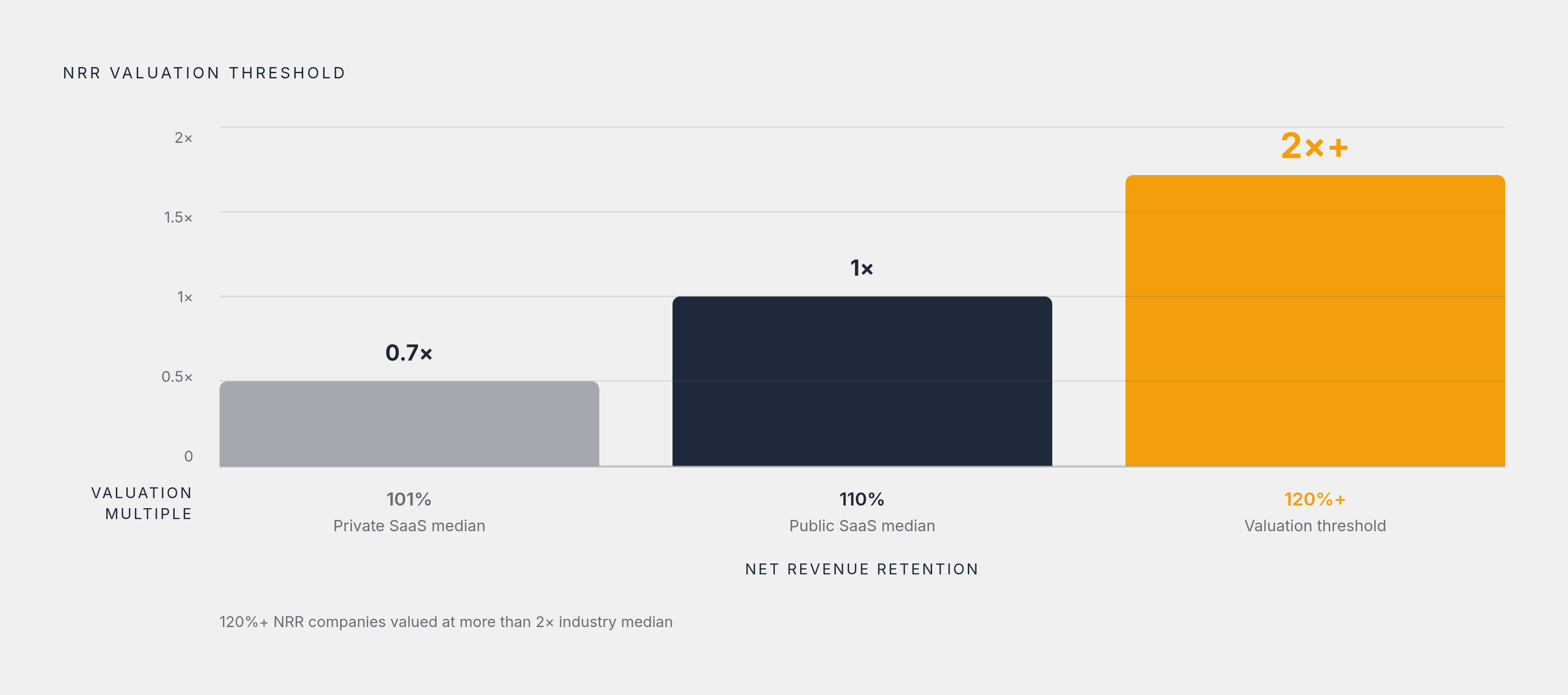
Net revenue retention is the number that tells you whether any of this is working. Fullview puts median NRR for public SaaS companies at 110%, with private SaaS closer to 101%, which functions as the floor for sustainable growth. A 2024 Software Equity Group analysis found companies clearing 120% NRR earn valuations more than double the industry median, and that valuation gap reflects a fundamentally different growth trajectory, at least to whoever's writing the check.
A renewal-aware motion has a specific rhythm. Conversations start 90 to 120 days out, not 30, because a customer who's checked out 30 days from renewal made that decision weeks earlier and nobody caught it. CSMs talk business outcomes, not feature click counts. Expansion conversations get built on usage evidence showing where a customer's genuinely outgrown their plan, rather than a sales call wearing a check-in disguise. At-risk accounts get a real escalation path that pulls in leadership, not just whichever CSM happens to own the account that week.
B2B SaaS averaged 3.5% annual churn in 2025; a genuinely good rate runs under 1% a month. That gap between average and good is exactly where revenue compounds year over year, or quietly walks out a side door nobody bothered to lock. Customer service in SaaS functions as a revenue engine that has to re-earn the customer every single period, whether anyone likes that framing or not.
How to audit where your own support operation actually stands against these markers
According to blog.hubspot.com, customer service professionals rank CSAT as most important at 31%, with response time close behind at 29%. That lines up almost exactly with everything covered above, which is either reassuring or a little damning, depending on how your own numbers read.
So ask the uncomfortable questions and actually write down the real answers, not the ones that sound good in a meeting. What's the median first response time, broken out by channel and customer tier, against that 67% expecting resolution inside three hours? Does onboarding have a defined time-to-value milestone with someone specific accountable for it? Are health scores running, and when's the last time a CSM reached out to an account that hadn't filed a single ticket? If someone contacts you by email, then switches to chat, then calls, does the third agent see the whole history or start cold?
The silent churn number should color how you read everything else on this list. With only 1 in 26 unhappy customers actually complaining, a CSAT score built from survey respondents is probably more flattering than reality deserves, so check the response rate on your surveys right next to the score itself. A great CSAT built on a very low response rate reflects only the opinion of the few who bothered to answer, which is a thin basis for confidence.
Data from fullview.io puts SaaS companies spending roughly 8% of ARR on support and success combined. Before arguing that number up or down, trace where it actually goes. If most of it sits in reactive ticket resolution and almost nothing touches onboarding or proactive monitoring, that's an allocation problem, and it'll show up in the NRR line eventually whether anyone's watching for it or not.