Personalized Customer Interactions at Scale in B2B SaaS
How to build the systems that let B2B SaaS feel personal without hiring endlessly.
Every new customer added to a B2B SaaS book makes the average customer harder to know. Yet every buyer still expects to feel known. Fixing that takes more than better manners — it's an engineering problem, one that needs a solution built from data infrastructure, segmentation logic, and a few carefully placed human checkpoints.
At 50 customers, "personal" was easy. One CSM knew the account history, the champion's name, the renewal date, and probably the exact support ticket that was still open and annoying everyone. At 500 customers, that same CSM is covering dozens of accounts, and all that knowledge lived in her head, not in any system anyone else could query. When she leaves, the account remembers her fondly; the company forgets everything she knew by Tuesday.
Hiring more CSMs doesn't fix this. One CSM per N accounts means cost per customer climbs right alongside the customer base, which is the opposite of what a scaling software company is supposed to do. Systems that remember for them solve what more headcount can't, and that's the whole argument for everything below.
The buyer on the other end of the renewal call has changed, generationally as much as technologically. Per Forrester's 2025 Buyers' Journey Survey, 64% of business buyers at manager level and above are Millennials or Gen Zers, people who grew up Googling their own answers before anyone tried to sell them anything. That habit walks straight into enterprise procurement with them.
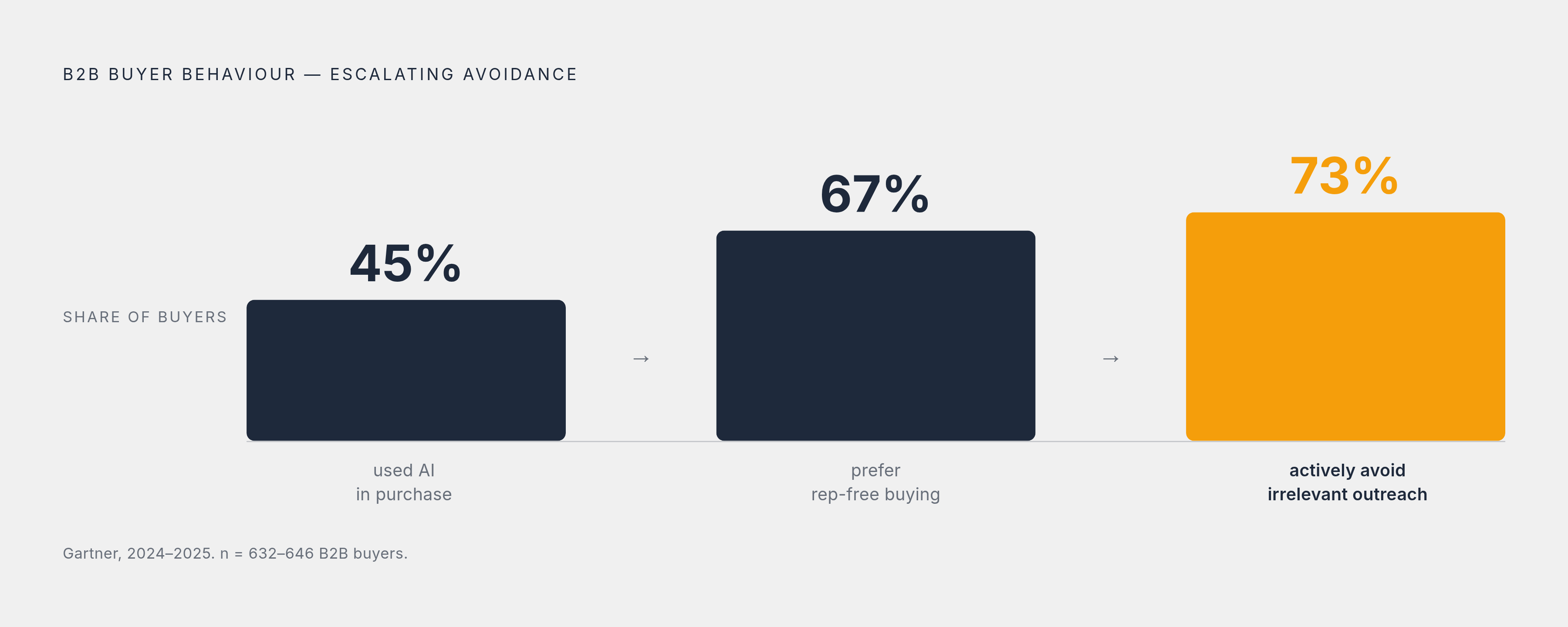
A Gartner survey of 646 B2B buyers, run August-September 2025, found 67% prefer a rep-free buying experience, and 45% used AI during a recent purchase. Translation: the website, the product trial, and the automated email sequence now carry more weight than whatever the salesperson says on a call that might not even happen.
Here's the part that should worry a marketing team more than any of that: generic outreach doesn't just fall flat, it costs deals outright. A separate Gartner survey (632 B2B buyers, August-September 2024) found 73% actively avoid vendors who send irrelevant outreach. Personalization's absence actively drives buyers away, full stop, on top of whatever upside it adds when done well. Zendesk's 2025 research backs the internal read on this too: 88% of CX leaders call personalized experiences critical to their technology investment. The bar buyers set keeps dropping, not rising, and vendors who miss it don't get a second look.
The data foundation that makes personalization reproducible
Without unified data, every team sees fragments. Marketing sees an email open, support sees a ticket, sales sees a call log. Nobody sees the account.
A Customer Data Platform fixes that by pulling data from every source, running identity resolution to stitch it into one profile per account, and making that profile queryable in real time. In B2B, identity resolution is genuinely harder than in consumer software, because a purchase involves a buying group, not a single shopper. The CDP has to connect the IT manager, the CFO, and the VP of Engineering into one account view, not three disconnected contact records sitting in three different tools.
Picture the difference. Without a unified profile, someone on the team notices one person visited a blog post last week. With one, the team sees that the IT Manager read technical docs, the CFO opened the pricing page, and the VP of Engineering clicked through an email, all inside the last 48 hours. That's a buying signal, not a coincidence, and it tells the CSM exactly what to say and when to say it.
The inputs feeding this layer aren't exotic: product usage telemetry, CRM activity, support tickets, marketing engagement, billing events. The hard part is keeping all of it current and accurate at the same time, because every downstream system, the segmentation rules, the AI models, the automated emails, inherits whatever errors live in this layer. Garbage in, personalized garbage out. There's no clever segmentation rule that fixes a CDP with stale contact records.
Segmentation logic: how to divide a customer base so personalization is actually deliverable
Segmentation gets filed under "marketing tactic" in a lot of people's heads, which sells it short. In this context, segmentation is the mechanism that lets automation feel personal instead of feeling like a mail merge with someone's first name slapped on top.
Four axes do most of the real work. Firmographic data (industry, company size, geography) decides which case study and which compliance answer actually apply to the account in front of you. Behavioral data (feature adoption depth, login frequency, usage patterns) shows where someone actually sits on the value curve, not where the contract says they should be by now. Engagement data (email opens, ticket volume, CSM touchpoint history) is the relationship's pulse, checked continuously instead of once a quarter. Revenue data (ARR tier, contract type, distance to renewal) decides who gets attention first when attention runs out, which it always does.
Run the same automated playbook through these segments and it produces different outputs on purpose. A power user gets an upsell nudge; a quiet, disengaged user gets an onboarding refresher and a check-in that doesn't read like a form letter. Same machine, different output, because the inputs got sorted first.
Granularity is the trap here, and most teams get it wrong in the same direction: they slice too fine. Segments need to be different enough from each other to justify separate treatment, and broad enough that automating across them is worth the setup cost. Slice too fine and someone spends the week maintaining segment definitions instead of running campaigns. Slice too broad and the output slides right back to generic, which defeats the entire point of doing this in the first place.
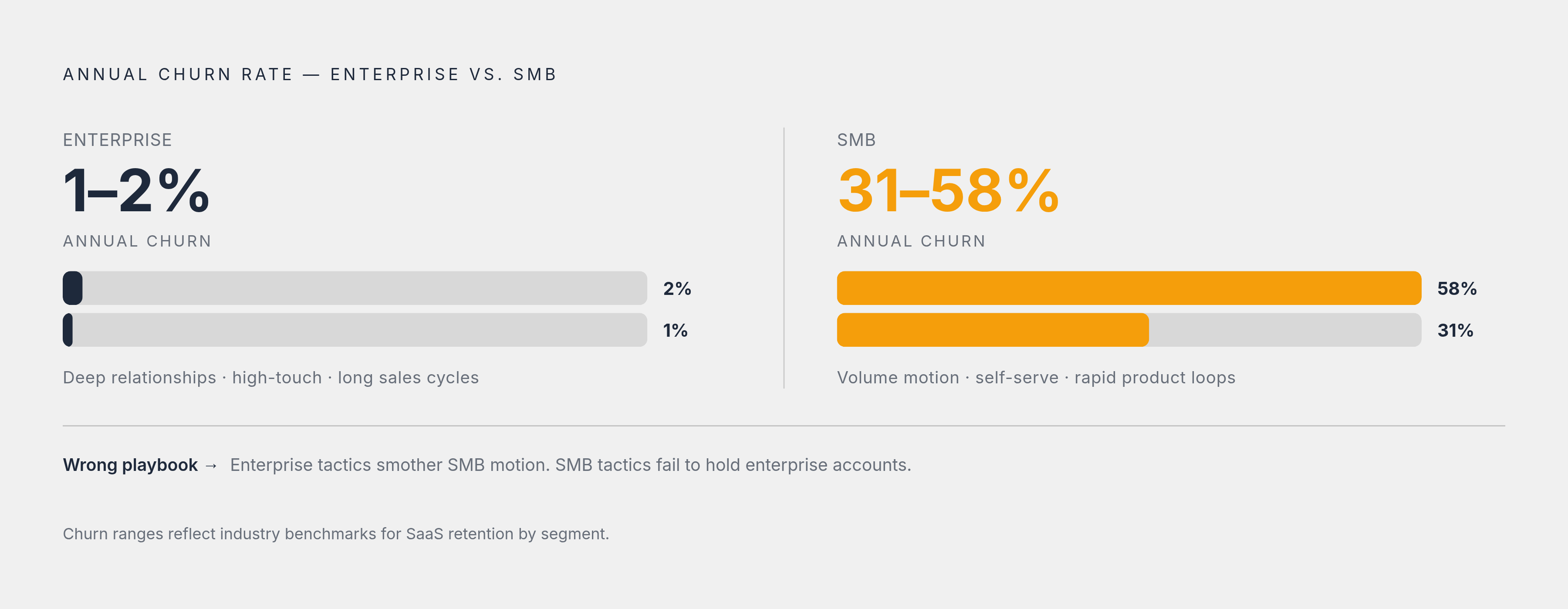
SMB and enterprise deserve separate treatment, and lumping them together is where a lot of retention strategy quietly falls apart. Enterprise accounts run annual churn around 1 to 2%. SMB-heavy books run 31 to 58%. Those are different problems wearing the same shirt. A playbook tuned for enterprise, heavy human touch, long sales cycles, will smother an SMB motion that needs to stay lightweight and mostly automated. Run either playbook on the wrong segment and value doesn't stall, it evaporates.
Segments should also move on their own. An account that's been healthy for a year and suddenly goes quiet needs to migrate into a risk segment automatically, triggering a different playbook without anyone having to catch the drop in real time. Humans still write the segment logic and review the migrations; the system just executes at a volume no team could match by hand.
Where AI intervention earns its place in the customer journey
AI's real job here is making sure the CSM shows up already knowing what's wrong before the customer has to explain it. Worth being blunt about the scope of that: AI isn't replacing the CSM's judgment. It's removing the lag between a problem happening and someone finding out about it.
Health scoring is the clearest version of this. Machine-learning models watch usage, ticket volume, and sentiment, and flag risk before the cancellation email lands, not after. A 2024 Gartner forecast put the ceiling at up to a 15% churn reduction from AI-driven CRM tools that anticipate client needs. Teams running AI-driven personalization report monthly churn dropping 2 to 3 percentage points, which sounds small until it's the gap between median retention and top-quartile retention.
Onboarding gets the same treatment. AI adjusts the path based on the goals a customer stated up front, and steps in when usage data shows someone's stuck on step three of setup, without a CSM babysitting every new logo by hand. The same signal set that flags churn risk also flags the opposite: accounts whose usage pattern says "ready to expand," surfaced to sales before the customer has thought to ask for more seats.
Content generation is where this gets almost absurdly practical. Generative tools now build a fintech-specific pitch deck, or swap fintech case studies onto a homepage for a fintech visitor, or write an email that speaks to a healthcare buyer's actual regulatory headache, at a volume no content team could hand-write in a year. By 2024, 74% of SaaS companies had AI features built into the product, and 87% reported real growth from AI-driven personalization.
Front-line support is the other big lever, and it's the one with an actual case study attached. By 2025, 85% of customer service leaders were piloting generative AI bots for routine queries, freeing human agents for the complicated, relationship-shaped problems instead of resetting the same password for the two-hundredth time. Anthropic's use of Intercom's Fin AI agent puts real numbers on this: a 50.8% AI resolution rate within roughly a month, 96% of conversations handled by the bot, and over 1,700 hours saved in that first month alone. Gartner's caveat matters just as much as the win, though: this only works with a strong knowledge base underneath it. An AI support agent is only as good as what it's allowed to read, and a thin knowledge base just means confident wrong answers at scale.
AI-powered CRMs, more broadly, lift sales productivity by 30%. Not a small number, and not a coincidence either; it's what happens when a rep stops spending half the morning hunting for account context that already exists somewhere in the system.
Account-Based Experience as the strategic frame for high-value accounts
Account-Based Marketing targets accounts. Account-Based Experience, ABX, puts the customer's actual experience at the center of marketing, sales, and customer success at the same time, instead of running three separate campaigns that happen to aim at the same logo.
Here's why that distinction earns its own section instead of getting filed as a rebrand: per 6sense's 2025 data, B2B buyers only talk to a salesperson during 61% of their journey. The other 39% gets shaped by content, product experience, and automated touchpoints, and those need to agree with each other or the whole thing falls apart. A beautiful ABM campaign that dumps a warm lead into a generic onboarding flow has a leak in it, and the leak is where the deal drains out.
ABX adds three layers on top of ABM. Intent signals separate accounts actively evaluating from accounts just sitting there, so personalization budget goes where it can actually convert instead of getting spread evenly and thin. Cross-functional orchestration puts marketing, sales, and CS on one shared account score and one shared playbook, instead of three teams independently guessing what the account wants. Post-sale experience finally gets the same rigor as the pitch, instead of getting treated as paperwork once the contract's signed.
That last piece has real money attached to it, and this is the part that should reset how a leadership team allocates budget: for most B2B SaaS scale-ups, a substantial share of revenue comes from renewals and upsells, not new logos. Top performers push net revenue retention past 120%, and more than half of new ARR at elite companies comes from expansion, not acquisition. Treat the renewal conversation like a chore, and that revenue simply doesn't show up.
Tiering ABX by account value is the right structural move. Start 1:Few with your highest-value accounts, expand once early results hold up, then graduate to a 1:Many rollout. Tier the program to account value and to how proven the playbook actually is; don't run the same script on account one and account six hundred. The expectation of a personalized experience is now table stakes across B2B. ABX is the operational answer for the accounts where that expectation carries the most revenue on the line.
Human-in-the-loop checkpoints: where automation must stop and a person must decide
More automation does not mean less human judgment, and that's the mistake most teams make, because automation feels like progress by default, even when it's quietly making things worse.
Certain moments need a human hand on the wheel, full stop. Any change to how a segment gets defined or prioritized needs a person's sign-off. So does outreach to a high-risk or high-value account that deviates from the approved playbook, and any claim the system generates about the product, a competitor, or a customer's specific situation. Same goes for any strategy reset, pausing a campaign, deprioritizing a segment, pulling a content touchpoint, that touches accounts already in motion.
The math on mistakes changes at scale, and not in a forgiving direction. A misconfigured segment or a wrong automated message doesn't reach one customer; it reaches hundreds or thousands of them, simultaneously, before anyone notices the blast radius. A single rep's bad call costs a bad afternoon. A bad automation rule costs a bad quarter, and by the time someone catches it, the damage is already sitting in a churn report.
Gartner's caution on generative AI bots applies directly here: they work only with a solid knowledge base and realistic expectations, and the system needs to recognize what it doesn't know and escalate rather than confidently guess. In practice, that oversight looks like a strategy queue where proposed automations sit for approval before they fire, a weekly review of AI-flagged accounts before a CSM acts on the signal, and a firm "do not touch" rule for any page or touchpoint already earning real engagement. No internal scoring model gets to override evidence of what's actually working in the wild.
The right split: let the system own volume, pattern recognition, and routine execution. Reserve the human for calls that carry real consequence, strategy shifts, high-stakes account decisions, anything that could go flatly wrong if left unchecked. 55% of Customer Success Managers expect their focus to shift more toward data and AI going forward, and that's a head start, not a demotion: AI hands them the summary so the conversation starts somewhere useful instead of at "so, tell me about your account."
What the ROI evidence actually shows — and what it doesn't
McKinsey estimates businesses using AI for personalization see 5 to 15% higher revenue by 2025 than competitors that skip it. Wide range, and the width is the point: it tracks how much implementation quality varies from company to company, not some inherent unpredictability baked into personalization itself.
The website-specific numbers are more concrete, and worth taking at face value. B2B enterprises running website personalization typically see a 10 to 30% improvement in marketing ROI alongside a 10 to 15% revenue lift. Mature programs report an average of $20 back for every dollar spent on automated personalization, and 70% of the more advanced implementers cross exceptionally high ROI thresholds. Tailored web experiences produce a 19% average lift in conversion, and targeted calls-to-action convert 202% better than the generic version sitting right next to them.
Sit with the caveat before getting excited about any of that, though. The $20 return and the 200% ROI figures come from mature programs, companies that already did the infrastructure and segmentation work described above, not from someone running a first-month pilot. A company reporting a personalization "win" without showing the sample size, the time window, and what specifically changed is handing over a slide deck, not evidence, and the two get confused constantly.
None of this happens against an easy baseline, either. 75% of software companies reported declining retention in 2024, and that's exactly why the marginal gains from getting personalization right compound so fast: the starting line is already sliding backward, so real progress shows up quickly against it. The ROI case is strong enough to justify the investment. It is not strong enough to let anyone skip the data infrastructure and segmentation work that has to happen first, because every one of those returns sits downstream of a foundation that either holds or doesn't. Skip the foundation, and the personalization layer on top is just guessing with better formatting.