Customer Relations Examples from B2B Companies
Repeatable moves that keep big accounts from walking away.
B2B customer relations comes down to a handful of specific, repeatable moves. The companies that keep their biggest accounts run a tighter set of plays than the ones that lose them, and this piece walks through those plays at real companies. "Build strong relationships" is the kind of advice that sounds true and tells you nothing, so let's look at what actually happens on the ground.
Switching vendors in B2B carries real friction compared to canceling a streaming subscription. Renegotiating contracts, redoing SLA reviews, untangling compliance obligations, ripping out systems wired directly into daily operations, that's the actual cost of walking away, and it's steep enough that most clients won't do it over a bad month. A small number of accounts usually carries a disproportionate share of revenue too, so losing one stings more than losing a single customer in a consumer business. Rarely is "the customer" one person anyway. It's a user, a budget owner, and an executive, each with a different idea of what a good vendor relationship even looks like. That's why dedicated account managers, tiered SLAs, and scheduled reviews exist in B2B and mostly don't in consumer markets, since nobody assigns a personal account manager to someone buying a toaster.
What the retention numbers actually reveal about B2B relationship quality
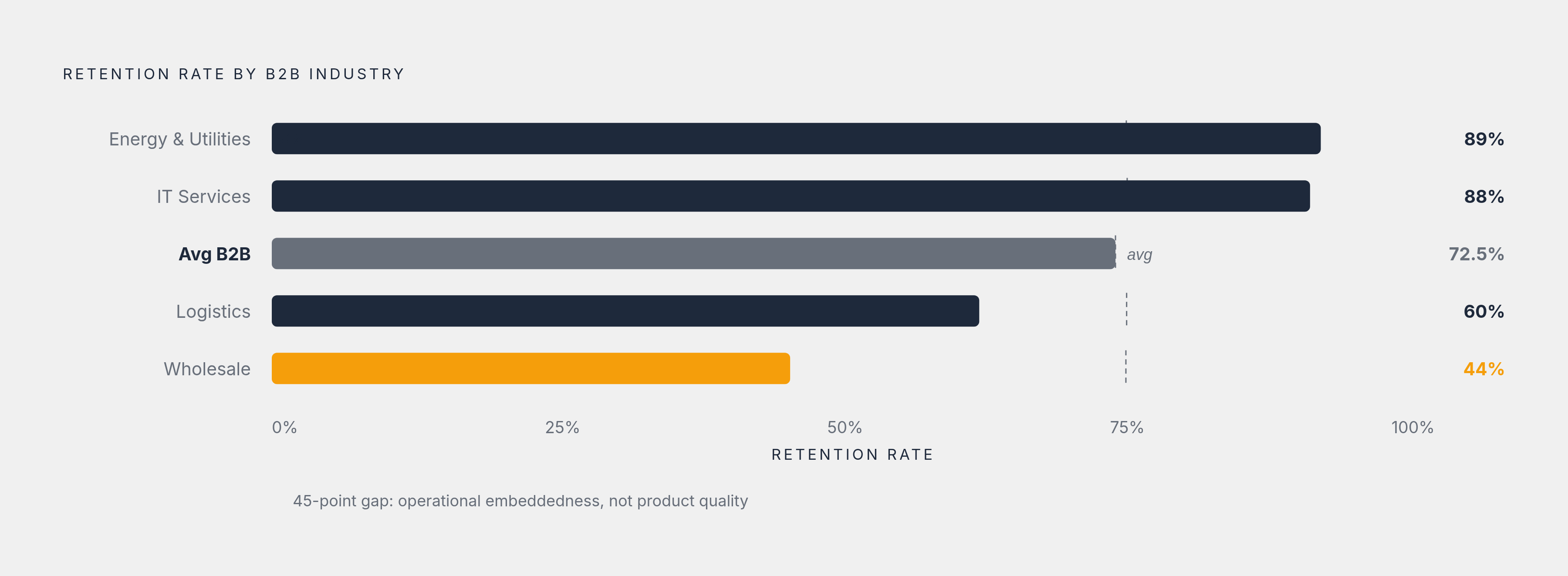
Average B2B retention sits around 72.5% in 2025, according to CustomerGauge. That number alone tells you almost nothing, and the spread underneath it is where the real story lives.
Energy and Utilities hold retention near 89%. IT Services sits close to 88%, and both are industries where contracts run deep and switching means tearing out infrastructure, not changing a login. Compare that to Wholesale, stuck around 44%, or Logistics at 60%, where the relationship is thinner and a competitor's better price is one email away.
This gap tells you retention doesn't track product quality on its own. It tracks how deeply embedded the vendor gets into the client's operations.
The same pattern shows up inside B2B SaaS specifically. Enterprise SaaS churn runs 1 to 2% a year, because those accounts get intensive account management and the switching cost is brutal. SMB-focused SaaS churn runs 31 to 58% a year, because down there the relationship is often just a support ticket queue and a login page.
Here's the number that should make any exec sit up straight: Bain & Company's "Economics of Loyalty" research found a 5% improvement in retention can lift profits by 25 to 95%. Profit, measured directly, not some proxy for revenue. Everything else in this piece really just answers one question: how do you climb from the bottom of that retention curve to the top?
How dedicated account management turns a vendor into a strategic partner
A support rep waits for the phone to ring, while a good account manager calls first, because they've been watching the client's usage data and already know something's off before the client does. That's the real shift here, reactive support turning into proactive partnership.
Customer Success Management, or CSM, is the formal version of this. A CSM's job leans less on fixing what breaks and more on making sure the client actually hits their own goals with the product. One role reacts to fires; the other prevents them, and for a high-value account, that difference is often the gap between a renewal and a very awkward exit interview.
Not every account gets the same treatment, and that's by design. Companies typically tier accounts by ARR, strategic value, and growth potential, then assign 1:1 CSMs to the ones that justify the cost while pooling smaller accounts into shared support.
HubSpot runs this playbook through education, building resources around where a client actually sits in their growth. HubSpot's own data shows 83% of Service Hub users report improved retention, about as direct a line as you'll find between a tooled CSM program and reduced churn.
IBM takes the same problem from a different angle, centralizing customer data and coordinating account management across a client base spanning practically every industry on earth. At IBM's scale, this infrastructure is load-bearing, built for daily use.
The question was never whether to invest in account management. It's how finely you slice the tiers.
How ZoomInfo and Dell show what data-driven retention looks like in practice
ZoomInfo tracks customer experience and usage data continuously across the customer lifecycle. The payoff shows up in consistently low churn, as continuous measurement catches a disengaged account before the account itself notices it's disengaged.
Dell Technologies proves this approach extends past SaaS. Its "I.T. Squad" relational marketing campaign paired personalized outreach with data analytics and reported a 25% jump in customer satisfaction scores. Dell sells hardware and services, not software licenses, and that matters, since it means measuring and acting on relationship data works well outside the SaaS world that usually gets credit for inventing it.
There's a second layer here that goes past churn prevention. According to Sales Hive, 56% of companies now use analytics specifically to find expansion opportunities inside existing accounts, alongside spotting who's about to bolt. The best B2B SaaS companies push net revenue retention past 120%, meaning what they make expanding existing accounts more than covers whatever they lose to attrition.
Take away the dashboards and the fancy tooling, and the logic underneath is almost stupidly simple. Usage data, login patterns, support tickets, NPS scores, it's all already sitting inside the relationship, waiting. The only real question is whether a company built a pipeline to act on it, or whether that data just rots in a dashboard nobody opens.
What SLAs and QBRs actually accomplish inside a B2B relationship
An SLA is a contract, sure, but its real job is turning implicit expectations into explicit ones. Response times, performance metrics, penalties for missed guarantees, none of that is exciting reading, but it means both sides agree in advance on what "good" looks like, instead of finding out they disagreed the hard way during an outage at 2am.
Most companies tier SLAs by severity and by client importance, so a P1 outage for an enterprise account gets a different response than a routine question from a small one.
QBRs, Quarterly Business Reviews, are where a vendor and client sit down and check outcomes against goals, surface problems before they fester, and plan the next quarter. Companies running these consistently report higher expansion revenue and lower rates of what's called silent churn. Silent churn is the quiet killer: a customer who never complains, never escalates, just slowly disengages until the renewal call goes straight to voicemail.
EBRs push this same review up the chain to the budget owner instead of just the day-to-day user, because somebody who actually signs the check needs to confirm the relationship is healthy too.
CSMs lean on platforms like Gainsight, ChurnZero, and Totango to track health scores between these scheduled reviews. The SLA sets the standard, the QBR audits performance against it, the health score flags trouble before next quarter rolls around, three pieces working as one feedback loop.
How Salesforce and Zendesk build relationships through community and co-evolution
Salesforce treats Dreamforce as relationship infrastructure, gathering customers to see the roadmap, swap notes with peers, and feel like they've got a stake in where the platform goes next. That's community-building, and it works precisely because it doesn't read like a sales pitch wearing a lanyard.
Salesforce Einstein AI shows the product side of the same instinct, feeding recommendations built from each client's own data. When a vendor keeps visibly getting better in ways a client can actually measure, staying stops feeling like an obligation and starts feeling obvious.
Zendesk and Airbnb tell a different kind of story, one built more on co-evolution than fandom. As Airbnb scaled into a global operation, support volume exploded and Zendesk adapted alongside them. A rival can undercut Zendesk on price or ship a shinier dashboard tomorrow. What they can't fake is years of already knowing how Airbnb's operation actually runs.
Both companies, in their own lane, turned the relationship into something closer to a partnership in the client's success, well beyond a transaction with a support line stapled on.
Why omnichannel and self-service access have become baseline expectations in B2B
B2B buyers are done sitting on hold, and the numbers back it up. McKinsey found 70% of B2B decision-makers are willing to make purchases over $50,000 through self-service or online channels, and 27% would go as high as $500,000 without picking up a phone at all. A company whose relationship infrastructure only lives in human-to-human channels is missing a big chunk of where its buyers actually want to be.
Buyers now bounce between Slack, Microsoft Teams, email, in-app forms, and the occasional phone call, and they expect the conversation to follow them across all of it. Nobody wants to re-explain their whole account situation for the third time because two channels never talked to each other. Modern support platforms fix this by consolidating touchpoints into a single thread, so the account history doesn't vanish somewhere in the handoff.
HubSpot's 2024 State of Customer Service Report backs this up from the other side: a large majority of service leaders say their customers are comfortable resolving issues on their own, and forcing a human into every interaction now reads as friction.
Self-service portals, knowledge bases, in-app support, these have quietly become part of the relationship itself, filling the gaps between a CSM's scheduled check-ins. The channels keep multiplying, but the underlying rule hasn't budged: meet the client where they already are instead of making them adapt to however the vendor prefers to work.
The personalization imperative in B2B and what segment-of-one looks like in practice
Personalization is harder in B2B than in consumer markets, and also more necessary. Every client already runs its own systems, protocols, and workflows, so a one-size-fits-all pitch signals the vendor never bothered to look.
Gartner has pointed to a shift toward targeting individual customers with relevant messaging instead of running broad segment campaigns, sometimes called "segment-of-one" targeting, the logical endpoint of everything data-driven account management has been building toward this whole time.
Look back at the examples already covered and the pattern's hard to miss. Dell's I.T. Squad ran personalized outreach built from analytics. HubSpot serves up the right webinar or guide for exactly where a client sits on their growth curve. Salesforce Einstein builds recommendations from each client's own data.
The thread running through all three goes deeper than custom messaging. It's proof, in a way the client can actually feel, that the vendor understands their specific situation, their goals, their constraints. This thread has to run through the whole relationship, not just the first email. Onboarding, renewal, everything in between, personalization works as a habit here, not a top-of-funnel trick.
The common thread across these examples and what it means for building a B2B relationship program
Every example in this piece shares one structural feature. The vendor made a point of knowing the client's situation more deeply than the client expected them to. ZoomInfo tracked usage data continuously rather than waiting for a quarterly check-in. Zendesk adapted its product as Airbnb's needs exploded, letting the tool bend around Airbnb. Salesforce built a community that made clients feel like stakeholders in the platform's future. HubSpot built education that helped clients win on their own, which is exactly what keeps clients from leaving.
None of this runs on good intentions. The infrastructure behind it costs real money: the global CRM market was valued at USD 66.85 billion in 2024 and is projected to reach USD 198.10 billion by 2034. That spending only pays off when the systems it funds actually face the client, rather than feeding some internal report nobody outside IT ever opens.
The retention math closes the loop pretty tidily. A 5% improvement in retention lifting profits by 25 to 95%, per Bain, is about as loud a case for investing in relationships as economics gets.
What separated the companies in this piece from their competitors was rarely the product itself. More often, it was the relationship, turned into something a client couldn't just go copy down the street. Whether that value is actually landing, whether the right message hits the right stakeholder, whether the content gets read and not just published, that's a harder thing to check than it sounds, and it takes the same discipline as retention analytics does, which is the kind of measurement problem Letterbrace addresses by tracking both search rankings and AI-answer citations for B2B SaaS brands.
So the real question for anyone fixing a B2B relationship program is which practices are missing right now, and which account tier deserves the fix first.