Building a Lead Management Program From Scratch
Establish these six foundational decisions in order to stop leaking revenue at every stage.
Most B2B revenue teams buy a CRM, argue about lead scoring, and only figure out what a "lead" actually means around month four — usually after a painful pipeline review reveals that 79% of their marketing leads never converted to sales. The sequencing problem is the real issue: each foundational decision in a lead management program depends on the one before it, and skipping ahead creates compounding structural failures across capture, qualification, routing, nurture, and handoff. Only 22% of businesses report satisfaction with their lead conversion rates, per Salesforce's 2024 data, which means the majority of teams are running programs that look functional on a dashboard but are quietly leaking revenue at every stage. This guide walks through the six decisions that actually move that number, in the order they need to be made.
Define what a lead is first
Ask your VP of Sales and your Head of Marketing to define "lead" independently, then compare answers. Nine times out of ten, you get two different definitions, and that gap is where your program breaks down. If sales thinks a lead is "someone who requested a demo" and marketing thinks it's "someone who downloaded a whitepaper," your scoring thresholds mean nothing and your handoff criteria have no consistent foundation.
A useful illustration: a mid-size software company whose sales and marketing teams had been arguing about lead definitions for so long that new hires assumed it was just how the company communicated. When both sides were asked to write a one-sentence definition of "lead," marketing wrote "anyone who engaged with content" and sales wrote "someone who's ready to talk pricing." Two definitions, two fundamentally different programs running inside the same company.
Before you touch a single tool, decide these things and write them down:
What counts as a lead versus a contact versus a prospect, because these are not interchangeable terms regardless of what your CRM vendor may have implied
What disqualifies someone immediately: wrong geography, company too small, no budget authority, or whatever your version of an automatic no looks like
Whether you're building this for inbound, outbound, or both, because the capture setup is genuinely different for each
Your Ideal Customer Profile is the input every scoring rule, every routing rule, and every nurture sequence downstream will reference. Get it wrong here and you're not fixing a typo later; you're rebuilding the entire foundation.
Map your lead sources before capturing anything
Not all leads arrive the same way, and treating them as if they do is where many programs quietly fall apart. A 2025 study found 46% of respondents named affiliate and partner marketing as one of their highest-ROI channels, followed by paid ads at 43% and email at 34%. In B2B specifically, LinkedIn accounts for 80% of leads sourced from social media, and organic search leads close at 14.6%, noticeably higher than most other channels.
Every channel needs its own capture mechanism: a form, a chatbot, an event scan, an inbound call log, a purchased list. But all of those entry points need to feed into a single unified data structure. That means consistent field mapping before launch, not a cleanup project six months later when someone discovers three different fields all trying to capture company size.
Source tagging at the moment of capture is not optional. You cannot evaluate channel performance or attribution if the origin of each lead isn't recorded when it enters the system.
The classic failure mode is a marketing team that builds a separate capture flow for every campaign with no shared schema. Leads get captured, but they become impossible to compare across campaigns or channels, which undermines the core purpose of measurement. Cost is also a relevant input here: B2B inbound leads average around $205 in cost-per-lead versus $450 for outbound. Cheaper is not automatically better; lead fit and intent determine value, not acquisition cost.
Configure your CRM to match how you sell
Vendor default pipeline templates are built for a generic sales process, which means they don't accurately reflect how any specific team sells. The most visible symptom is pipeline stages that reps can't actually define in practice, labels like "Stage 3: Qualified" that have no shared meaning across the team. Fix that before go-live, not after reps have already learned to work around the system.
What needs configuring up front:
Lead stages that mirror how deals actually move through your pipeline, with definitions both sales and marketing can agree on
Required fields at each stage gate, enough to enforce completeness without creating excessive friction for reps
Owner and source fields populated at the moment the record is created, not backfilled later during a data cleanup
CRM data decays at roughly 25% per year, which means a clean database at launch becomes a stale one within twelve months if hygiene isn't built into the workflow from the start. Most small-to-mid-sized teams can stand up a working system in four to six weeks by starting with core features rather than attempting to configure every capability before launch. Skip this configuration step and routing breaks down, scoring can't run reliably on incomplete data, and reps stop trusting the system as a source of truth.
Score leads on fit and engagement together
61% of B2B marketers send every lead directly to sales, but only 27% of those leads are actually qualified. The result is that the majority of a sales team's time gets spent pursuing contacts who were never viable buyers, a problem that lead scoring is specifically designed to solve.
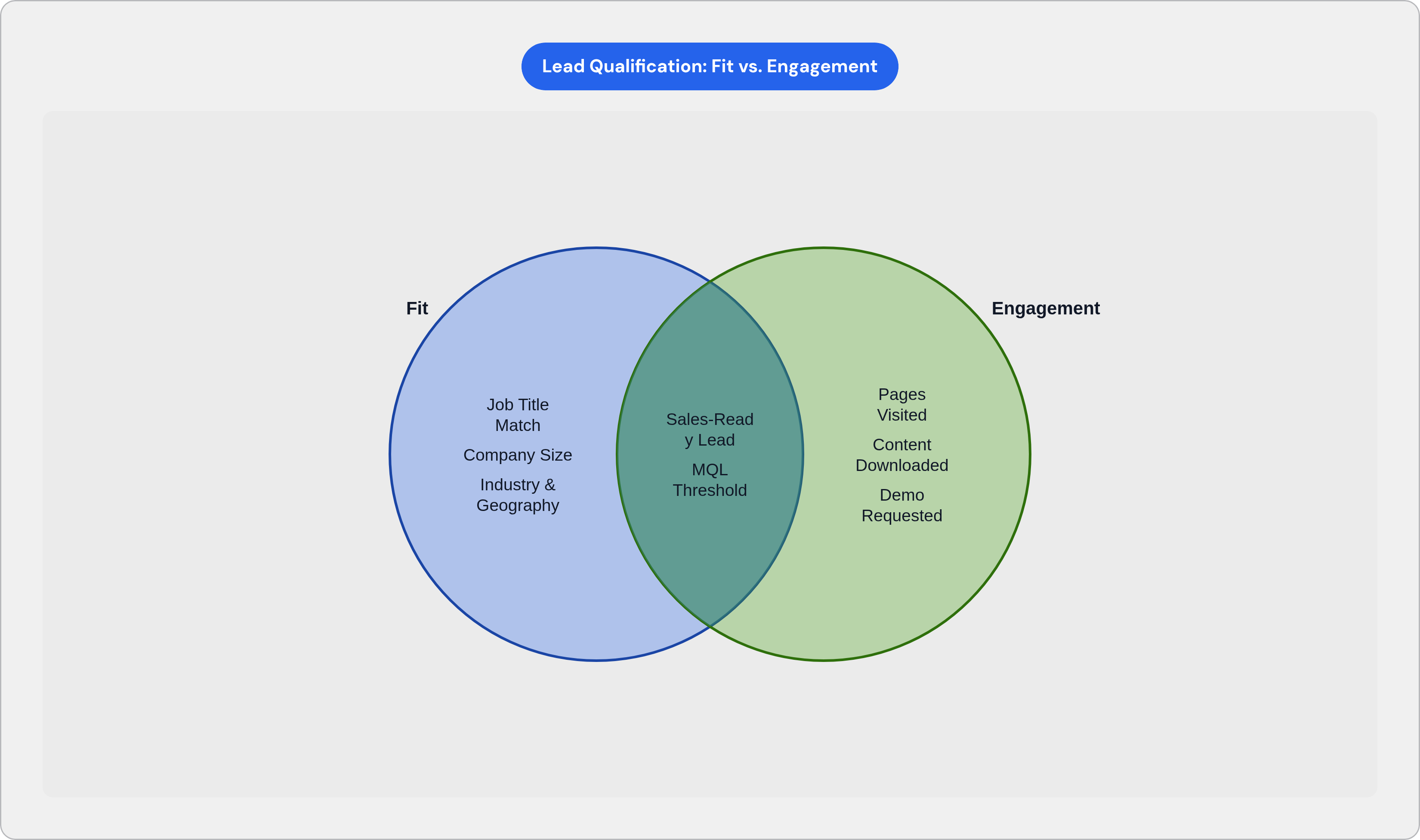
Effective scoring measures two separate dimensions. Fit is whether the lead matches the ICP you defined in step one: title, company size, industry, geography. Engagement is what the lead has actually done: pages visited, content downloaded, emails opened, demo requested. Both are necessary before a lead reaches sales-ready status. A perfect-fit lead who has never engaged with anything is not ready. A highly engaged lead from a company well outside your ICP parameters is not ready either.
The mechanics involve assigning point values to fit attributes and behavioral signals, then building in negative scoring as well. Deduct points for prolonged inactivity, for visiting the careers page rather than product pages, for unsubscribing. Without negative scoring, lead scores inflate over time and the threshold loses its meaning. Add score decay on top of that so a lead who went quiet four months ago doesn't retain a high score that no longer reflects their actual intent.
Most teams set an MQL threshold between 60 and 90 points, with leads scoring high enough to bypass the MQL stage entirely and route directly as SQLs. Review the model every quarter, because buyer behavior shifts and a scoring model calibrated in January can start passing the wrong leads by mid-year without anyone noticing until pipeline quality drops. Teams that build and maintain this correctly see conversion rates climb 20 to 40%, and one Lenskold Group study found 68% of marketers named scoring a top contributor to revenue.
Route qualified leads fast with clear rules
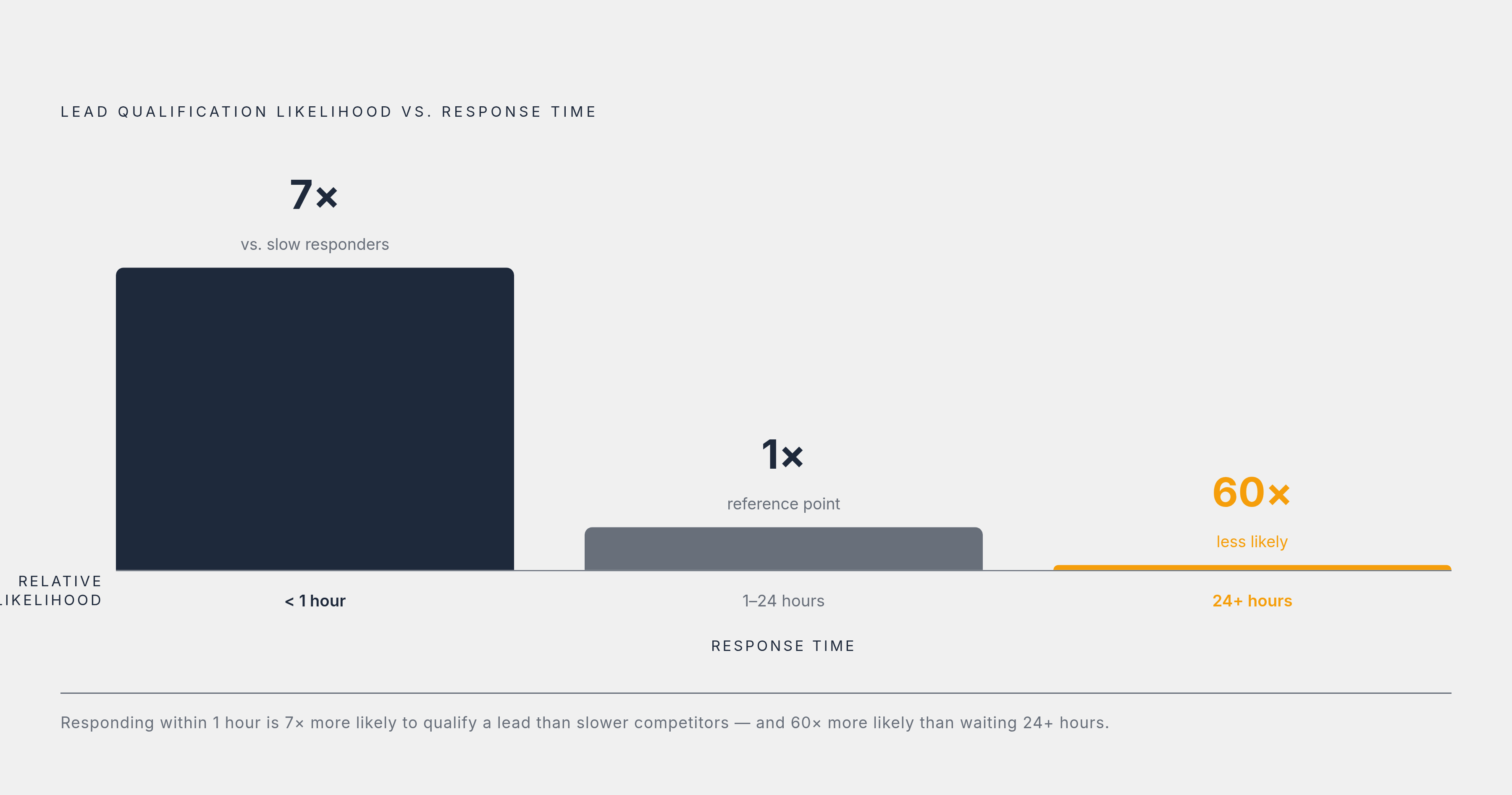
Response speed determines whether qualification work translates into revenue. Harvard Business Review analyzed 2.24 million leads and found companies that responded within an hour were seven times more likely to qualify the lead. Waiting 24 hours or more makes a team 60 times less likely to qualify that same lead compared to one-hour responders.
Routing logic needs to be systematic rather than manual. Criteria-based routing assigns leads to the rep best suited by territory, company size, product line, or language. Round-robin distribution keeps workload balanced when specialization is not the primary factor. Score-threshold routing lets your highest-scoring leads bypass the standard queue and land directly with a senior rep.
Most sales teams still route manually, which introduces delay, inconsistency, and accountability gaps. Without defined rules, lead assignment defaults to whoever responds first regardless of fit, and performance becomes impossible to evaluate fairly. Routing logic without SLAs attached also solves nothing; a hot lead assigned to a rep who takes two days to respond still loses the opportunity.
Build nurture sequences for leads not yet ready
Not every lead captured is ready to buy immediately, and a nurture track exists to develop fit and engagement over time for those contacts. Industry research consistently shows that nurtured leads produce more sales-ready opportunities at lower cost than leads left without follow-up, and email remains the dominant nurture channel across B2B programs.
A functional nurture track requires a sequence of touchpoints, content matched to where the lead actually sits in their buying process (problem-aware content early, proof and competitive comparisons later), and behavioral triggers that pull a lead back into active scoring the moment they show meaningful intent signals such as a pricing page visit, a reply to an email, or a second content download weeks after the first.
One structural rule matters more than any other: the nurture track cannot become a permanent holding pen. Leads that never re-engage need a defined recycle or disqualification point. Otherwise the program accumulates a large volume of contacts receiving communications with no realistic path to conversion, which inflates activity metrics without producing pipeline.
Formalize the marketing-to-sales handoff criteria
The handoff is a decision, not a moment, and it needs to be written down and agreed to by both teams before the program launches. What specifically makes a lead sales-ready? If marketing and sales answer that question differently, the scoring model and the routing logic built on top of it are operating without a shared standard.
A complete handoff package includes the lead score and the specific signals that drove it, the full interaction history covering pages visited, content consumed, emails opened, and forms submitted, any disqualifying information the rep should know before making contact, and a named next-action owner with a timestamp.
Field data confirms how frequently this breaks down: 44% of sales reps cite lead quality as a top frustration, 39% cite readiness to buy, and 37% cite inability to reach the contact at all. None of those are sourcing problems. All three are handoff problems that stem from incomplete information or misaligned expectations between teams.
Sales also needs the ability to reject a lead with a specific reason attached: wrong title, no budget, already a customer. That rejection reason is the feedback that should directly inform the next round of scoring calibration. Without that feedback loop, marketing calibrates scoring in isolation while sales continues receiving leads that don't meet their criteria, and the quality gap compounds over time.
Measuring the program once it's running
Every stage needs its own metric or performance gaps become invisible until they surface as pipeline problems.
Capture is measured by volume per channel and source attribution accuracy. The CRM layer is measured by data completeness and decay rate. Scoring is measured by MQL volume and the MQL-to-SQL conversion rate. Routing is measured by average response time and SLA compliance. Nurture is measured by re-qualification rate and engagement by sequence stage. Handoff is measured by SQL rejection rate broken down by reason code, and close rate by original lead source.
If you track only one number, track the percentage of captured leads that eventually become closed revenue, segmented by source. That metric reveals whether the entire chain from capture through handoff is functioning, or only appearing to function on individual stage reports.
One important caveat: a metric reading zero is not automatically a program failure. It may indicate that the measurement itself is broken, a tag that didn't fire or a field that didn't map correctly, rather than a genuine performance gap. Those two situations look identical on a report and require completely different responses, so verify the data infrastructure before drawing conclusions about program performance.
Set a review cadence and maintain it: weekly for operational indicators like response time and SLA compliance, monthly for conversion funnel analysis, quarterly for a full scoring model review. Each cadence surfaces different types of issues and should inform different types of decisions. The program is not a one-time build. Measurement tells you which stage is weakest, and the fix always cycles back to that stage's original structural decision, whether that is capture setup, qualification criteria, routing logic, or handoff standards.