Essay sales leads
Lead Scoring Models for B2B SaaS Pipeline Prioritization
Scoring models identify high-value leads before they vanish in a noisy pipeline.
Without a scoring model, sales works leads in the order they land, which often isn't the order they're worth working. A lead that fills out a form at 9:01 AM gets called before a lead that fills out a form at 9:03 AM, regardless of whether the first one is a student doing homework and the second is a VP with a live budget and a Friday deadline. Treating arrival time as a priority system means the highest-value accounts often get worked last, or never worked at all, simply because they showed up at the wrong time on the wrong day.
This breaks down even further once volume climbs. A rep looking at ten form fills a day can maybe eyeball which ones look promising. A rep looking at three hundred a week cannot. At that scale, nobody can reliably tell a VP mid-evaluation apart from a curious researcher with no budget just by glancing at a form. Without scoring, sales has no way to tell them apart before wasting a call on the wrong one.
Reps catch on once the queue is noisy enough, and that's when the real damage happens. A sales team given a lead queue that's noisy enough, often enough, stops trusting it. They start working their gut instead. Marketing has no way to see which signals the reps are actually responding to, so marketing keeps optimizing for a queue that sales has quietly abandoned. The feedback loop that's supposed to connect what marketing generates to what sales converts goes dark, and both teams end up making decisions without reliable data.
What a layered scoring model does
The fix is a layered scoring model, one that answers three separate questions about every lead instead of collapsing everything into a single, mysterious number. The three questions are: can this account actually buy (fit), has this prospect shown real intent (engagement), and has this user already experienced enough value in the product to be ready for a sales conversation (product signal). A model that only answers one of these questions will get the wrong leads to the top of the pile, consistently and predictably, because it's only ever looking at a third of the picture.
A fit-only model builds a list of companies that match the ideal customer profile on paper: right industry, right headcount, right job titles. The list looks great in a slide deck, but it tends to be full of accounts that match every demographic box while showing zero interest in buying anything. A behavior-only model has the opposite problem. It rewards activity, so it elevates anyone who clicks a lot of links and downloads a lot of PDFs, including researchers, students, and competitors doing homework, none of whom have a dime to spend or the authority to spend it.
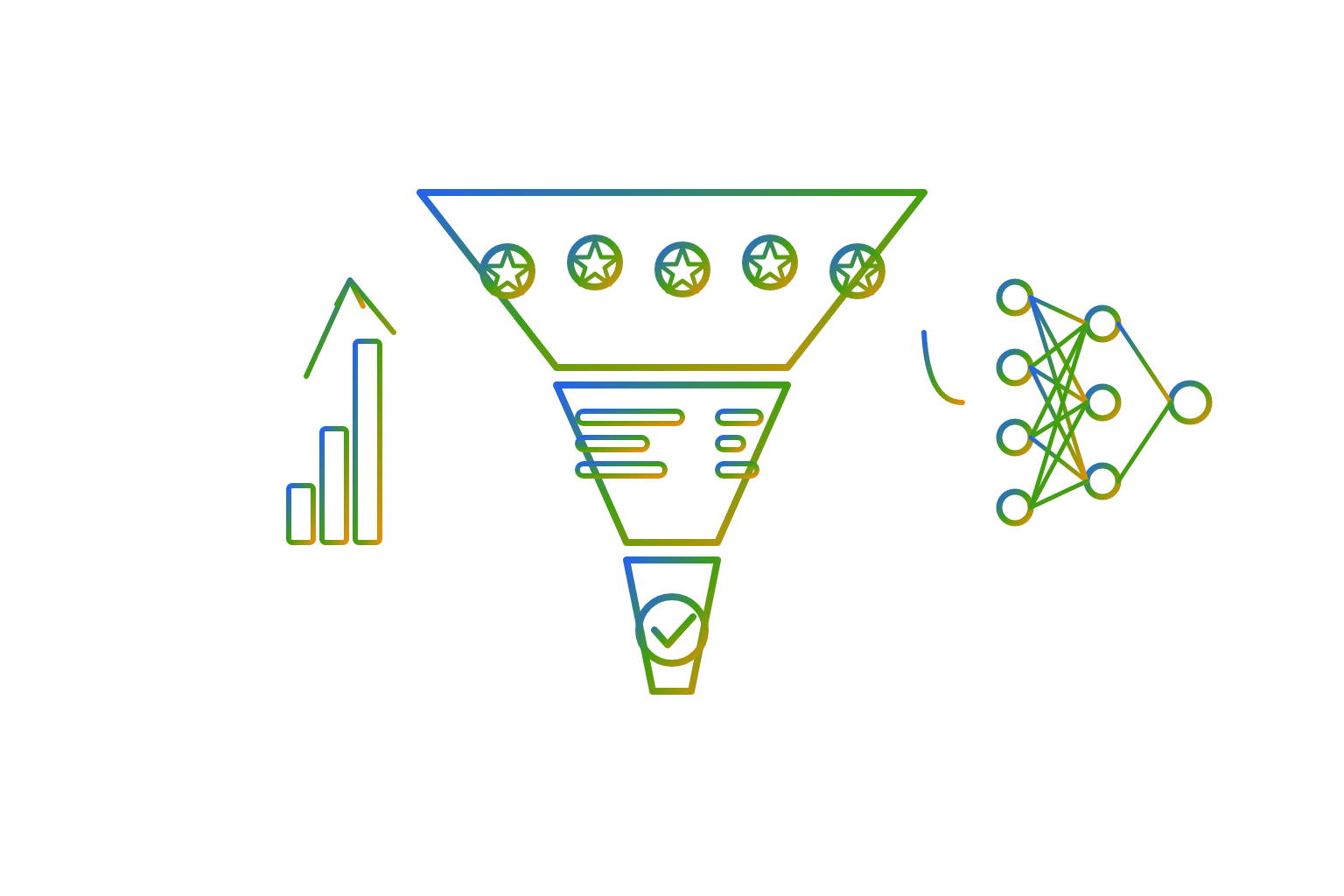
A strong model uses four signal types, each one answering a different piece of the puzzle: firmographic and ICP fit, third-party intent data, technographic and product usage, and direct behavioral engagement. Layering the signals is how a model avoids both failure modes. What matters just as much as which signals go into the model is whether the output stays visible. A single score that hides its own reasoning doesn't help anyone. When a rep sees "72" with no explanation of what built that number, every decision downstream gets shakier, because the rep has no idea whether that 72 means "great fit, no engagement" or "hot prospect, wrong company size." The score needs to show its work.
Firmographic scoring sets the floor
Firmographic scoring is where every B2B model starts, and for good reason: it answers the most basic question in the whole funnel, whether a prospect could buy the product. It checks the things that don't change day to day, like industry, sub-vertical, company size by headcount and revenue, job title and seniority, and geography where that affects the sales motion or compliance requirements. A company's current tech stack belongs here too, because what a prospect already runs says a lot about both fit and timing. A prospect running tools that integrate neatly alongside the product in question is a much easier sell than one that would need to rip out its entire stack to make room.
Weighting matters here too, and it isn't flat across every contact at an account. A single pricing-page visit from a confirmed budget-holder means a lot more than the same visit from an intern doing research for a boss who isn't even in the CRM yet.
The risk with firmographic scoring is treating it as the finish line instead of the starting line. A lead that scores high on fit and shows no engagement at all is a cold prospect: correct title, correct company size, correct industry, and absolutely no signal that they're actually in-market right now. The fix is to rebalance the model so recent, active intent carries real weight alongside fit scoring. Fit tells a team who could buy. It says nothing about who's ready to buy right now, which is exactly the gap the next layer is built to close.
Behavioral scoring separates intent from browsing
Behavioral scoring only earns its keep when it weights actions by how close they sit to an actual buying decision, not by how many actions a prospect racked up. A prospect who does five things on a website isn't automatically five times more interested than a prospect who does one thing. It depends entirely on what those things were.
A prospect who downloads three whitepapers over a month might be a researcher with no budget and no mandate to buy anything. A prospect who visits the pricing page once and then emails asking about contract terms has done far less and matters far more. A prospect returning to the same product page more than once in a short window is likely building a case internally rather than casually browsing. A prospect asking about API limits, SSO support, or specific integration requirements is doing technical due diligence that only someone who has to make the integration work would bother with.
Lower-intent activity still belongs in the model, but needs lighter weighting: content downloads, email opens, webinar attendance, and single page visits with nothing following them. These are worth tracking, but not worth triggering an outbound call. A model that treats a whitepaper download the same as a pricing-page visit has already failed at the one job behavioral scoring exists to do. Third-party intent data fills a gap that on-site tracking can't see: a spike in external research around a product category, or around a specific competitor, appears before a prospect ever lands on the site. That makes it a leading indicator rather than a lagging one, catching intent earlier than any on-site click ever could. None of this works if a rep only sees a number. A rep needs the score plus the reasoning behind it, including which pages, which emails, and which content drove it, because a bare number doesn't tell anyone what to say on the call or why today is the right day to make it.
Reps catch on once the queue is noisy enough, and that's when the real damage happens.
Product usage signals real buying intent
For any SaaS company running a self-serve or product-led motion, product usage data is the strongest buying signal available because it reflects what a prospect actually did inside the product rather than what they clicked on a marketing page. Connecting an integration, inviting a teammate, or setting up a core workflow indicates that someone found enough value to invest real time.
A Product Qualified Lead, or PQL, is a user who has already experienced value through self-serve usage and is likely to convert to a paid plan. A PQL is a structurally different animal from an MQL. The strongest usage signals to track include trial activation (completing the specific setup steps that correlate with a user actually getting value, not just creating an account), adoption of core features tied to the product's main value proposition, connecting third-party integrations, and inviting teammates onto the account. Each of these signals that the user is investing time because the product is already working for them.
Building this layer requires product analytics or event tracking wired into the pipeline. The companies growing fastest in B2B SaaS right now are hybrid: product usage data triggers and prioritizes outbound outreach, so a sales rep calls a trial user the week they invite three teammates and connect an integration, not six weeks later after the trial has already gone cold. That combination pairs the reach of self-serve acquisition with the precision of a sales team that knows exactly who to call and why.
Score buying committees at the account level
Most B2B SaaS deals of any real size are decided by a committee: a champion, an economic buyer, a technical evaluator, sometimes a procurement contact who shows up only at the very end. Scoring individual contacts without rolling those scores up to the account level means missing the most important signal of all, which is a whole buying group moving at once. Five separate contact records showing medium scores, sitting unconnected in a CRM, appear unremarkable even when they represent a live committee evaluation.
Account-based scoring solves this by pulling individual contact signals together into one account-level number that reflects the whole group's intent. Three design choices matter most in building this layer. First, score at both the contact level and the account level, and show both numbers to the rep rather than hiding one inside the other. Second, flag it when a senior, economic-buyer-level contact becomes newly active at an account, even if that person's individual score looks unremarkable on its own, because a signal from the person holding the budget outranks a louder signal from someone who isn't. Third, track the number of engaged contacts per account, because multiple stakeholders engaging simultaneously is a stronger indicator of active evaluation than any single contact score.
Skipping this layer doesn't just lose a little precision. It systematically undercounts exactly the enterprise accounts a sales team most wants to win, because those are the deals with the most people involved and the most contact-level noise to untangle.
Rule-based, predictive, or AI: choosing correctly
The choice between rule-based, predictive, and AI-driven scoring comes down to how much historical data exists and how ready the organization is to act on what that data says.
Rule-based scoring is the simplest of the three: a human defines the criteria, assigns point values, and the system adds them up. It's manual, transparent, and easy to adjust, which makes it the right fit for early-stage teams, smaller pipelines, or any team that hasn't closed enough deals yet to train a predictive model on real outcomes. The weak spot in rule-based scoring is that the point values reflect someone's best guess about what predicts conversion, not necessarily what actually predicts it in that company's own data.
Predictive scoring replaces guesswork with history: it studies which signals actually appeared on deals that closed, rather than which signals seemed important at the time. Without enough historical data behind it, predictive scoring produces numbers that sound confident but mean very little, because a model trained on fifty closed deals is really just trained on noise.
AI and machine learning scoring adjusts continuously as new deals close and buyer behavior shifts, without someone manually rebuilding the model every quarter. This tier fits teams with complicated sales cycles, several distinct buyer personas, or lead volume too high for manual scoring to keep up with. Each tier fits a different stage of data maturity, and implementing AI scoring before the data can support it produces a more sophisticated version of the same bad guesswork that rule-based scoring was built to avoid.
Decay and negative scoring prevent model drift
A scoring model that never changes after launch slowly fills up with false positives, and a queue full of false positives puts sales back in a position of ignoring the list and working off gut instinct instead. Two mechanisms prevent that from happening. Score decay lowers a lead's score automatically as time passes without new engagement, so a prospect who looked promising three months ago and has gone silent since doesn't keep sitting at the top of the queue. Negative scoring works the other way, actively subtracting points for actions that signal disqualification: an unsubscribe, a bounced email, a job title that turns out to belong to a student or a job-seeker, or a company that falls outside the size range the product is built for.
Together, these two mechanisms keep a scoring model accurate over time rather than just accurate on the day it launched. A model needs the same kind of ongoing upkeep as the pipeline it's meant to prioritize, and teams that treat scoring as a living system, rechecked and adjusted as the business changes, are the ones who keep sales trusting the queue instead of quietly working around it.
Notes
- ICP Scoring Rubric for B2B SaaS: 4 Weighted Pillars (2026)
Supported the point that behavioral scoring must weight actions by their proximity to a buying decision rather than raw activity count.
- Product Qualified Leads (PQL): Definition, Scoring Model & Playbook
Supplied the key PQL usage signals to track, including trial activation, core feature adoption, integration connections, and teammate invitations.
- What Is a Product Qualified Lead? PQL Guide for B2B
Provided the definition of a Product Qualified Lead as a user who has experienced value through self-serve usage and is likely to convert to a paid plan.