Lead Nurturing Sequences for Long B2B Sales Cycles
Strategic nurturing beats generic drip campaigns in long B2B sales.
Gartner's research puts the average B2B purchase at up to 22 people and six to eighteen months to close. Most nurture programs still act like they're talking to one person who'll decide by Friday. That mismatch is the whole reason pipeline evaporates: the follow-up was built for a buyer who doesn't exist, and honestly never did.
None of the stretch in modern sales cycles is a blip caused by a soft economy or jumpy buyers. Enterprise software deals run 12 to 18 months. Mid-market runs 6 to 9. That's just how committee-based purchasing behaves once the check gets big enough to need six or more signatures.
Drip and nurture get treated as synonyms, and that mix-up is costing pipeline. A drip campaign fires the same five emails, on the same schedule, to everyone who filled out a form, no matter what they do next. Nurture watches what a prospect clicks, downloads, or revisits, and changes the next move based on that. Drip is a tactic that lives inside a nurture strategy. Owning a hammer doesn't make someone a carpenter, and scheduling five emails doesn't make someone a nurture program.
Skipping the distinction costs real pipeline. Invesp research found 80% of new leads never convert to sales, mostly from a lack of follow-through, while half of all leads are qualified but simply not ready yet. The upside runs the other direction just as hard: the Annuitas Group found nurtured leads make purchases 47% larger than non-nurtured ones, and Marketo research shows 63% of leads who weren't ready at first contact eventually convert when a real nurture sequence is running underneath them.
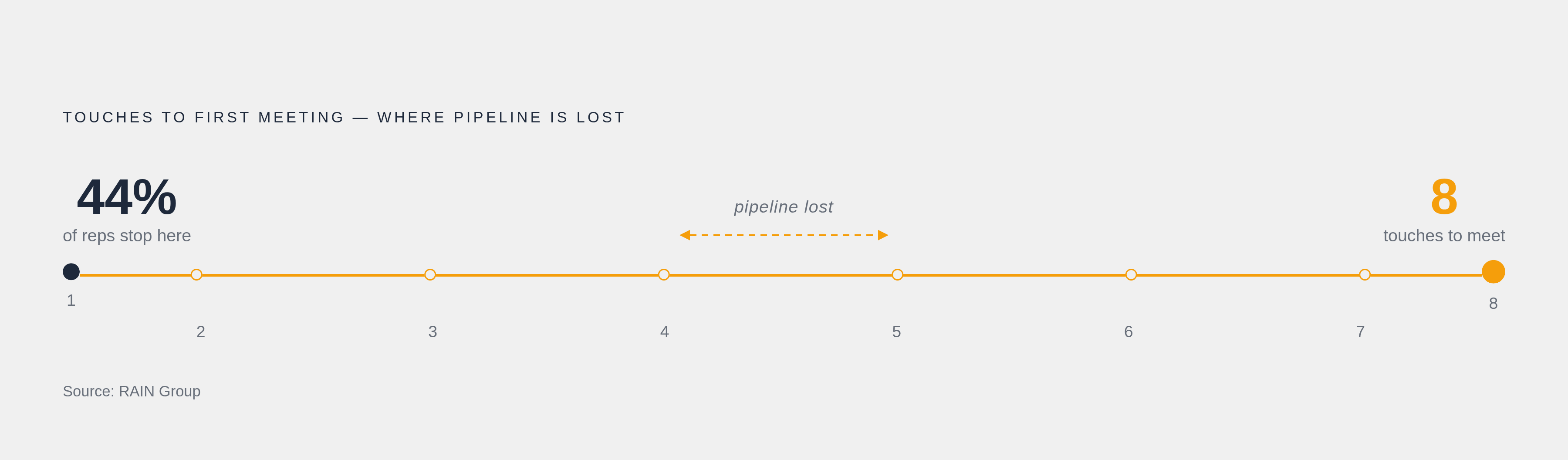
RAIN Group puts the average number of touches needed to land a first meeting at around 8. Yet 44% of sales reps give up after a single attempt. That gap, between touch one and touch eight, is where entire quarters of pipeline quietly go to die. Closing it means building sequences around three things: stage, stakeholder role, and behavioral signal.
Mapping the buying journey before building a sequence
Dreamdata's 2026 benchmarks clock the average B2B buyer journey at 272 days across 88 touchpoints. Eighty-eight. A good chunk of those happen somewhere no tracking pixel can reach, such as a Slack forward, a hallway conversation, or a private group chat where someone types "hey, did you look at this vendor yet?"" Gartner adds the uncomfortable part. Buyers spend only about 17% of total purchase time actually meeting with suppliers, and a small fraction of that time with any single rep while comparing options. The rep is barely in the room. The sequence is doing the job the rep physically can't be in two places to do.
So before a single email gets written, map the terrain.
Start with stages defined by behavior, not by feeling. Awareness looks like someone reading a category-level article with zero product mention. Consideration looks like a downloaded comparison guide. Decision looks like a pricing page visit. Late-stage validation looks like someone searching for a security whitepaper at 11pm the night before a board meeting. "Awareness" and "consideration" work fine as labels on a slide deck, but they can't trigger an email on their own. Behavior is the only thing that can.
Then map roles, because a deal with six to ten stakeholders has six to ten different definitions of convincing. The economic buyer cares about business impact and risk exposure. The champion wants to know if this fits into a Tuesday afternoon without breaking their workflow. The technical evaluator cares about implementation detail and exactly where this breaks under load. Procurement cares about contract terms and about whether the vendor will still exist in three years.
Sending the technical evaluator's content to the economic buyer causes them to stop reading at paragraph two. Nothing wrong with the content itself, it's just aimed at the wrong nervous system. A single persona deck covering "the buyer" doesn't survive contact with a real deal. The program needs a distinct content path for each role, or the CFO ends up forty pages into an implementation spec and never reaches the part where someone tells them what this costs.
Intent data closes the loop. Third-party intent data sources, including platforms like G2, Bombora, and LinkedIn, flag when an account starts actively researching the category, sometimes before anyone fills out a form. Layering that against a prospect's own behavior (pricing page visits, comparison downloads, a sudden spike in how fast they open emails) forms a real picture. Accounts routed to sales quickly after an intent trigger convert at meaningfully higher rates than accounts sitting in a standard MQL queue. Speed decides the outcome here. Catch a buyer mid-thought and it converts. Catch them after they've already picked someone else and it doesn't.
One more input gets skipped by nearly every marketing team: the CRM notes and call recordings sitting untouched on the sales side. Talk to account executives regularly. If three separate reps mention prospects stalling on data compliance questions, that's not a line item for the FAQ page. That's a content gap with a name and a stage attached to it.
The output of all this mapping is a matrix: stage down one side, role across the top. That grid says exactly which sequences to build and who each one is actually talking to.
Sequence architecture: structuring tracks by stage, role, and deal size
Every send answers three questions before it goes out. Where is this person in the journey? Which role are they playing on the buying committee? And what's the most recent thing they actually did?
Stage sets the content type. Awareness-stage sends should read like a sharp friend explaining the category: FAQ-style breakdowns, thought leadership that answers the question behind the question. Consideration-stage content turns tactical, webinars, how-to guides, role-specific comparisons someone can carry into a meeting with their boss. Decision-stage content needs teeth: case studies with named companies and specific numbers, ROI framing solid enough to survive getting forwarded to a CFO who's never spoken to the rep and never will. Late-stage validation content stops trying to excite anyone. Its whole job is removing risk: implementation guides, compliance documentation, customer references proving the vendor won't vanish after the contract's signed.
Role determines the branch, and this is where most programs cut a corner they shouldn't. A single champion carrying the entire case through six to ten stakeholders is a fragile bet. One internal reorg or one skeptical VP and the deal stalls out. Build separate paths for each major role instead of relying on one internal advocate to relay the pitch secondhand, badly, three weeks after they last thought about it. Write everything to survive forwarding, too. A technical brief that lands in a CFO's inbox with zero context will get forwarded whether anyone planned for it or not, so it needs to hold up on its own.
Deal size sets the pace, and treating a five-figure subscription and a six-figure enterprise contract as the same animal just annoys the buyer. Enterprise cycles need more room between touches, because the prospect is genuinely gathering internal consensus across a dozen people, not stalling out of disinterest. Active leads generally want consistent, reasonably frequent contact. Less engaged ones want less. Space it out too far and the deal cools. Cram it in and the vendor becomes the one everyone mutes.
Format is the factor most sequences never account for, and it's not a minor one. Video ranks as the most effective B2B content type according to 58% of marketers, with case studies close behind at 53%. Both belong squarely in consideration and decision tracks. LinkedIn video watch time has grown sharply, so a video case study built for email can get a second life natively on the platform. Here's the specific mistake most SaaS companies make with case studies: they keep them vague. "Company X saw great results" convinces no one. Company X, dated, with a number attached, convinces a skeptical technical evaluator. A vague case study just confirms the suspicion that something's being hidden.
Run a 3:1 give-to-get ratio through the whole sequence: three pieces of real value before any direct ask. Cut the "just checking in" email. It carries no new information, and the prospect knows it on sight.
Behavioral signals that trigger sequence branches and prevent drip decay
Branch logic is the mechanism that separates a nurture sequence from a fancy drip campaign wearing a nicer outfit. Someone clicks an email about a specific feature? The next send is a case study on that exact feature, not email four from whatever generic queue they got dropped into on day one. Someone visits the pricing page? That's a loud signal, and it should route to a different branch entirely, one that fires because of what just happened rather than whatever awareness-stage piece was next on autopilot.
Set up alerts for the loud signals specifically: pricing page visits, demo request page views, comparison content downloads, a sudden jump in open speed. One download alone means almost nothing. Someone could've clicked it by accident on a slow Tuesday afternoon. But a pattern, three downloads, two pricing visits, a spike in open rate inside a two-week window, is a real signal that demands acting on immediately.
Lead scoring only works when it's built against actual closed-won deals, not assumptions about what "engaged" looks like on a dashboard. A scoring model that doesn't track with real revenue erodes trust between sales and marketing fast, and once that trust is gone, reps just start ignoring the score. Content Marketing Institute research found 47% of B2B marketers say they lack solid data management and reporting, and many cite weak lead nurturing processes alongside it. Same root problem, two different survey questions: the infrastructure to run behavioral branching properly often just isn't there yet.
Slowing down matters as much as speeding up. A prospect who's gone quiet doesn't need more emails, they need fewer of them. Gartner found 73% of buyers actively avoid suppliers whose outreach misses the mark, and volume was never what buyers were asking for. Relevance was. Pile more emails onto a cooling lead and the unsubscribe just arrives faster.
For leads who've genuinely gone quiet, and most of them have, thanks to budget cycles, internal approvals, priorities that shifted three times since last quarter, build a lighter re-engagement track. A touchpoint every 30 to 45 days works, whether it's an industry update, a webinar invite, or a new resource, as long as nothing feels pushy. The only goal is staying visible, so that when the buyer's situation changes, and it will, the name in their inbox is already familiar instead of something they have to go dig up.
AI now drives a meaningful chunk of this. Research found 87% of content teams already use AI to help create content, and the pattern extends into lead scoring and email drafting across sales organizations. The useful application is sorting: who to prioritize, what to personalize, across thousands of contacts at a scale no human team could manage by hand.
Omnichannel coordination: layering LinkedIn, calls, and events alongside email
Email still does most of the heavy lifting. UpLead's 2026 benchmarks have 78% of nurturing practitioners ranking it the most effective channel for sustained engagement. But buyers rack up 62 or more touchpoints before deciding, and no inbox survives that many emails without the recipient reaching for the unsubscribe link out of sheer self-defense.
Multi-channel just means using more than one channel. Omnichannel means those channels talk to each other, and the buyer notices the coordination the instant it happens. A LinkedIn connection request referencing the case study someone downloaded last week reads as one continuous conversation. A random InMail with zero context reads as noise. Coordinate the sequence so each touch, an email, a LinkedIn message, a call, builds on the one before it, so the prospect feels like they're in one ongoing conversation rather than three separate campaigns that happen to be aimed at the same inbox.
LinkedIn carries real weight here. It is widely recognized as the leading B2B platform and remains the clearest path to decision-makers who won't answer a cold email. Paired with that 36% jump in video watch time, a video case study built for email nurture gets meaningfully more reach once it's also distributed natively on the platform.
Events and webinars deserve a bigger role in the sequence than most teams give them. Webinars are broadly recognized as high-performing channels for nurture, holding strong opportunity-to-close numbers relative to other formats. Events work specifically for nurture because they put multiple stakeholders in the same room, or the same video call, at once, which is the only real shot at addressing a shared objection collectively instead of repeating the same answer on six separate calls. Treat the invitation itself as a sequence decision: decide who gets invited, at what stage, and what happens next for the person who showed up versus the person who registered and vanished.
Calls belong inside the sequence too, not floating outside it as some separate motion sales runs on its own clock. A call made with no reference to what the prospect has actually engaged with is a cold call wearing a nurture costume. Calls should fire off behavioral triggers, an intent spike, a specific page visit, and the rep should walk in already knowing the engagement history. Nobody wants to re-explain their own situation to someone who's supposed to already be paying attention.
Coordinate frequency across all channels combined, not per channel in isolation. A prospect getting two emails, a LinkedIn message, and a call in the same week doesn't care that each channel individually stayed "within cadence." They just feel hunted.
The sales handoff: where most nurture programs break down
Most nurture programs fail at the handoff, the exact moment marketing passes a lead to sales. It sounds like the simplest step in the whole process, and it's almost never the one that goes right.
Almost always, there's no shared, written definition of what actually qualifies a lead for sales attention. Marketing and sales need to agree, in writing, on the specific score or behavioral trigger that fires a handoff. Skipping that agreement puts a high-scoring lead on a rep's desk who can offer nothing better than a vague memory of a whitepaper the prospect downloaded six months back. The prospect can tell nobody's been paying attention. Trust between the two teams erodes fast after a few rounds of that, and before long the scoring model itself gets treated as noise nobody bothers checking.
Timing compounds the problem. A lead sitting in a queue for three days after crossing the qualification threshold is a lead cooling back down in real time. Routing intent-triggered accounts to sales quickly produces meaningfully higher conversion rates than the standard MQL handoff timeline, and that routing has to be automatic, fired the instant the threshold hits. Waiting on a human to notice a dashboard update lets three days slip by unnoticed, and three days is often the whole margin.
The feedback loop is the piece almost every team skips, and it's the one that matters most over time. Sales needs to report back what content came up in the conversation, what objections surfaced, and how the deal turned out. Skipping that loop means the scoring model never gets corrected against reality. It drifts, quietly getting less accurate every quarter while everyone assumes it still works. Validate the model against closed-won data continuously, not once a quarter at the business review.
And then there's nurture purgatory: leads circling through the sequence indefinitely with no way to raise a hand and say "actually, I'm ready now." Every sequence needs an obvious, unmissable path to a real sales conversation, a call-to-action that doesn't make the prospect go hunting for it. Skipping that puts the best-fit lead in the entire database in the same drip queue as someone who downloaded one PDF once and never opened another email again.