Essay Sales
Decision Maker Identification in B2B Enterprise Sales Cycles
Buying committees now average 8 to 13 people, making title-based targeting obsolete.
Enterprise B2B sales used to run on the assumption that they would find the person with the right title and get them to sign. The single-decider model is dead. It has been for a while. What killed it was a pile-up of structural changes, not one dramatic event. Digital transformation wired every system to every other system. A purchase in marketing now touches IT, security, and ops whether anyone planned it that way. Add post-COVID risk aversion, brand-new governance roles for AI and ESG that did not exist a decade ago, hybrid work adding friction to internal approvals, and procurement departments locking down controls tighter than ever. Putting all that together produces committees, not commanders.
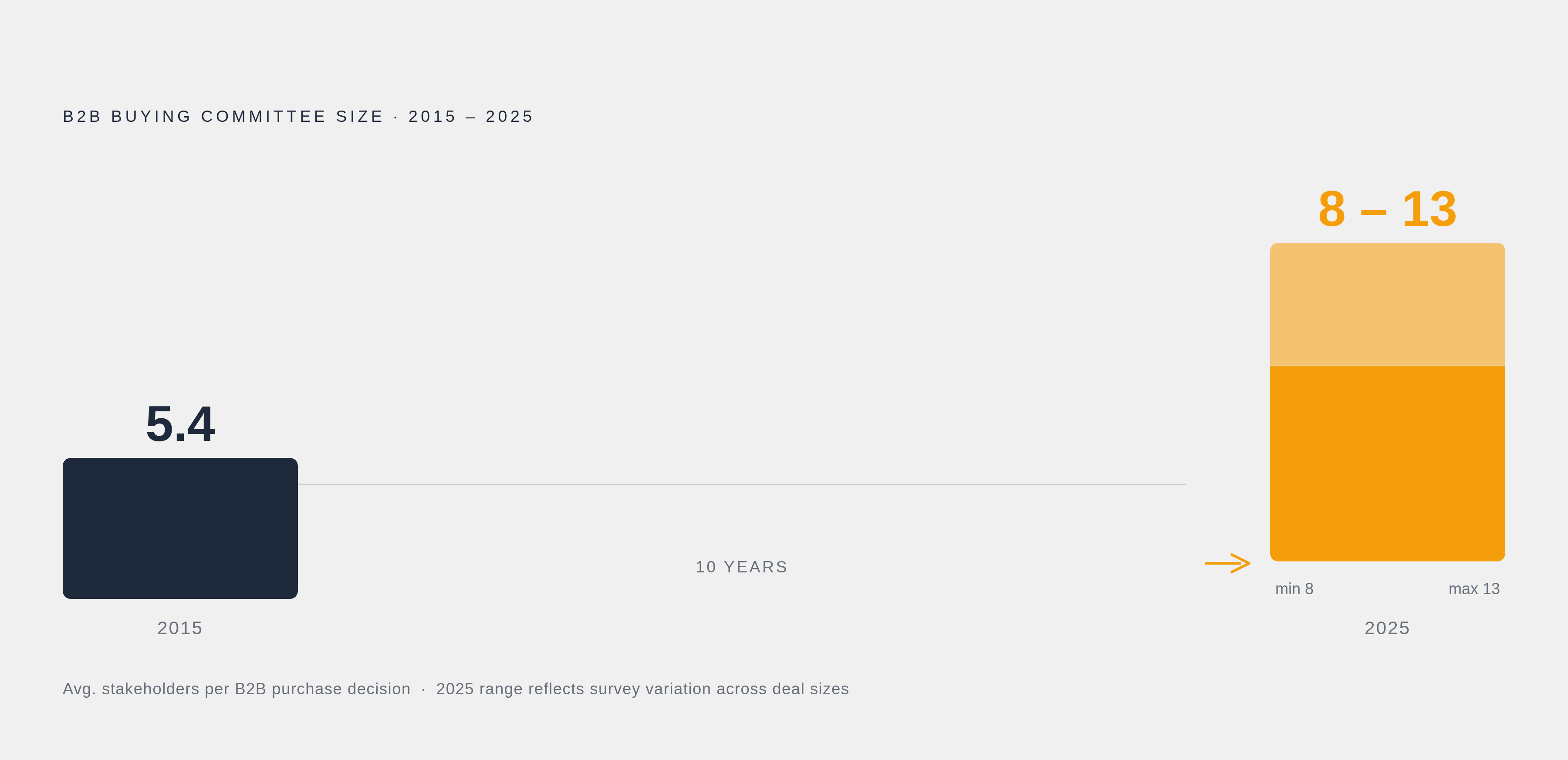
The numbers back this up. The buying committee has grown from 5.4 stakeholders in 2015 to 8 to 13 in 2025, nearly doubling in a decade, according to documented findings (Attainment Labs, reechee.io). That is a structural shift in how organizations spend money, not a gradual drift. For sales and marketing teams, this changes who to contact first. The person who replies fastest to an email is often just the most responsive person on the committee, not the one who decides anything. Behaviors tell the real story.
How Authority & Veto Power Are Distributed
The buying team does the actual legwork, like researching vendors, sitting in demos, building the comparison spreadsheet. The buying committee is the formal approval body, and some of its members may never show up on a sales call before they sign off or kill the deal.
Inside that committee, there are five roles that often show up across orgs. The Economic Buyer holds the P&L and cares about budget and ROI above all else. The real signal to look for is not seniority but who actually owns the initiative. The Technical Buyer sits in IT, InfoSec, Engineering, or RevOps, and worries about integrations, security, and compliance. A Manager of Revenue Operations can carry more real technical weight than a Director of IT, depending on how the organization is structured. The User Buyer is whoever's team will actually live inside the tool every day, and they care about workflow fit and whether it saves them time. The Champion is the mid-level contact who advocates internally when nobody from the vendor side is in the room, usually identified by how fast they respond and how specific their questions get mysterydemo.com. The Blocker, usually sitting in Finance, Legal, or IT Security, is more often than not the least-engaged person in the whole outreach effort, even though objections about risk, compliance, and budget are among the most common reasons deals stall late in the process.
Data on how these roles actually appear inside real committees puts primary decision makers at 45%, champions at 29%, researchers at 26%, and end users at 21% mysterydemo.com.
Organizational hierarchy affects who can approve or block a deal, but it doesn't track titles the way most people assume. C-level executives approve the largest decisions, department heads and directors run departmental-level decisions, and managers can influence without ever touching a budget line. Company size determines which layer actually holds the power for any given deal. A "VP" at a 12-person startup might control zero budget, while a "Senior Manager" at a 500-person company might own a six-figure line item outright reechee.io. Real buying power comes down to who controls the budget, who is accountable if the purchase fails, and who has enough organizational credibility to push a decision through committee reechee.io. According to MysteryDemo, 89% of B2B purchases involve two or more departments, and Gartner finds buying groups spanning as many as four functions.
Committee Size by Deal Size and Sector
Committee size scales with deal complexity. General enterprise deals run 6 to 10 decision-makers per Gartner, and each one arrives already carrying 4 to 5 pieces of independent research they conducted before any vendor contact. Complex purchases push that to 13 internal stakeholders plus another 9 external participants such as analysts, consultants, and implementation partners, according to Forrester's 2026 research. Once a deal crosses the $1 million mark, committee headcount jumps to between 14 and 23 people. In the most complex enterprise deals, Forrester's research extends the full decision network out to 22 people.
Technology purchases run larger still. The average tech-buying committee is around 25 people, split roughly 13 from IT and 12 from lines of business reechee.io. At enterprise scale specifically, that average influencer count climbs to 33, with 17 from IT and 16 from the business side.
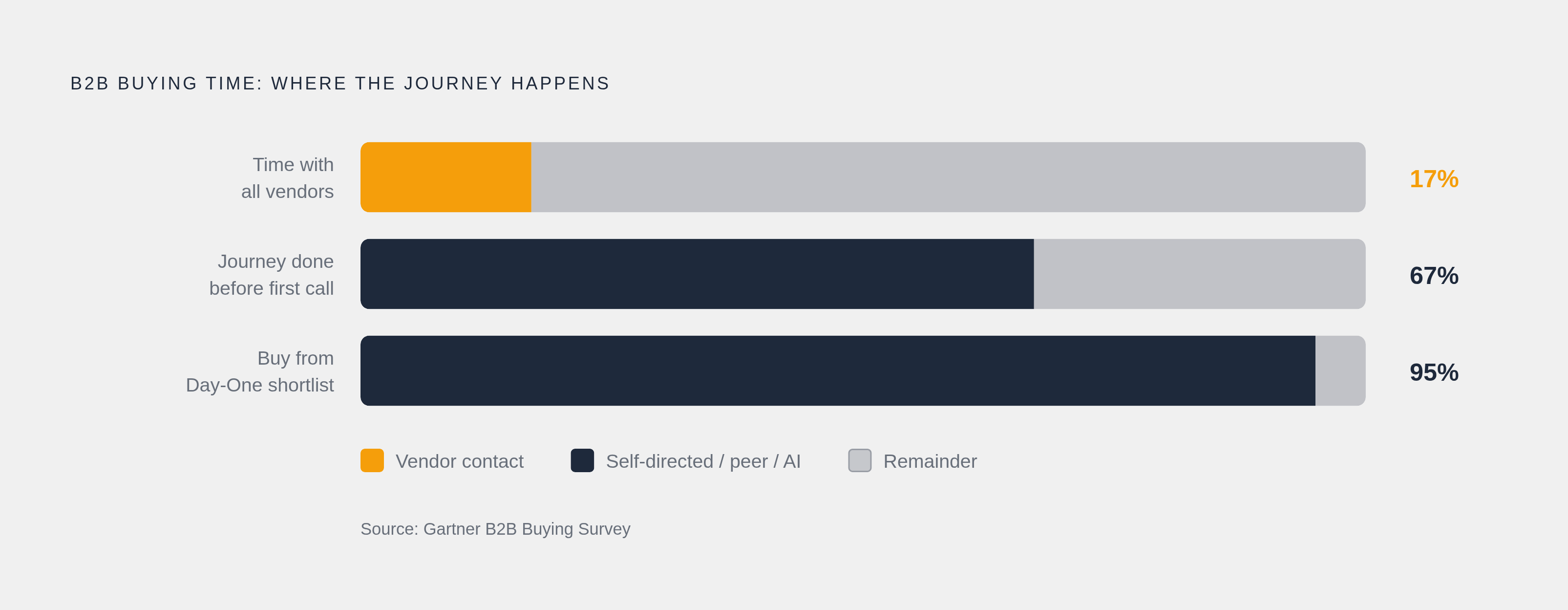
Forrester found 27 separate interactions happen across the buying group before a purchase closes, and 67% of the buying process wraps up before sales ever gets involved. Committee size also appears to be leveling off around 12 stakeholders as procurement teams start capping committee size on purpose to reduce decision paralysis, so growth here is not unlimited.
Even a modest enterprise committee of 6 to 10 people, each arriving with independent research already completed, represents more pre-formed opinion than any single sales call can realistically reshape. Sellers who understand this stop trying to persuade from scratch and instead focus on confirming existing beliefs or earning a place on the shortlist.
Why Buyers Shortlist Before Contacting Sales
More than 80% of buyers have already picked their vendor before they ever make first contact with a salesperson, and 95% end up buying from whoever was on their initial shortlist, a number that should reframe every enterprise go-to-market plan.
61% of B2B buyers now say they would prefer to complete the entire purchase with little to no involvement from a sales representative. The buyer's journey itself has stretched out too, averaging 272 days, up from 211 days just a year prior, spanning 88 touchpoints across 4 different channels, with 10 stakeholders touching the deal along the way.
The majority of that time goes into content consumption, peer conversations, AI-generated answers, and review sites, activity that no salesperson ever observes directly. Gartner's research found that only 17% of a buyer's total time across the entire purchase process gets spent meeting with vendors, which means every vendor interaction has to be substantive and directly relevant to that buyer's specific concerns.
The buying team does the actual legwork, like researching vendors, sitting in demos, building the comparison spreadsheet.
Mapping the Decision Unit Before First Outreach
Start with the org chart rather than a contact list pulled from a database. LinkedIn Sales Navigator's account view surfaces recent hires, mutual connections, and departments that are visibly growing. Search VP and C-suite titles in the relevant function first, then filter down to the Directors and Managers who report into them. Press releases naming an executive as the lead on a strategic program indicate who actually owns an initiative, and job postings that describe budget responsibility are a reliable signal for identifying the Economic Buyer.
Mapping each role takes a different approach. For the Economic Buyer, look for P&L accountability and involvement in past vendor-selection decisions such as product launches or budget reallocations. For the Technical Buyer, title alone tells you nothing useful; confirm through discovery what systems they own and what they are responsible for if an integration fails. The Champion reveals themselves through behavior: how fast they respond, how specific their questions get, and whether they volunteer internal context that was never requested mysterydemo.com. The Blocker is often identified by absence, meaning who has not been mentioned anywhere in the Champion's account of how the internal process works.
MEDDIC and its extended variant MEDDPICC give enterprise sellers a qualification framework covering Metrics, Economic Buyer, Decision Criteria, Decision Process, Paper Process, Identify Pain, Champion, and Competition. Each element forces an explicit answer about stakeholder roles, which prevents assumptions from filling the gaps. Part of the discipline here is keeping the buying team and buying committee separate in practice, tracking who is doing the research day to day versus who only appears at the final approval stage, and ensuring outreach reaches that second group before the approval meeting, not during it.
The most common mapping mistake is treating seniority as a substitute for budget authority. A Senior Manager at a large enterprise can easily own the exact budget line that a VP only reports on.
Why Multi-Threading Wins More Enterprise Deals
Single-threaded deals carry a structural weakness: if the one internal champion changes roles or leaves the company, the deal resets. B2B technology roles turn over frequently, and a six-month enterprise sales cycle gives ample time for that contact to depart mid-process.
Won deals in the $50,000 to $250,000 range typically include at least 10 stakeholders touched along the way. Multi-threading a deal above $50,000 in annual contract value boosts win rates by 130%, which is a decisive difference rather than a marginal improvement.
Operationally, multi-threading means reaching Finance and IT simultaneously instead of waiting on one to respond before engaging the other, which eliminates the dead time deals spend stuck in sequential approval queues. Enterprise purchases require consensus across Finance, IT, Operations, and Legal. When each function receives a slightly inconsistent version of the pitch, that internal misalignment can kill a deal as effectively as losing to a competitor. Multi-threading also means equipping the Champion with role-specific materials they can carry into internal discussions the vendor is never invited to: ROI summaries, case studies, and competitive comparisons built around that account's specific situation.
Tailoring Message to Each Stakeholder Role
A CFO does not want to hear about features; they want to know that the finance team closes the books two days faster. A CMO wants to know that content quality holds up because a qualified person remains in the workflow. The same product capability needs to be translated into whatever outcome each role is actually measured on.
Thought leadership carries more weight than most sales collateral. 73% of target decision-makers say it demonstrates vendor value better than traditional marketing or sales materials. C-level contacts reply positively 14.16% of the time when the pitch centers on ROI, strategic alignment, and competitive positioning. VPs reply at 11.3% when the framing shifts to business outcomes and pipeline impact. At the director level, reply rates stand at 2.46%, favoring operational efficiency framing. At the manager level, reply rates run roughly 1.5 to 2.0%, favoring daily workflow friction and feature completeness framing, according to Sales.co 2026 research based on more than two million emails analyzed.
Content needs also vary by purchase stage. Early research calls for thought leadership and long-form educational material, which self-directed buyers consume before they build a shortlist. Mid-evaluation calls for ROI summaries, case studies, and competitive comparisons the Champion can use as internal enablement material. Late-stage consensus-building content needs to speak directly to the Blocker, addressing compliance posture, failure scenarios, and risk mitigation directly rather than treating those concerns as secondary.
Research from Matt Dixon and Ted McKenna, published in Harvard Business Review and based on 2.5 million analyzed sales conversations, found that 40 to 60 percent of deals were lost not to a competitor but to indecision. Buyers who genuinely intended to purchase simply never acted. Content strategy needs to treat that indecision risk with the same seriousness it treats competitive differentiation, because a deal lost to inertia and a deal lost to a rival produce identical outcomes on the scoreboard even though the interventions required are completely different.
How AI Engines Determine Vendor Shortlists
GenAI chatbots are now the single most influential source shaping B2B vendor shortlists, at 17.1%, ahead of software review sites at 15.1%, vendor websites at 12.8%, and peer recommendations at 8.9%. For buyers specifically researching software categories, 51% now start their evaluation with an AI chatbot more often than they start with Google.
Google's AI Overviews appear in front of 72% of B2B buyers during research, determining at the very top of the funnel whether a brand gets considered at all. Since 95% of buyers end up purchasing from whoever made their initial shortlist, a vendor that is invisible in AI-generated answers for its category's core buying questions is effectively excluded at the moment that matters most.
Gartner's 2025 data indicates that brands absent from generative AI answers face measurable exclusion from shortlists within 12 to 18 months. The share of inbound demo requests that reference an AI-generated comparison is a leading indicator worth tracking. 67% of buying committees now use AI-powered evaluation tools to assess B2B suppliers directly.
What this requires from content strategy is direct: structure content to answer the specific questions each stakeholder on the buying committee is already asking an AI system. The Economic Buyer focuses on budget and ROI and is identified by project ownership rather than seniority alone. The Technical Buyer cares about integrations, security, and compliance and may carry more decision-making weight as a Manager of Revenue Operations than a Director of IT depending on organizational structure. The Blocker from Finance, Legal, or IT Security is the most under-engaged role in enterprise outreach, even though objections around risk, compliance, and budget are among the most common causes of late-stage deal failure.
Notes
- B2B Buying Committees: Why 8-13 Stakeholders Changed Enterprise Sales | Attainment
Provided the statistic on buying committee growth from 5.4 stakeholders in 2015 to 8–13 in 2025, cited directly in the article.
- News Release Details
Sourced the figure that 67% of the buying process completes before sales engagement, linked directly in the article.
- Forresters 2026 Buyer Insights GenAI Is Upending B2B Buying As Leaders Face Mounting Pressure To Justify Every Dollar Spent
Provided Forrester's 2026 research on complex purchases involving 13 internal stakeholders plus external participants and the extended decision network.
- Multi-Threading Enterprise Deals: Why Single-Threaded Selling Kills Win Rates | Landbase
Provided the statistic that multi-threading deals above $50,000 ACV boosts win rates by 130%.