Salesforce CRM Certification Paths and Costs
Navigate six credential tracks, weigh upfront costs, and chart your best path to hiring.
If you've ever stared at the Salesforce certification catalog and felt your brain quietly short-circuit, you're not alone. There are 40+ credentials now, spread across six distinct tracks, each with its own prereqs, price tags, and maintenance obligations. Most people encounter this catalog the same way you encounter a foreign city without a map: wandering, spending money on things they didn't need, and eventually ending up somewhere they didn't intend to be. This article is the map. Specifically, it covers what the tracks are, what they cost after Salesforce's July 2025 pricing update, and how to sequence your path based on the role you're actually targeting.
How Salesforce Breaks Down Its 40+ Credentials Into Six Tracks
The six tracks are: Administrator, Developer, Consultant, Architect, Designer, and Marketer. Salesforce also has a growing AI/Agentforce category, which we'll treat separately because it deserves its own explanation.
Within each track, credentials are roughly tiered. Think of it as Associate, then Professional, then Specialist or Advanced, then Architect at the top. Not every track goes that deep. The Architect track is the longest ladder in the building. The Designer track is comparatively short.
There are two kinds of sequencing logic at play here:
- Hard prerequisites. You cannot sit for Credential B without holding Credential A. The system enforces this.
- Soft prerequisites. No gate, but the exam is built to filter out anyone without real-world platform experience. You can technically register and pay your money. You probably won't pass.
One small but practical note: as of May 2024, MuleSoft certifications migrated into the main Salesforce Certification program and now live under the same login. One account, one dashboard, all credentials. That's a quality-of-life improvement that actually matters if you're tracking multiple certs.
The big takeaway here is simple. The track you choose determines how many exams stand between you and a credential that gets you hired. That's worth thinking about before you start clicking "Register."
The Administrator and Developer Paths Are Where Most People Start
This is the fork in the road, and it's worth slowing down here.
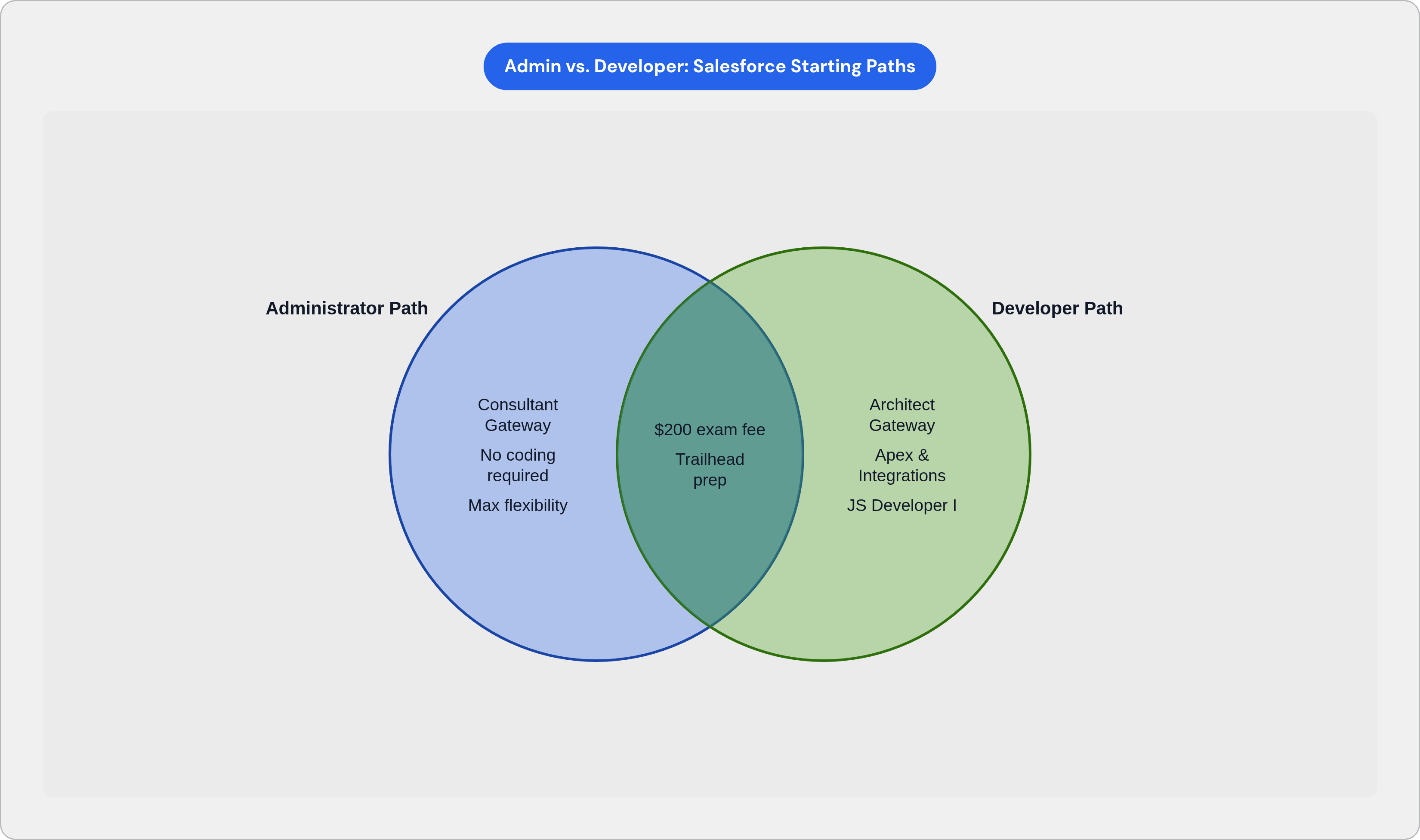
The Administrator track is the most beginner-accessible entry point with real market value. The Certified Administrator credential assumes six to twelve months of hands-on experience. That's not a hard rule enforced by a system. It's just what the exam difficulty implies.
What makes the Admin credential particularly strategic is that it's also the gateway into Consultant and Specialist paths. If you're not sure exactly where you want to land, Admin first gives you the most flexibility. It's the highest-leverage starting credential in the whole program.
The Advanced Administrator builds on it. It goes deeper into security, automation, and configuration. Think of it as the same world, but with the difficulty dial turned up.
The Developer track runs parallel. Platform Developer I is the unavoidable first gate for most application-level and Architect-track credentials. Platform Developer II covers advanced Apex, integrations, testing, and design patterns. JavaScript Developer I exists mainly for Lightning Web Component-focused roles and is genuinely optional for most paths.
Pricing at this tier (core professional exams): $200 per attempt, $100 to retake, per the July 2025 update.
The Admin-first vs. Developer-first decision isn't cosmetic. If you're heading toward Consultant or Architect credentials, the path you pick here shapes your entire roadmap. Consultants typically start with Admin. Architects have to go through Developer. These are different roads, and they don't merge cleanly later.
Consultant, Designer, and Marketer Paths Are Where Specialization Actually Happens
Once you have a foundation credential, the catalog opens up. Here's how the three specialization tracks break down.
Consultant track. This requires prior Admin or Developer credentials as a baseline. Key credentials here include Sales Cloud Consultant, Service Cloud Consultant, and CPQ Specialist. Each targets a specific product or business function. Solution Architect certifications within this track split into B2B and B2C paths, covering data architecture, sharing, visibility, and integration.
Designer track. The User Experience Designer is the entry-level credential. It focuses on human-centered design and the Salesforce Lightning Design System. The Strategy Designer sits above it and requires three or more years of experience. It targets professionals building design strategy for enterprise applications. The market is narrower here than in Admin or Developer roles, but competition is also thinner. UX-focused Salesforce roles don't have a crowded applicant pool.
Marketer track. The Marketing Cloud Engagement Foundations credential is the starting point. It's beginner-level but expects at least six months of Marketing Cloud experience before you walk in. This track serves a distinct audience. It's mostly marketers who are moving toward platform expertise, not developers who are pivoting sideways.
All credentials in these tracks are priced at $200 per attempt, $100 to retake. Same as the core professional tier. These credentials stack on top of your foundation certs, so the investment compounds. But so does the salary premium. Per the Salesforce Ben 2025/26 Salary Report, Functional Consultants earn in the range of $117,750 to $167,750 annually.
The Architect Path: What It Actually Takes to Reach the Top
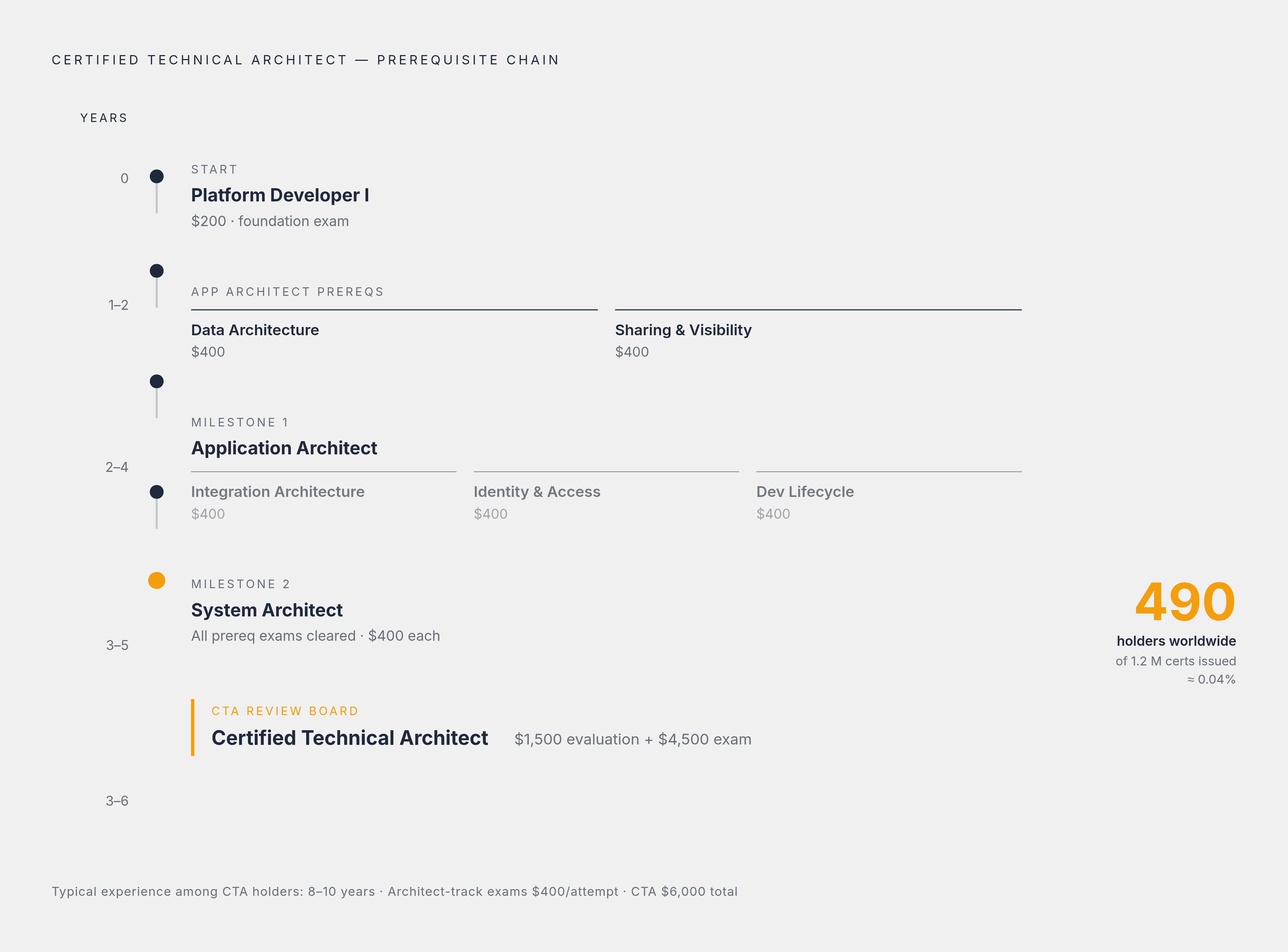
Let's be honest about what the Certified Technical Architect credential is. It is, without exaggeration, one of the hardest professional certifications in the enterprise software world. Of more than 1.2 million Salesforce certifications issued worldwide, approximately 490 people hold the CTA. That's roughly 0.04%.
Before you can even apply for the CTA Review Board, you need two intermediate Architect credentials:
- Application Architect, which itself requires Platform Developer I, Data Architecture and Management Designer, and Sharing and Visibility Designer.
- System Architect, which requires Integration Architecture Designer, Identity and Access Management Designer, and Development Lifecycle and Deployment Designer.
Most candidates spend three to five years just satisfying those prerequisites. That's not a complaint. That's the design.
The CTA exam itself is unlike anything else in the program. There are no multiple-choice questions. You receive a complex business scenario, design a full solution in 180 minutes, present to a panel for 45 minutes, and then defend your decisions in a 40-minute Q&A. It's closer to a doctoral defense than a professional certification exam.
The cost structure:
- Architect-track exams: $400 per attempt, $200 to retake
- CTA itself: $1,500 for the Review Board Evaluation, $4,500 for the Review Board Exam. That's $6,000 total, not counting the eight upstream Architect exams you paid for on the way there.
The realistic timeline is three to six years of dedicated study alongside active project work. Most successful CTA holders have eight to ten years of Salesforce experience. The payoff, per the Salesforce Ben 2025/26 Salary Report, is real. Solution Architects and CTAs can earn $250,000 or more annually.
If you're early in your career, this isn't a discouragement. It's just the honest picture. Plan accordingly.
The Agentforce Specialist Credential and Where AI Fits Into All of This
The AI certification landscape inside Salesforce has shifted faster than almost any other area of the program. Here's what's current.
Salesforce retired the AI Associate certification, with the last exam date passing in May 2025. If you were preparing for it, that path is closed. The active credential now is the Salesforce Certified Agentforce Specialist, launched in March 2025. It was previously called AI Specialist but was retooled around Salesforce's Agentforce-first platform strategy.
The exam is 60 multiple-choice questions plus five unscored, with a 105-minute time limit and a 73% passing score required.
The Summer '25 update changed the content meaningfully:
- Before: Focus on configuration and prompt building.
- After: Focus on how agents reason and act in real business contexts. Deterministic behavior, filters, variables, channel connectivity across email and Slack.
- New section added: Multi-Agent Interoperability, covering agent-to-agent communication via Model Context Protocol (MCP) and the Agent API. It's only 5% of the exam, but it signals clearly where Salesforce's long-term architecture is heading.
There's also something called Agentblazer Status, which runs parallel to traditional certifications. It has three levels: Champion, Innovator, and Legend. It covers AI fundamentals, custom agent building, and advanced concepts. It's not a certification in the traditional sense, but Salesforce is positioning it as the replacement for the retired AI Associate credential for entry-level orientation purposes.
Pricing note: the free first-attempt promotion for the Agentforce Specialist expired at the end of 2025. It now costs approximately $200 for a first attempt, $100 to retake.
What Every Exam Actually Costs After the July 2025 Pricing Update
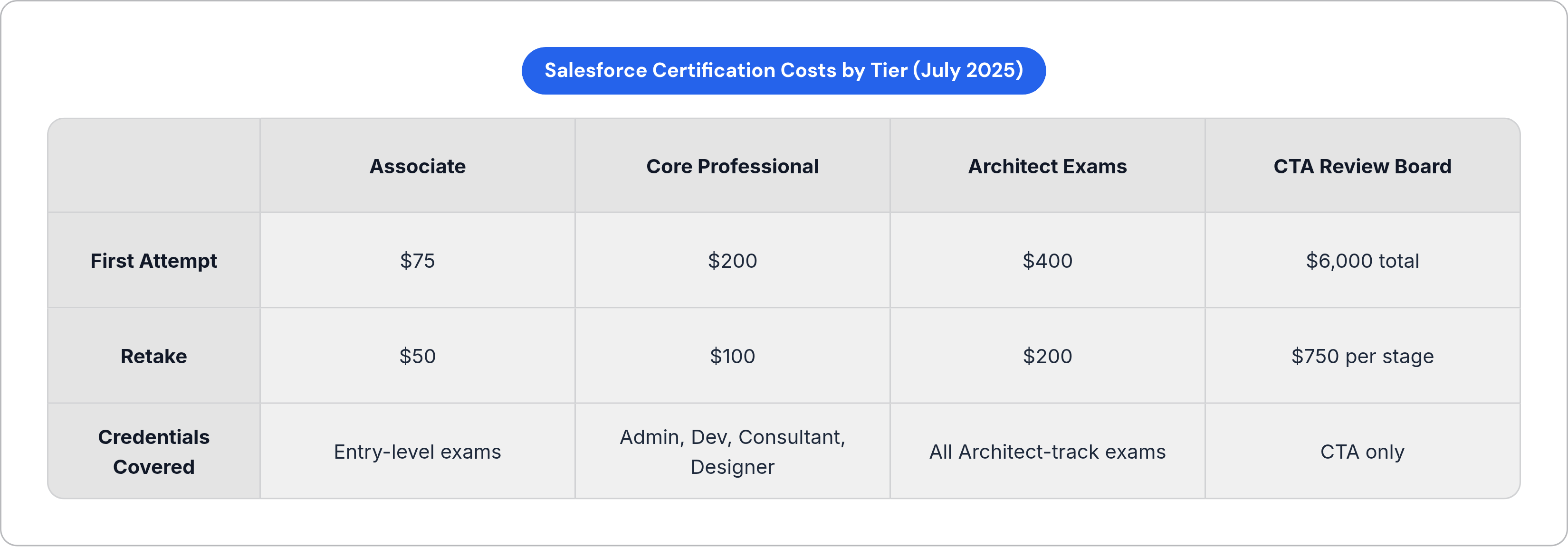
Salesforce overhauled its pricing on July 21, 2025, and moved to a self-service registration system through Pearson VUE's Salesforce Exam Voucher Store. Here's the full breakdown:
| Credential Type | First Attempt | Retake | |---|---|---| | Associate exams | $75 | $50 | | Sales Representative | $75 | $50 | | Core Professional (Admin, Developer, Consultant, Designer) | $200 | $100 | | Architect exams | $400 | $200 | | Accredited Professional (AP) exams | $200 | $100 | | CTA (Review Board Evaluation + Exam) | $6,000 total | $750 per stage |
A few things worth knowing before you buy:
- Taxes vary by region and are calculated at checkout.
- All sales are final. No refunds once a voucher is purchased.
- Tiered partner discounts and Premier/Signature customer pricing are still available after account validation.
The range across the full program is $75 for a single Associate exam with no retake, all the way to $6,000 for the CTA alone. And that $6,000 doesn't include the eight upstream Architect exams you'll have paid for before you even get there.
How Much Self-Study Can Actually Replace Paid Training
Here's the honest answer: quite a lot, depending on the credential.
Free resources. Salesforce Trailhead is the official study platform and costs nothing. For many credentials, especially at the Associate and core professional level, a disciplined Trailhead study plan is a realistic primary preparation strategy.
Low-cost paid options:
- Udemy courses run $15 to $200 depending on sale cycles (and Udemy is almost always running a sale)
- Focus on Force offers study guides and practice exams for $40 to $80 per certification; their multi-exam bundles run $60 to $80
- Individual practice tests from other providers typically run $20 to $40 each
Instructor-led training from Salesforce partners runs $1,000 to $2,000 for multi-day courses. That investment is more justifiable for complex credentials like Platform Developer II or Architect-track exams, where the conceptual load is higher and practical guidance matters more.
Bootcamps run $3,000 to $6,000 but often include exam vouchers and retake guarantees. For career-changers without any Salesforce background, that all-in structure can actually be efficient.
Total realistic spend by approach:
- Pure self-study (Trailhead plus exam fee): as low as $200 for a single core credential
- Self-study with paid practice materials: $250 to $400 per credential
- Bootcamp with exam included: $3,000 to $6,000 for a foundational credential cluster
One thing candidates underestimate: if you're pursuing a multi-credential path like the full Architect prerequisite chain, preparation costs are a recurring line item, not a one-time expense. Budget for them that way.
Maintenance Is Free, But It Will Absolutely Sneak Up on You
Salesforce releases platform updates three times a year: Spring, Summer, and Winter. For every release, you'll need to complete a maintenance module for each credential you hold that's affected. Miss the deadline and your certifications expire or become suspended.
The good news: maintenance modules are free. Reactivating a lapsed certification is also free. You just complete the overdue modules. No penalty fee, no reexam.
The actual cost is your time and calendar discipline. Modules typically take 20 to 60 minutes each. For someone holding one or two credentials, that's a minor commitment. For someone holding ten credentials across multiple tracks, every release cycle becomes a maintenance project.
This is worth factoring into your path-planning decisions. More credentials means more maintenance. It's not a reason to avoid them. It's just a reality to build into your schedule.
How to Actually Map a Certification Path to Your Target Role and Budget
Start with the role, not the catalog. The catalog is enormous and built to serve everyone. Your path should be built to serve you specifically.
By target role:
- Admin or Consultant target. Start with the Certified Administrator credential. It's the most flexible foundation and opens the most lateral paths. It's also the right starting point before you pursue most Consultant specializations.
- Developer or Architect target. Platform Developer I is the unavoidable first gate. Plan for a multi-year credential sequence from the beginning. Going in with a five-year mental model is not pessimism. It's realistic.
- AI/Agentforce target. The Agentforce Specialist is now the primary credential. Agentblazer Status trails serve as structured orientation for people newer to the platform.
- Marketing or UX target. These tracks don't require Admin or Developer prerequisites. They are genuinely independent entry points, which makes them accessible to professionals coming from non-technical backgrounds.
By budget:
- Single-credential entry (Admin or Agentforce Specialist): $200 to $400 all-in with self-study
- Consultant cluster (Admin plus one or two specialist credentials): $600 to $1,200 in exam fees alone
- Full Architect path to CTA: exam fees alone exceed $5,000 before the CTA's $6,000 evaluation; preparation time and course costs are the dominant variables on top of that
Salary context against those numbers, per the Salesforce Ben 2025/26 Salary Report:
- Administrators: $90,000 to $112,500, with senior admins reaching $140,000
- Developers: $100,000 to $129,000 at the junior level, $178,000 or more at the senior level
- Technical Consultants: $134,000 to $190,000+
The return on investment here is real across every track. The goal of all this planning isn't to make certification feel like a bureaucratic maze. It's to make sure the first $200 you spend is pointed in the right direction, and that every credential after it builds on the one before it rather than sitting in isolation on your resume. That's the difference between a credential collection and a career path.