Monitoring Customer Interactions Across Digital Channels
Buyers research in channels companies can't track, leaving most of the journey invisible.
B2B buyers now do most of their homework before anyone from sales hears from them, and they do it across so many channels that most companies can't see where it's happening. Gartner projects 80% of B2B sales interactions will run through digital channels by the end of 2025. That's not really a stat about channel mix. It's a stat about blindness, and most revenue teams are still budgeting like it's 2016.
The part that should actually keep people up at night: 61% of B2B buyers say they'd rather not talk to a rep at all, and many buyers only want salespeople involved once they're already deep into evaluation. So the research, the comparison shopping, the shortlisting? All of that happens before contact. By the time someone fills out a form or takes a call, the decision is mostly baked. Watching what happens after that point is like walking into a movie during the credits and trying to guess the plot.
Dreamdata's 2026 benchmarks, built on more than 66 million sessions and 3.5 million customer journeys, put a number on how long that movie actually runs: 272 days, 88 touchpoints, 4 channels, 10 stakeholders. A monitoring setup that only watches the company website, email, and CRM is watching a few frames of a very long, very crowded film and calling it the whole story. Anyone still reporting pipeline off last-touch data is grading a movie by its final scene.
The Dark Funnel Is Bigger Than You Think
The dark funnel is every bit of buyer activity that happens somewhere you can't track it, crawl it, or attribute it to anything. Private Slack threads, LinkedIn DMs, closed community groups, a friend mentioning your product on a podcast, someone forwarding a link over WhatsApp. None of it leaves a trace a marketing dashboard can pick up, and no amount of wishful tagging changes that.
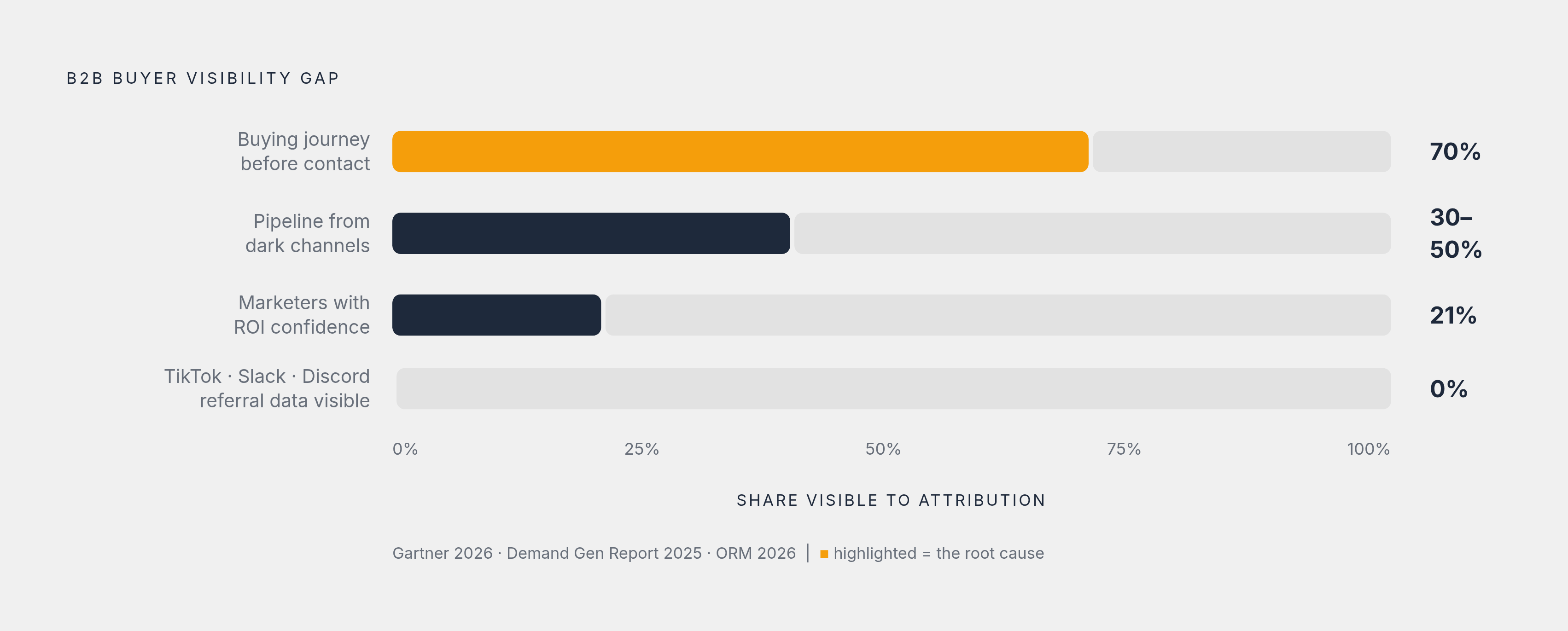
Gartner 2026 puts a number on this: 70% of the B2B buying journey happens in the dark funnel before a buyer ever fills out a contact form. Form-based attribution catches less than a third of what's actually going on. That's not a rounding error. That's most of the story missing, and no amount of dashboard polish changes what the form was never built to see.
Look at direct traffic for some of the most heavily marketed SaaS companies around, and the picture gets clearer. Similarweb data shows Gong at 72.1% direct traffic, HubSpot at 71.6%, Outreach at 71.1%, Salesforce at 64.5%. More than two-thirds of visits to these sites arrive with no referral information at all, and that's not because people are typing URLs from memory like it's 1998. It's because the channels they came from strip out origin data before the click even lands.
SparkToro's research on dark social explains the mechanism plainly. Visits from TikTok, Slack, Discord, Mastodon, and WhatsApp show up as 100% direct traffic, every single time. Facebook Messenger does the same 75% of the time. The platforms themselves strip the referral data, so any click coming through them looks, to an analytics tool, exactly like someone who typed the domain in by hand.
The confidence numbers reflect the confusion. Demand Gen Report's 2025 research found only 21% of B2B marketers say they can measure ROI with real confidence, and yet a large share of B2B marketing teams still lean on last-touch attribution, a model that credits whatever channel happened to be there right before conversion, even though buyers are touching 27 or more points across a multi-month cycle. Last-touch attribution isn't a flawed measurement so much as it is a story teams tell each other because the real one is harder to build. ORM's 2026 attribution analysis estimates 30% to 50% of pipeline comes from channels digital attribution simply cannot see.
None of this gets fixed by better tooling. No tag, no pixel, no clever bit of scripting recovers it, because the channels themselves don't emit anything trackable in the first place. It's baked into how the internet works now. Private messaging apps encrypt by design. Communities gate content behind logins. Word of mouth has never left a paper trail, and it's not about to start now just because marketing wants a dashboard for it.
What Each Channel Can Actually Tell You
B2B buyers now touch an average of 10 channels during a purchase, up from 5 back in 2016. Trying to instrument all of them equally is a fool's errand. The smarter move is triage: figure out what each channel can actually tell you, and stop expecting more out of it than it's built to give.
Owned channels such as website, product, and email give behavioral data: page visits, content sequences, who's hitting the pricing page, who's poking at a feature in a trial. The ceiling here is obvious once someone says it out loud. These channels only show people who've already found the company and stuck around long enough to leave a footprint. A trial user who's gone quiet for a few days, or a prospect circling the pricing page, generates a signal that's genuinely worth acting on because it's timely and specific. Tools like HotJar show how visitors actually move through a page, layering behavioral detail on top of aggregate numbers.
Search used to mean keyword rankings and click-through data, but now it's messier. Research found zero-click searches reached 69% after AI Overviews rolled out, so a page can rank well and still send nobody through the door. AI search has turned into its own animal entirely, with Similarweb clocking AI chatbot referral traffic at 1.1 billion visits in June 2025, up 357% year over year. The practical fallout is that a buyer who asked ChatGPT about a category and got a recommendation may never click a search result at all, and their first visit shows up as direct with no referrer, indistinguishable from the dark social traffic sitting right next to it in the same report.
Social and community channels split cleanly into visible and invisible halves. LinkedIn is the visible half, where 75% of B2B buyers say social media informs their purchase decisions, and where it has become a frequently cited source across AI search platforms. Closed communities, Slack groups, Discord servers, and private forums make up the invisible half. Peer recommendations happen there constantly with zero outbound signal, and that's dark funnel by design rather than by accident.
Third-party review platforms such as G2, Capterra, and category sites capture buyers doing anonymous research who never touch a vendor's own site. The signal arrives a bit delayed, after the fact rather than in real time, but it means something real: active consideration, not idle browsing.
AI-generated answers deserve their own section, and they get one below, because AI assistants now shape who makes the shortlist before a buyer visits a single vendor page.
Omnichannel Platforms Unify What Fragmentation Breaks
The pitch behind omnichannel analytics is simple enough: put every interaction, including chat, call, email, and website session, under one customer profile, so patterns invisible channel-by-channel show up once everything sits in one place. Recurring support complaints, channels that are overstaffed or understaffed, and sentiment souring across touchpoints that nobody has flagged individually as a problem all become visible through that unified lens.
Platforms built for this do a few things genuinely well. Freshdesk pulls email, phone, chat, and social into one dashboard, so a support team isn't reconstructing context from five different tools mid-call. Crescendo.ai runs multimodal AI and sentiment tracking as a managed service, catching frustration or confusion as it happens rather than after a churned customer explains it in an exit survey nobody reads. Improvado centralizes marketing data across channels so B2B teams can see revenue influence without stitching spreadsheets together by hand the night before a board meeting.
For the dark-funnel-shaped part of the problem specifically, a different set of tools tries to aggregate anonymous intent instead. 6sense pulls together anonymous buying signals and maps them against intent data to find patterns worth acting on. HockeyStack does similar work on intent aggregation and journey mapping. DreamData builds multi-touch attribution models across the whole B2B buying arc.
Here's the catch, and it's not small: these tools only surface data from channels where data exists to begin with. None of them recover a signal from a Slack DM or a private Discord server, because that signal was never emitted anywhere a tool could catch it in the first place. Companies with strong omnichannel strategies do retain more customers, 89% versus 33% for companies without one, but that gap comes from acting on the signals that are already connected, and it has nothing to do with having magically found the ones that aren't.
Tooling unifies what's already trackable. It doesn't push out the boundary of what's trackable to begin with, and any vendor pitch that implies otherwise is selling something it can't deliver.
AI Answers Are a Monitoring Blind Spot
The 6sense 2025 Buyer Experience Report, surveying 4,510 buyers, found 94% of B2B buyers used generative AI somewhere in their purchase cycle. That's close enough to the entire audience forming an opinion of a brand based on what an AI model says, without the brand ever knowing the conversation happened.
AI assistants are also doing something more aggressive than search engines ever did: compressing a shortlist of a dozen vendors down to three or five, and evidence suggests the eventual winner is typically on that shortlist from very early in the process. That's not discovery; that's pre-qualification done by a model before a human sales rep ever gets a shot at the room.
AI Overviews now show up in 48% of searches, up from 34.5% in December 2025, and 93% of AI Mode sessions end without a single click. So whatever the AI says about a brand in that response is often the whole impression from start to finish, with no follow-up visit to check the facts against reality.
It gets messier across platforms, too. Even within Google alone, AI Overviews and AI Mode frequently diverge on which sources to cite. Monitoring a single AI engine gives you a picture that's incomplete by design rather than by oversight, since different platforms cite different things entirely. ChatGPT leans on Wikipedia and Reddit, with Forbes showing up a distant 18th. Google's AI Overviews favor YouTube, Reddit, and Quora. Perplexity leans toward Reddit, YouTube, and Gartner. And LinkedIn has emerged as a prominent source for professional queries across several major AI platforms.
Visibility doesn't hold still, either. Research into AI citation patterns suggests only a minority of brands stay visible from one AI answer to the next, and even fewer show up consistently across consecutive runs of the identical query. Models rebalance constantly, chasing freshness and variety, which means a brand's spot in an AI answer today says almost nothing about where it sits tomorrow.
Most AI citations trace back to earned media rather than owned content or paid placement, and brand mention signals appear to matter more to AI citation logic than traditional backlink counts. Content strategy hasn't caught up to that shift. Most teams are still budgeting for backlinks in a world that's started grading on mentions instead.
Tools That Track What AI Says About You
AI answers aren't fixed. Ask the same question twice and the model might answer differently both times, and different platforms answer differently from each other again. A single spot-check run once tells you almost nothing worth acting on. Real measurement means running the same prompts repeatedly, across platforms, at a sample size big enough to tell a genuine pattern apart from noise.
Any visibility number that shows up without its sample size deserves suspicion, not applause. "Cited in 40% of responses" means something different if that's 40 out of 100 prompts versus 2 out of 5. A serious monitoring setup reports hits-out-of-asks, along with how many prompts ran, so a team can tell a real authority gap apart from a measurement setup that's just broken.
A few platforms built specifically for this space are worth noting. Peec AI, founded in 2025 and backed by an €18M Series A after a €7M seed round, tracks brand visibility and sentiment across the major AI search engines. Pricing starts at €89 a month for a Starter tier covering 25 prompts and runs up to €499-plus for Enterprise, covering 300-plus prompts and roughly 27,000 answers a month. Evertune pairs direct API access with a demographically weighted panel called EverPanel, built from more than 150 million real user conversations, to gauge AI visibility across multiple models and consumer-facing apps.
Whatever tool a team picks, a few things separate a useful one from a vanity dashboard. Coverage across platforms matters more than depth on one, since a brand invisible on Perplexity but strong on ChatGPT is still half-blind. Prompt volume and cadence matter too, since a weekly check can't catch the daily volatility the citation research keeps turning up. Sentiment and framing matter as much as raw presence, since being named isn't the same as being described accurately or favorably. And competitor visibility inside the same queries turns a lonely metric into a comparison that actually means something.
The category is growing fast, with the GEO market projected to hit $365.4 million in 2026 at a 42.9% compound annual rate. Fast growth means real capability is arriving quickly, but it also means plenty of vendors are happy to oversell what any single metric actually proves. Pick the tool that shows its work, not the one with the shiniest chart.
Join Pre-Sale Signals Into One Coherent Picture
No single tool covers the whole pre-sale arc, and chasing full coverage is a waste of a quarter better spent elsewhere. The goal is a connected system that catches the highest-value signal at each stage, not a surveillance net thrown over every possible channel just because the channel exists.
Stage 1, category awareness, is fully dark. Buyers are researching the problem itself, asking peers, reading third-party writeups, and getting category summaries from an AI assistant. Nobody has visited a vendor site yet, so owned-channel analytics have nothing to show. What can be watched instead is which AI engines mention the brand, how often, and in what tone, plus share of voice on review sites, plus which pieces of content AI models actually cite when they answer category questions. That's the whole visible surface at this stage, and it deserves treatment as its own discipline rather than an afterthought bolted onto SEO reporting.