Essay Sales Contract Workflows
Sales-Initiated Contract Redline Process for AEs
Account executives need a clear playbook to move redlined contracts toward signature without delays.
A sales-initiated contract redline process gives account executives a clear job from the time they get a customer’s edits until the agreement is signed. AEs need to own intake, routing, tracking, and follow-up. A repeatable workflow keeps a deal moving toward its close date.
What contract redlining is and where it sits in the deal cycle
Redlining is how people propose, track, and settle changes to contract language where others can see them before signing. It sits after the initial draft and before final approval and signature. Ironclad’s contract guide says the term comes from red-ink markups on paper and that today it takes the form of tracked changes and comments in shared digital documents. The ink changed, but the purpose did not.
That visible record is not the whole negotiation. Legartis’s redlining guide distinguishes redlining from contract review, which evaluates the terms in front of you, and negotiation, which steers positions across rounds. For an AE, the distinction is useful because an edited document shows where agreement still needs work. A redline signals that the customer is actively working toward a final agreement.
Why the AE — not legal — is the first actor in every redline cycle
The customer’s redline lands in the AE’s inbox because the AE owns the relationship and the deal from qualified opportunity to closed-won. At that moment, a familiar response is to forward the attachment to legal and hope for the best. The document moves, but the context may not. Legal receives edits without knowing the deal’s priority, the customer’s sensitivities, or which changes threaten the commercial agreement. Each question asked to get that background adds another round trip.
In most organizations, the process gap leaves the AE’s position as first touchpoint with little defined authority, no approved fallback positions, no routing rules, and no clear view of the queue. Responsibility arrives before the instructions do. An intake bottleneck follows and can look, from the outside, like slow legal review.
The guide describes business teams, including sales, reviewing pricing, deliverables, and timelines as active participants in the contract process. The AE therefore has a commercial job to do before and during legal review. That job is to make the customer’s request understandable and route it correctly. Good intake gives legal the background needed to make a decision.
How unstructured redline handling stalls deals that were otherwise ready to close
Enterprise contracts usually go through more than one redline round before they are signed. Without a clear handoff, each round adds time in the queue and loses context, and those delays can add up enough to shift a quarter-end close. Commercial agreement alone cannot prevent that delay. A customer may be ready to buy while the document moves through a process with no clear owner for its next step.
Legartis identifies a recognizable pattern in its guide. Attachments go back and forth by email with no clear latest version, edits made at the same time lead to drafts that conflict, and the reasons for earlier concessions get lost. Fallback positions also vary because they live in someone’s head and lack a shared rule. Percipient’s redlining best practices connects unclear roles to conflicting edits, missed updates, and backtracking.
The status label often hides the cause. “Waiting on legal” does not say whether legal has the customer’s business reason, the relevant risk context, or even the right draft. An AE who supplies that information can reduce queue time without changing legal’s capacity. Legartis warns that an unresolved change or stray edit can survive into the signed agreement when the final clean-copy review is skipped.
The four steps an AE owns in a structured redline workflow
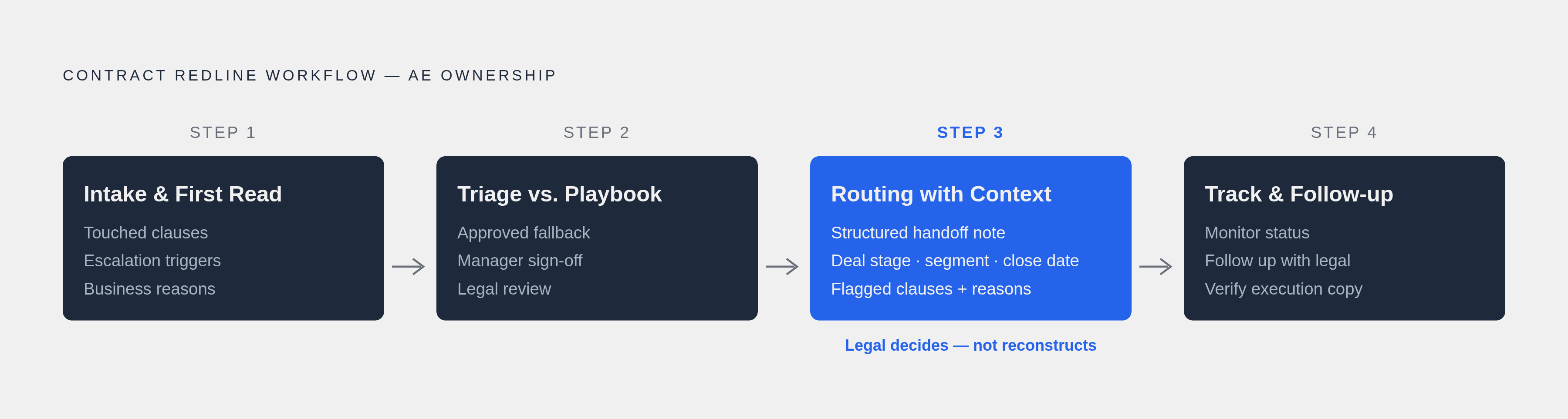
The practical response starts with intake and a first read. Before routing the document, the AE reads it to identify the clauses the customer touched, any known escalation triggers, and the likely business reason behind each change. Through this commercial read, the AE is gathering the context that lets the next reviewer act. This maps to the opening actions in Legartis’s sequence, receiving the draft and reviewing it against internal standards.
The second step is triage against the playbook. Each changed clause goes into a set category, such as an approved fallback, a change that needs manager sign-off, or a term that needs legal review. The playbook supplies the authority the AE otherwise lacks. Its hierarchy sets out a preferred position, a pre-approved fallback for standard enterprise customers, and a trigger for escalation. A mature playbook resolves the majority of redlines, including routine deviations, without legal involvement, leaving legal to handle genuinely complex or high-risk terms.
The third step is routing with context. When legal review is required, the AE sends a structured handoff note with the deal stage, customer segment, close date, flagged clauses, reasons for flagging them, and the customer’s stated business reason. The handoff also needs versions named the same way each time. Percipient says the reasons for changes matter as much as the changes themselves, and the routing note gives those reasons to the team. It turns the first task from reconstructing the deal into deciding what to do next.
The fourth step is tracking and follow-up. Sending the document does not complete the AE’s role, even if the email makes a satisfying whoosh. The AE actively tracks where the redline sits and follows up with legal for updates. As negotiation repeats, that ownership continues through the return to the customer and the next round. Before the execution version goes out for signature, the AE checks that it matches the terms actually agreed.
Legartis’s redlining guide distinguishes redlining from contract review, which evaluates the terms in front of you, and negotiation, which steers positions across rounds.
What clauses most commonly trigger escalation, and how to recognize them at intake
A preferred position might cap liability at fees paid in the prior 12 months, while a pre-approved fallback might allow a multiple of fees for standard enterprise customers. Uncapped liability is a different category altogether. The AE’s job is to identify where the requested change falls in that hierarchy.
Broad consequential damages, data security exposure, and regulated-use exposure are also escalation triggers that must go to legal. A customer’s edit may take up little space on the page but change the exposure enough to need legal review. The amount of red ink is not a substitute for the playbook’s rules.
Data processing terms deserve particular attention because customers are increasingly inserting or expanding data protection and processing clauses. Flagging those edits at intake lets legal see a compliance trigger early in the cycle. This is where a clear escalation rule protects both sides of the handoff. The objection that AEs might make legal calls is valid only if the process asks them to do so. With a written clause hierarchy, they follow rules legal has already approved.
How track changes discipline and version control keep the workflow from breaking down mid-cycle
To preserve that structured handoff across rounds, the document needs the same discipline as the routing process. Percipient recommends tracked changes for every addition, deletion, and rewording so reviewers can see what changed. Silent edits defeat that visibility at once. Comments have a separate job, explaining the reason for a material edit without putting the explanation into the contract language. Unattributed comments and untracked changes leave the next reviewer trying to reconstruct intent.
Legartis recommends naming versions the same way each time to keep people from exchanging drafts that conflict or are out of date. That habit protects the substance of the negotiation. Sending a version that omits a concession already made can force the parties to revisit ground they thought was settled. A stray accepted change can create the opposite problem by surviving unnoticed into the signature copy. The AE’s final-copy review is the last opportunity in this workflow to catch that mismatch before the agreement is signed.
How CLM tooling and AI triage change the AE's role without removing it
As contract volume grows, manual discipline has more work to do. Contract lifecycle management platforms can enforce the playbook’s rules and give everyone a shared place to work together. Ironclad is one example of that approach. Its guide describes how people can work together through cloud-based CLM in a single shared document, so they avoid the confusion over versions that comes with emailing attachments. The workflow still needs an owner, but that owner no longer has to keep an attachment family tree.
AI-assisted triage adds another change at intake. It can break an inbound agreement into clauses, compare them against corporate playbooks, generate tracked redlines, and surface escalation triggers. That can compress work that sat in a multi-day legal queue into same-day automated triage. The AE’s task consequently shifts from checking clauses by memory to controlling the quality of what enters the system. The key checks become whether the document is correctly identified, the deal metadata is right, and the document is going to the right place.
Automation does not remove the need for judgment. AI works well on standardized clauses and large numbers of routine agreements, but strategic edits, terms that could affect the relationship, and high-risk clauses still need human legal review. The division of work is therefore routine processing for AI and consequential decisions for legal. The AE remains the intake coordinator who supplies the commercial context and follows the deal through the process. A faster triage step does not make an incomplete handoff complete.
Tracking redline cycle metrics as a leading indicator of deal health
A structured workflow also makes delay visible before it becomes the quarter-end explanation. Round count, cycle time by complexity, and frequently contested clauses show more than how much paperwork a deal has produced. They show where progress is slowing. For the AE, those signals can support a timely escalation or a decision to re-engage an executive sponsor.
Deal desks use redline density, which is the number of redlines per deal read in light of the deal segment, along with cycle time by complexity. Standard redlines target faster turnaround, while non-standard redlines target under 48 hours. Complexity gives the clock useful context. A deal that stays in redlining longer than expected calls for a deal-health response. A delay pattern left unaddressed can turn a late close into a lost deal.
The content of the edits offers a different signal. When customers keep pushing back on the same clauses, that pattern can help shape the next MSA refresh. An AE who brings that pattern to legal and product helps clear up the same sticking points before they slow the next deal. The workflow thus produces something more useful than a cleaner paper trail.
Before countersignature, the execution copy must match the agreed terms, without stray unresolved edits. A quick signature on the wrong language is not a successful close. The AE who owns that final check and acts early on signs of delay uses the redline process to help win deals as well as meet compliance needs. The rep can then manage the close date as well as put it in the forecast with hope.